You may have seen the word invoke in legal documents, religious prayers, or formal writing — but what does it actually mean?
Quick answer: Invoke means to call upon something for support, authority, or assistance. It is often used in legal, religious, or formal contexts.
In everyday English, invoke usually suggests formally requesting help, referencing a rule or law, or appealing to a higher power. For example, a lawyer may invoke a constitutional right, or someone may invoke divine protection in prayer.
The word comes from the Latin invocare, meaning “to call upon.” Because of its formal tone, invoke is rarely used in casual conversation and is more common in official, academic, or ceremonial language.
Invoke is a verb meaning to call upon, appeal to, or activate something such as a law, right, emotion, or function. The invoke definition in English describes formally requesting support, authority, or action.
People often search for “invoke meaning” when encountering the term in contracts, speeches, court cases, or religious texts — where understanding the exact usage matters.
💡 What Does Invoke Mean?
“Invoke” means to call upon or appeal to something or someone for help, support, or action.
It can also mean to activate, cause, or bring something into effect — depending on the situation.
It’s a formal English verb, often used in professional writing, spiritual discussions, and technical contexts like programming.
🔄 Invoke vs Invoking vs Invoked
“Invoking” is the present participle of invoke, meaning the act of calling upon something.
“Invoked” is the past tense, referring to something already called upon.
“Invokes” is the third-person singular form.
For example:
“She invoked her right.”
“He invokes tradition.”
“They were invoking authority.”

🏛️ Origin and Popularity
The word “invoke” originates from the Latin term invocare, which combines in- (“upon”) and vocare (“to call”).
It literally means “to call upon.”
📜 Timeline Snapshot:
- 14th century: Used in religious contexts meaning “to call upon God or spirits.”
- 17th–18th centuries: Adopted into legal and political language (“to invoke rights or authority”).
- 20th century onward: Expanded to emotional and technical uses (“invoke a response” or “invoke a function”).
Today, the word appears in business communication, academic writing, spiritual texts, and even computer programming.
🌎 Invoke Meaning in Different Languages
If you’re searching for invoke meaning in different languages, here are clear translations with context:
🇮🇳 Invoke Meaning in Hindi
In Hindi, “invoke” translates to “आह्वान करना”, which means to formally call upon, appeal to, or summon.
🇧🇩 Invoke Meaning in Bengali
In Bengali, it translates to “আহ্বান করা”, meaning to call upon or request formally.
🇸🇦 Invoke Meaning in Arabic
In Arabic, invoke can be expressed as “يستدعي” (yastad‘i) or “يدعو” (yad‘u), meaning to call upon or appeal for help.
🇨🇳 Invoke Meaning in Chinese
In Mandarin Chinese, invoke may translate to “调用” (diàoyòng) in technical contexts (to execute or call a function) or “祈求” (qíqiú) in spiritual contexts (to pray or appeal).
🇵🇭 Invoke Meaning in Tagalog
In Tagalog, invoke can be translated as “tawagin” or “humiling”, meaning to call upon or request formally.
🇻🇳 Invoke Meaning in Vietnamese
In Vietnamese, it may translate as “kêu gọi” or “viện dẫn”, depending on context — especially in legal or formal use.
🇮🇳 Invoke Meaning in Malayalam
In Malayalam, invoke can be translated as “ആഹ്വാനം ചെയ്യുക”, meaning to formally call upon.
🌍 Invoke Meaning in Different Contexts
The word’s flexibility allows it to fit into multiple fields. Here’s how invoke changes meaning across contexts:
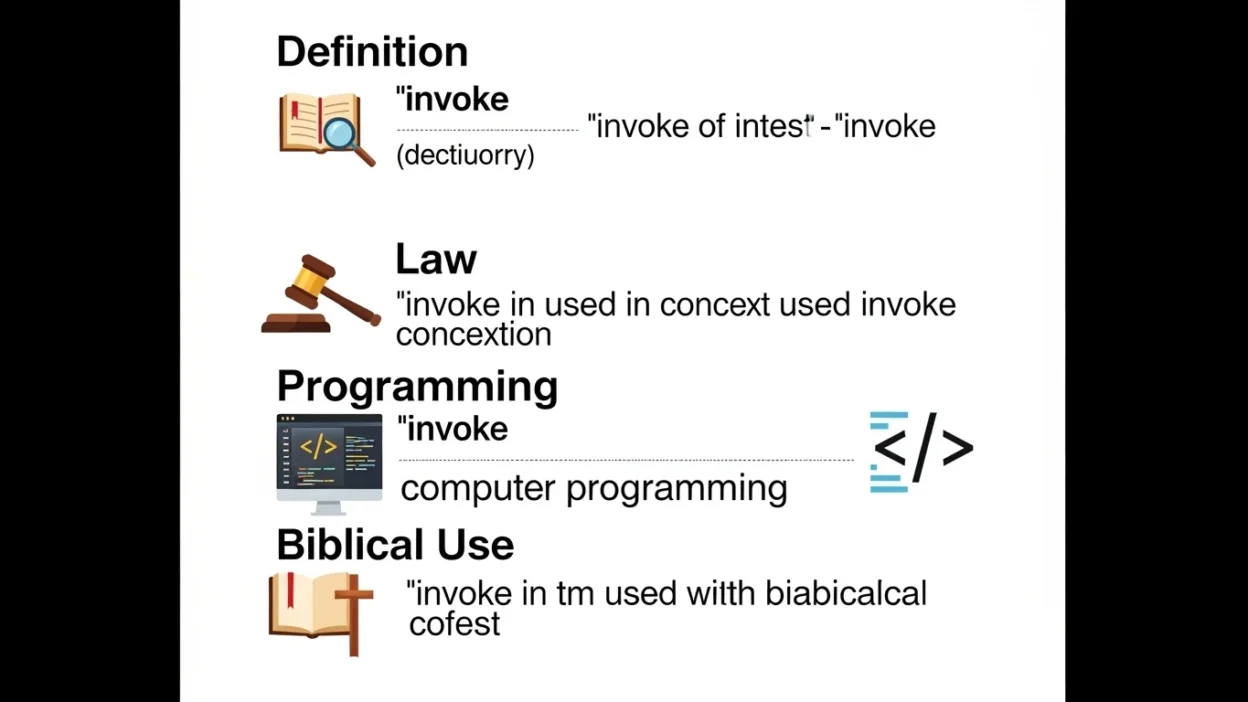
🧑💼 In Professional or Legal Contexts
Invoke means to appeal to or use a rule, law, or authority for support.
Example: “The lawyer invoked Article 10 of the Constitution.”
It’s a formal and persuasive term, often used in legal, political, or policy writing.
💭 In Emotional or Everyday Language
Here, it means to bring forth a feeling, image, or reaction.
Example: “The song invoked childhood memories.”
Writers and speakers use it to describe emotional resonance or mental imagery.
🕯️ In Spiritual or Religious Contexts
“Invoke” often refers to calling upon divine forces, deities, or spirits for guidance or power.
Example: “They invoked divine protection before the ceremony.”
It’s a sacred act in many belief systems — symbolizing prayer, intention, or manifestation.
📖 Invoke Meaning in the Bible
In the Bible, to invoke means to call upon the name of God for help, guidance, or blessing. Biblical texts often describe believers invoking the Lord in prayer or worship, emphasizing dependence on divine authority.
💻 In Technology or Programming
In computer science, to invoke means to call or execute a function or process.
💻 Invoke Meaning in Programming
In programming, invoke means to call or execute a function, method, or process within code. For example, when a script runs a function, it invokes that function. In languages like JavaScript, invoking a function triggers its defined behavior.
Example: “The program invokes a security check when you log in.”
This meaning is literal and mechanical, representing a command or trigger.
| Context | Meaning of Invoke | Example Sentence |
| Legal | Appeal to law or authority | “They invoked their right to remain silent.” |
| Emotional | Trigger or inspire feelings | “The movie invoked deep nostalgia.” |
| Spiritual | Call upon divine power | “The ritual invoked ancestral spirits.” |
| Technical | Execute a function or process | “The app invokes a data request.” |
“Salt of the Earth Meaning: You’ve Been Understanding It Wrong”
⚖️ Invoke Meaning in Law
In legal contexts, to invoke means to formally claim or exercise a legal right or protection. For example, invoking rights meaning refers to asserting rights such as the right to remain silent or the right to legal counsel. When someone invokes a law, they rely on it as authority.
💬 Examples of Invoke in Sentences
Example 1 (Formal):
“The minister invoked public safety as the reason for the policy change.”
Example 2 (Emotional):
“Her story invoked tears from the entire audience.”
Example 3 (Spiritual):
“They invoked blessings before the journey began.”
Example 4 (Technical):
“When a user clicks the button, the program invokes the payment API.”
Example 5 (Literary):
“Poets often invoke the muse for inspiration.”
🔁 Similar or Related Terms
Here are a few related terms and synonyms for invoke, along with how they differ:
| Word | Meaning | Difference from “Invoke” |
| Evoke | To bring to mind or recall | Evoke is about memory; invoke is about calling to act. |
| Summon | To call someone to appear | More physical or direct than “invoke.” |
| Call upon | To appeal to someone | A simple, less formal version of “invoke.” |
| Trigger | To cause something to happen | Common in tech or psychology, not legal. |
These words overlap in meaning but vary in tone and context.
For instance, “invoke authority” is formal, while “evoke emotion” is artistic.
🔍 Evoke vs Invoke Meaning
“Invoke” means to call upon or activate something, often formally.
“Evoke” means to bring a feeling or memory to mind.
For example, you invoke a law, but you evoke an emotion.
“Provoke,” by contrast, means to stimulate or cause a reaction, often intentionally.
🧠 How to Use “Invoke” Correctly
Here’s a quick guide to proper usage:
✅ Do:
- Use it in formal writing or technical explanations.
- Pair it with abstract nouns (law, emotion, right, power, function).
- Use it when referring to cause, appeal, or activation.
❌ Don’t:
- Use it in casual chat (“I invoke coffee!” sounds odd).
- Confuse it with “evoke” — they’re related but not identical.
- Use it without context; it’s a word that thrives on precision.
⚠️ Common Mistakes or Misinterpretations
- Confusing “invoke” with “evoke.”
→ “Invoke” means to call upon or activate; “evoke” means to bring to mind. - Overusing it in casual speech.
→ It’s a formal or technical term, not for everyday texting. - Forgetting the object.
→ You must invoke something (a law, right, emotion, etc.) — it’s not used alone.
❓ FAQ Section
1. What does “invoke” mean in simple words?
It means to call upon something or someone for help, action, or inspiration — like invoking a law, emotion, or spirit.
2. Is “invoke” the same as “evoke”?
No. Invoke means to call for action or authority, while evoke means to bring a feeling or memory to mind.
3. How is “invoke” used in programming?
In coding, “invoke” means to run or execute a function or method when certain conditions are met.
4. Is “invoke” formal or informal?
It’s formal. You’ll mostly see it in professional writing, speeches, academic papers, and spiritual texts.
5. Can you use “invoke” in a sentence about feelings?
Yes — for example: “The photograph invoked feelings of peace and nostalgia.”
6. What’s the noun form of “invoke”?
The noun form is invocation, meaning the act of calling upon something or someone.
7. What is the noun form of invoke?
The noun form of invoke is “invocation,” which refers to the act of calling upon someone or something for help, authority, or inspiration.
🪶 Conclusion
In short, “invoke” means to call upon, appeal to, or trigger something powerful — whether that’s a law, emotion, divine force, or computer function.
Its versatility makes it a strong, formal word suited for professional, spiritual, or technical contexts.
✨ Now that you know what invoke means, you’ll spot it everywhere — in books, code, and even rituals. Keep exploring our site to master more words that shape thought, law, and expression.

Patrick Gale is a word-meaning expert at Meanovia.com. He explains complex terms, definitions, and language trends with clarity and precision. His goal is to help readers understand the exact meaning behind every word they search.