
During election seasons, news channels often talk about an “incumbent president” or “incumbent mayor.” But what does the word incumbent actually mean?
Quick answer: An incumbent is the person who has a job or office right now. In politics, it means the current president or mayor. In business, it means the current manager or employee.
While explaining political vocabulary to readers and students on language websites, I’ve noticed many people confuse incumbent with “candidate.” In reality, an incumbent is the person already in power — the current officeholder running again or still serving.
The word comes from the Latin incumbere, meaning “to lie upon” or “rest on.” Today it’s commonly used in politics, business leadership, and organizational roles, where it helps clearly identify who is presently in charge.
People often search for “incumbent meaning” after hearing it in election news, job titles, or company announcements and wanting to understand its exact role-based meaning.
Incumbent means the person who has a job or office right now.
If you ask “what does incumbent mean,” it means the current office holder, not a new candidate.
📘 What Does Incumbent Mean?
Incumbent means a person currently holding a particular position, role, or office, especially in politics or business.
In simpler terms, the incumbent is the current holder of a job, title, or authority.
It’s a formal English word, often used in political, legal, and corporate contexts.
🔊 How to Pronounce Incumbent
Incumbent is pronounced:
in-KUM-bent
It sounds like “in-come-bent.”
The stress is on KUM.
🏛️ Origin and Popularity
The word “incumbent” comes from the Latin word “incumbere,” meaning “to lie upon” or “to rest on.”
It entered Middle English in the 15th century through Old French and Latin roots.
Historically, “incumbent” was used to describe someone who rests upon or occupies a position of responsibility — a metaphor for carrying the weight of a role.
📈 Popular Usage Timeline
- 1400s: Used in religious and clerical contexts (e.g., incumbent priest).
- 1800s: Adopted in politics to describe current officeholders.
- Modern Day: Common in both politics and corporate sectors, especially during elections or leadership transitions.
The term gained widespread attention due to media coverage of elections — phrases like “the incumbent president” or “incumbent party” are standard in news headlines.
🧩 Incumbent Meaning in Different Contexts
The meaning of “incumbent” can slightly change depending on the context — here’s a breakdown:
🗳️ In Politics
Refers to the person currently in office or holding an elected position.
Example: “The incumbent governor is running for a second term.”
Incumbent Meaning in Politics
In politics, the incumbent is the person who already has the job.
For example, the current president or mayor is called the incumbent if they are still in office or running again.
💼 In Business or Employment
Describes the current holder of a professional or leadership role.
Example: “The incumbent CEO announced his retirement.”
Incumbent Meaning in Business
In business, the incumbent is the person who has a job now.
For example, the current manager or CEO is the incumbent.
Sometimes people search “job incumbent meaning” or “incumbent manager meaning.”
It simply means the person who holds that job today.
🏢 In Organizations or Institutions
Used to identify the person responsible for a specific post.
Example: “The incumbent manager will mentor the new hire.”
| Context | Meaning of Incumbent | Example Use |
| Politics | Current officeholder | “The incumbent senator seeks re-election.” |
| Business | Current jobholder | “The incumbent CEO leads the company’s global strategy.” |
| Religion | Clergyman in charge of a parish | “The incumbent priest delivered the sermon.” |
💬 Examples of Incumbent in Conversations
Example 1 – Political Context:

Journalist: Who’s running for mayor this year?
Analyst: The incumbent, Sarah Khan, is seeking re-election.
Example 2 – Corporate Context:
HR Manager: The incumbent will train the new regional director before transitioning out.
Example 3 – Formal Usage:
“The incumbent prime minister addressed the nation last night.”
Example 4 – General Conversation:
“It’s tough to compete with an incumbent leader who’s been in charge for years.”
Incumbent Example Sentences
- The incumbent president is running again.
- The incumbent manager trained the new worker.
- The incumbent company still leads the market.
Current Incumbent vs Previous Incumbent
The current incumbent is the person in the job right now.
The previous incumbent is the person who had the job before.
Example:
“The previous incumbent retired last year.”
🔗 Similar or Related Terms
Here are a few related words and phrases that often appear alongside “incumbent”:
| Term | Meaning |
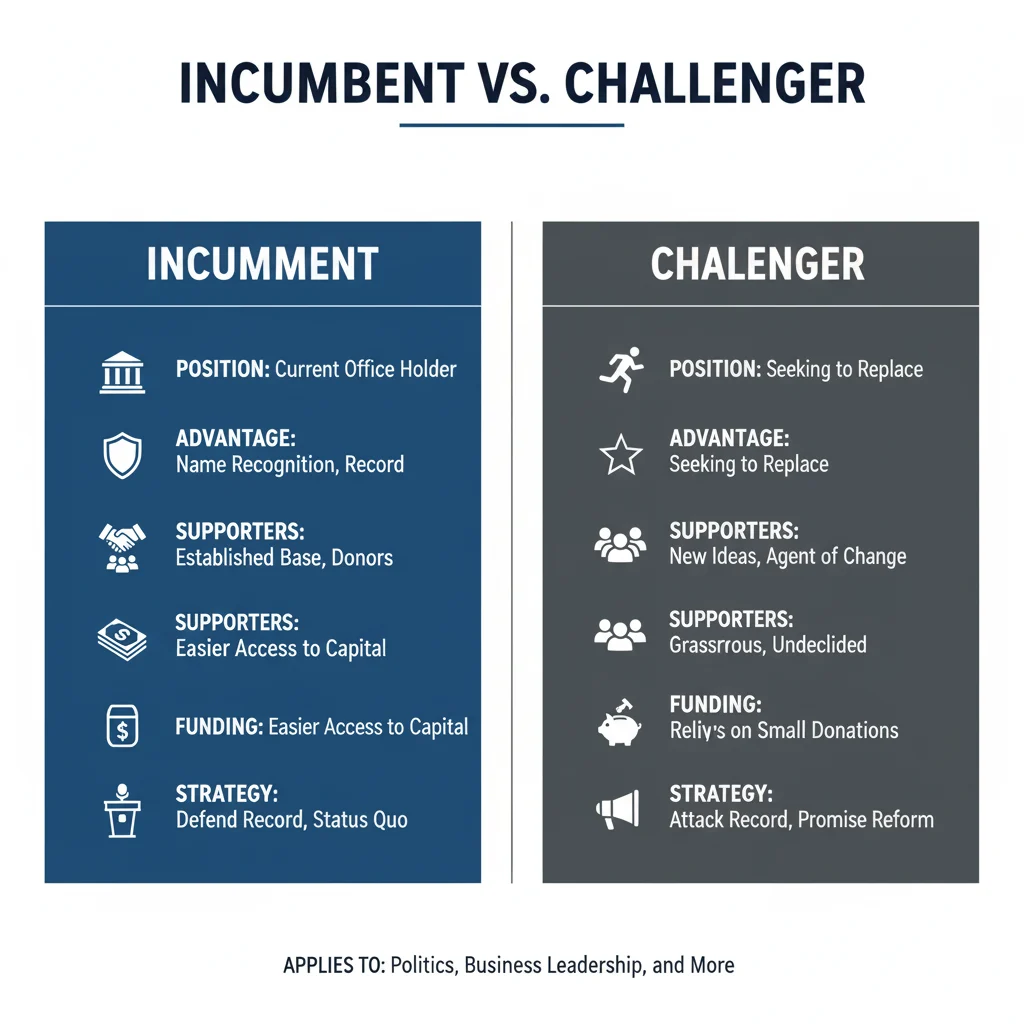
| Challenger | A person or candidate competing to replace the incumbent. |
| Predecessor | The person who held the position before the current incumbent. |
| Successor | The person who will take over the position after the incumbent. |
| Officeholder | A general term for someone who holds a public office or position. |
| Tenure | The period during which someone holds a particular position. |
Opposite of Incumbent
The opposite of incumbent is challenger or successor.
A challenger tries to take the job.
A successor takes the job after.
🧠 How to Use “Incumbent” Correctly
✅ Do’s
- ✅ Use in formal, professional, or political contexts.
- ✅ Use when referring to current role holders, not past or future ones.
- ✅ Use in reports, news, or speeches where titles matter.
❌ Don’ts
- ❌ Don’t use it for someone not currently in office.
- ❌ Avoid in casual speech or texting.
- ❌ Don’t confuse it with “incompetent” (a common error in writing).
⚠️ Common Mistakes or Misinterpretations
- Mixing “incumbent” with “incoming”:
→ “Incumbent” means current, while “incoming” means next or new. - Using it casually:
It’s a formal term best suited for business, legal, or political discussions. - Confusing it with “incumbency”:
Incumbency is the state or period of being an incumbent — not the person themselves.
Incumbent vs Incoming
Incumbent = person who has the job now.
Incoming = person who will start the job next.
Example:
“The incumbent mayor will train the incoming mayor.”
Incumbent Meaning in Other Fields
In insurance, law, or government, the incumbent still means the current person in charge.
Example:
“The incumbent judge heard the case.”
Incumbent Meaning in Other Languages
In Hindi, incumbent means “vartamaan padadhikari” (current office holder).
In Tamil or Kannada, it also means the person who has the job now.
In Chinese, it means the current leader.
❓ FAQ Section
1. What does “incumbent” mean in simple words?
It means the current person in a job or office, especially in government or business roles.
2. Is “incumbent” formal or casual?
It’s a formal term, typically used in professional, legal, or political contexts.
3. What’s the opposite of “incumbent”?
The opposite is “challenger” or “successor,” depending on whether you’re talking about an upcoming or replacement candidate.
4. How is “incumbent” used in a sentence?
“The incumbent president announced plans for re-election.”
5. What is “incumbency”?
It refers to the period of time someone holds an official position — for example, “During his incumbency, major reforms were passed.”
6. Can a company have more than one incumbent?
Yes, in some cases, multiple incumbents may exist across different departments or offices within a large organization.
🪶 Conclusion
In summary, the word “incumbent” refers to someone currently holding a position or office — whether in politics, business, or religion.
It’s a term that carries authority, responsibility, and continuity.
Now that you know what “incumbent” means, you’ll easily understand it in headlines, board meetings, and beyond. Keep exploring our site for more business and political terms made simple and clear

Patrick Gale is a word-meaning expert at Meanovia.com. He explains complex terms, definitions, and language trends with clarity and precision. His goal is to help readers understand the exact meaning behind every word they search.