Have you ever heard someone say, “Her style is impeccable!” and wondered what that really means? 🤔
The word impeccable pops up often — in compliments, reviews, and even job interviews — but few people know its deeper roots and proper usage.
In this guide, you’ll learn:
- ✅ The definition of “impeccable”
- 📜 Its origin and evolution
- 💬 How to use it in different contexts
- 💡 Examples in real conversations
- 🧠 Related words, do’s and don’ts, and FAQs
💬 What Does Impeccable Mean?
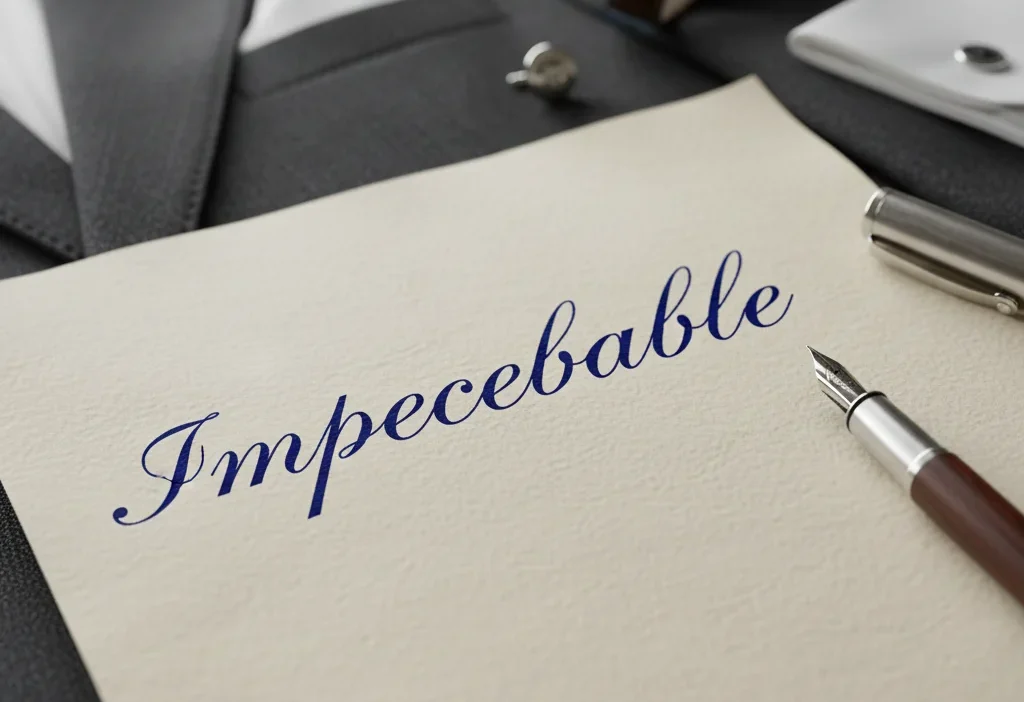
Impeccable means flawless, perfect, or without any mistakes.
It’s an adjective used to describe something or someone that meets the highest standards — whether it’s behavior, taste, manners, or performance.
Example:
“She gave an impeccable performance at the concert.”
🕰️ Origin and Popularity
The word impeccable comes from the Latin word impeccabilis, which combines in- (meaning “not”) and peccare (meaning “to sin” or “make a mistake”).
Originally, it referred to someone “sinless” or “morally perfect.” Over time, its meaning broadened to describe anything free from flaws or errors.
Timeline Snapshot:
- 📖 15th Century: Used in religious contexts to describe moral purity.
- 💬 19th Century: Adopted into general English to describe perfection in manners, taste, or quality.
- 🌍 Modern Usage: Common in fashion, hospitality, education, and everyday speech to highlight excellence.
🌐 Impeccable Meaning in Different Contexts
Here’s how “impeccable” is used across different settings 👇
🗨️ In Everyday Conversation
Used to praise someone’s style, behavior, or taste.
“His timing was impeccable — just when we needed him most.”
👔 In Business or Professional Settings
Used to describe work quality, service, or reputation.
“Our company is known for its impeccable customer service.”
🎭 In Arts and Performance
Used for flawless execution or delivery.
“Her impeccable acting skills earned her the award.”
📱 On Social Media
Often paired with images or videos showcasing perfection.
Caption example: “Vacation vibes 🌴✨ — impeccable view!”
| Platform | Common Use | Example |
| Text / Chat | Complimenting someone | “Your taste in music is impeccable!” |
| Caption praise | “That outfit is impeccable 🔥” | |
| Workplace Email | Describing quality | “Your attention to detail was impeccable.” |
🗣️ Examples of “Impeccable” in Conversations
Example 1:
A: “Did you see her presentation?”
B: “Yes, it was impeccable — not a single flaw!”
Example 2:
A: “Your manners are always impeccable.”
B: “Thanks! My parents were strict about etiquette.”
Example 3 (Formal):
“The CEO’s impeccable leadership guided the team to success.”
🔍 Similar or Related Terms
Here are some related words and phrases that share similar meanings with impeccable:
| Word | Meaning | Example |
| Flawless | Perfect, without any faults | “Her makeup was flawless.” |
| Spotless | Completely clean or pure | “He has a spotless record.” |
| Exemplary | Serving as a model of excellence | “Her performance was exemplary.” |
| Perfect | Free from defects | “His timing was perfect.” |
| Unblemished | Not damaged or marked | “An unblemished reputation.” |
🧭 How to Use “Impeccable” Correctly
✅ Do’s:
- Use it to praise perfection or excellence.
- Ideal for both formal and informal contexts.
- Works well in compliments or professional reviews.
❌ Don’ts:
- Don’t use it sarcastically unless clearly intentional.
- Avoid using it for minor things (“Your pen is impeccable” sounds odd).
Example sentence:
✅ “Her impeccable taste in design impressed everyone.”
❌ “That sandwich was impeccable” (better: “delicious”).
⚠️ Common Mistakes or Misinterpretations
Many people confuse impeccable with words like impressive or stylish, but the difference is:
- Impeccable = Flawless or perfect.
- Impressive = Remarkable or admirable, but not necessarily perfect.
Example:
“His impeccable grammar impressed the teacher.” (Flawless)
“His impressive effort earned him praise.” (Admirable, not perfect)
❓ FAQ: Impeccable Meaning Explained
1. What does “impeccable” mean in simple words?
“Impeccable” means perfect or without mistakes. It describes something done so well that there’s nothing to correct or improve.
2. Is “impeccable” a compliment?
Yes! Calling someone or something impeccable is one of the highest compliments, showing admiration for their excellence or precision.
3. Can “impeccable” describe a person?
Absolutely. You can say someone has impeccable manners, impeccable taste, or impeccable work ethic.
4. What is the opposite of impeccable?
The opposite would be flawed, imperfect, or defective.
5. Is “impeccable” formal or informal?
It’s a formal adjective, but it’s also acceptable in casual speech when emphasizing perfection.
6. When should you not use “impeccable”?
Avoid using it for minor or trivial things. Reserve it for situations or qualities that truly stand out as exceptional.
🏁 Conclusion
To sum it up, “impeccable” means perfect, flawless, and beyond reproach.
It originated from Latin, symbolizing purity and moral faultlessness, and today it’s used to describe excellence in performance, taste, manners, or quality.
Now that you know what impeccable means, you’ll never be confused again! 💡
So next time you see something truly perfect — call it impeccable. 👌
✨ Keep exploring our site for more word meanings, slang guides, and language tips