
Have you ever come across the term “emancipation” and wondered what it truly means?
It’s a word that carries deep historical, social, and personal significance — often associated with freedom, independence, and breaking free from control or oppression.
In this article, we’ll explore:
✅ The definition of emancipation
✅ Its historical origin and evolution
✅ Different contexts — from law to social justice
✅ Examples in real-life use
✅ Similar terms and FAQs for clarity
⚖️ What Does Emancipation Mean?
Emancipation means the act of being freed from someone’s control, authority, or restrictions, allowing an individual or group to gain independence.
It’s a formal term used in law, history, and social discussions — not a slang or abbreviation.

🕰️ Origin and Popularity
The word “emancipation” comes from the Latin term “emancipare,” meaning to deliver, set free, or release from control.
Historically, emancipation has been tied to freedom movements and legal independence:
- Ancient Rome: The term described freeing a child or slave from the authority of a father or master.
- 19th Century: It became globally known through the Emancipation Proclamation (1863) in the United States, which declared enslaved people free during the Civil War.
- Modern Era: The word continues to symbolize social liberation, youth independence, and gender equality.
🕰️ Timeline Snapshot:
| Period | Event or Context | Meaning of Emancipation |
| Ancient Rome | Legal release from authority | Personal freedom |
| 19th Century | Emancipation Proclamation | Abolition of slavery |
| 20th–21st Century | Women’s rights, youth emancipation | Social and legal independence |
🌍 Emancipation Meaning in Different Contexts
The meaning of emancipation varies depending on where it’s used — from legal rights to personal growth.
⚖️ In Legal Terms
Emancipation refers to a minor (under 18) gaining legal independence from their parents or guardians.
Example: “After turning 16, she filed for legal emancipation to live on her own.”
🗽 In History
It signifies the liberation of enslaved or oppressed people from servitude.
Example: “The Emancipation Proclamation ended slavery in the Confederate states.”
👩⚖️ In Social and Gender Movements
Represents the fight for equal rights, autonomy, and empowerment.
Example: “The women’s emancipation movement reshaped modern societies.”
💭 In Personal Growth
Symbolizes breaking free from emotional, societal, or mental limitations.
Example: “Self-emancipation means freeing yourself from negative patterns or toxic influences.”
| Context | Meaning | Example Usage |
| Legal | Gaining independence as a minor | “She was granted legal emancipation.” |
| Historical | Freedom from slavery or oppression | “The Emancipation Proclamation changed history.” |
| Social | Liberation and equality | “Gender emancipation remains a global goal.” |
| Personal | Emotional or mental freedom | “Therapy helped him achieve emotional emancipation.” |
💬 Examples of Emancipation in Conversations
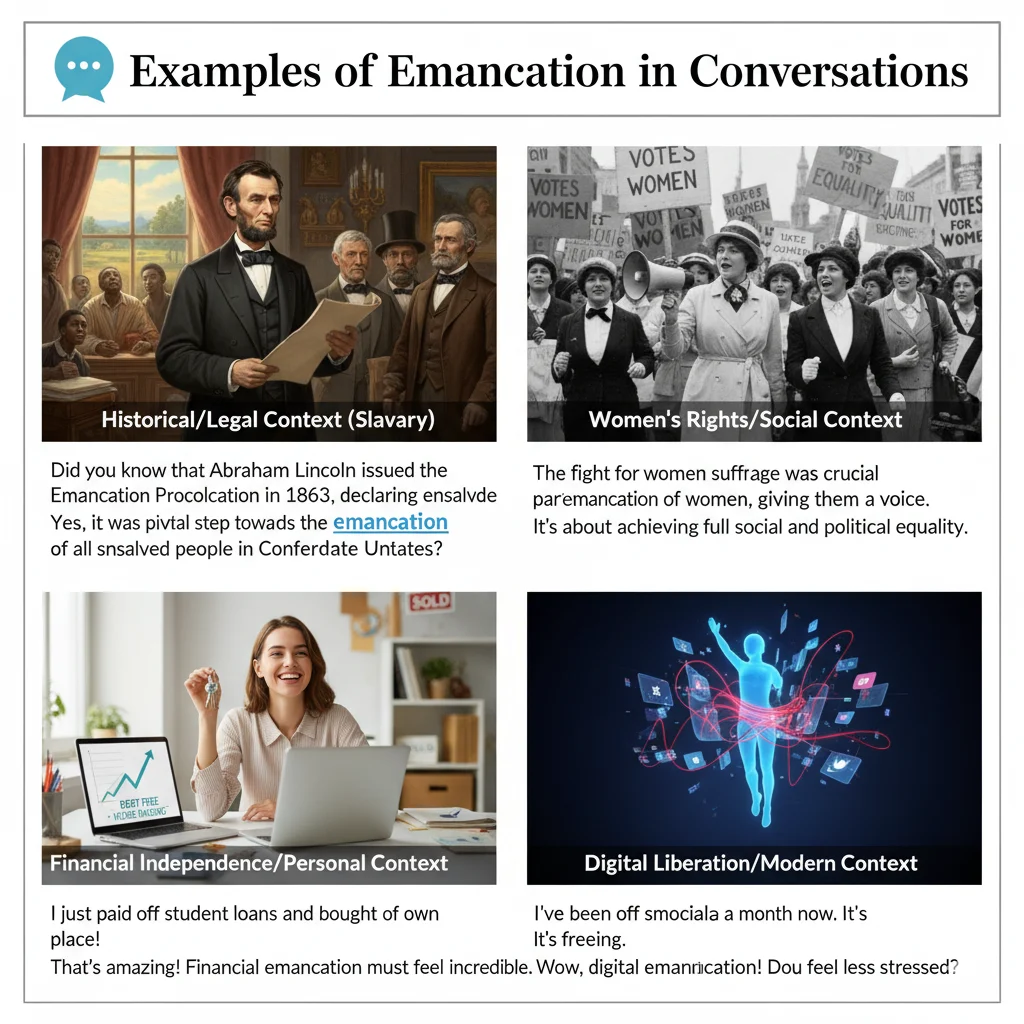
Example 1:
Student: What’s the Emancipation Proclamation?
Teacher: It’s the 1863 document that freed enslaved people in the U.S.
Example 2:
Lawyer: Once you’re legally emancipated, you’ll be responsible for your own finances.
Teen: So, it’s like being an adult before turning 18?
Example 3:
Historian: Women’s emancipation changed the global workforce forever.
Interviewer: Absolutely — it empowered generations to come.
Example 4 (personal context):
“I’ve finally achieved emotional emancipation — I’m no longer tied to my past fears.”
🔗 Similar or Related Terms
Here are a few terms often linked with emancipation to boost understanding and SEO relevance:
| Term | Meaning |
| Liberation | The act of being set free from restrictions or control. |
| Freedom | The power to act or think without restraint. |
| Independence | The state of self-governance or autonomy. |
| Equality | The condition of having the same rights and opportunities. |
| Empowerment | Gaining control and confidence in one’s life and decisions. |
These words are often used interchangeably, but emancipation specifically implies a formal or transformative act of release.
✅ How to Use “Emancipation” Correctly
Do’s:
- ✅ Use in formal, academic, legal, or historical discussions.
- ✅ Use when referring to freedom or independence.
- ✅ Apply it metaphorically in personal or mental growth contexts.
Don’ts:
- ❌ Don’t use “emancipation” as casual slang.
- ❌ Avoid confusing it with “liberation” when referring to legal independence of minors.
- ❌ Don’t use it lightly — it represents serious change or release.
⚠️ Common Mistakes or Misinterpretations
- Mistake: Thinking emancipation only means the end of slavery.
→ Correction: It can also mean legal or personal independence. - Mistake: Using it casually to describe small freedoms.
→ Correction: “Emancipation” implies a major release from authority or constraint. - Mistake: Assuming it only applies to history.
→ Correction: The term remains relevant in modern law and psychology.
❓ FAQ Section
1. What does emancipation mean in law?
In law, emancipation gives a minor legal adult status, allowing them to make decisions about housing, finances, and healthcare without parental consent.
2. What is the Emancipation Proclamation?
It’s a historic 1863 U.S. presidential decree by Abraham Lincoln that declared enslaved people in Confederate states to be free.
3. Can emancipation be emotional or psychological?
Yes. Emotional emancipation means freeing oneself from dependency, guilt, or toxic relationships to achieve inner peace.
4. What’s the difference between emancipation and liberation?
Liberation is broader and can refer to any kind of freedom, while emancipation often implies a legal or official process of release.
5. How can a teenager become emancipated?
A teen can file for legal emancipation through the courts by proving financial stability, maturity, and the ability to live independently.
6. Why is emancipation important?
It represents the journey from control to freedom, promoting personal responsibility, justice, and equality in society.
🌟 Conclusion
In essence, emancipation means freedom — legally, socially, or personally.
From freeing enslaved people to granting minors independence or helping individuals break emotional chains, the concept remains a powerful symbol of liberation and growth.
Now that you know what emancipation means and where it comes from, you can use it confidently — whether discussing history, law, or your own journey toward freedom.
✨ Keep exploring our site for more insightful explanations of key terms that shape language, society, and culture.

Claire Fuller is a word-meaning specialist at Meanovia.com. She explains complex words, phrases, and language trends in a clear, relatable way, helping readers quickly understand the exact meaning behind every term.