

Have you ever waved goodbye to someone heading off on vacation and said, “Bon Voyage!”, without fully knowing what it means?
Or maybe you’ve seen it written under an Instagram post with a plane emoji and wondered, “Is that English or French?”
Don’t worry — you’re not alone!
“Bon Voyage” is one of those timeless phrases that adds a touch of class and warmth to farewells, but few people know its full story, origins, and proper usage.
In this guide, we’ll break it all down in a friendly, modern way. You’ll learn:
✅ The true meaning of Bon Voyage
✅ Its French origin and global popularity
✅ How to use it correctly in texting, business, or captions
✅ Examples, synonyms, and related expressions
✅ FAQs and do’s/don’ts for mastering the phrase
🧭 What Does “Bon Voyage” Mean?
“Bon Voyage” means “Have a good trip” or “Safe travels.”
It’s a French phrase that has become part of English vocabulary. The word “bon” translates to good, and “voyage” means journey or travel.
So literally, it means:
➡️ Good journey!
In modern English, we use it as a warm, polite farewell when someone is going on a trip — whether it’s a family vacation, honeymoon, study abroad, or even moving to another city.
You’ll hear it in texts, cards, airports, or captions like:
“Bon Voyage, bestie! ✈️ Enjoy your Paris adventure!”

🕰️ Origin and Historical Background
🇫🇷 A Gift from French to the World
“Bon Voyage” has its roots in Old French, dating back to the 15th century.
At that time, voyages were literal sea journeys, often dangerous and long. Friends and family would wish travelers “bon voyage” as a blessing for a safe return.
🌎 English Adoption
By the 18th and 19th centuries, English speakers — especially the British upper class and sailors — began borrowing the phrase. It sounded elegant and cosmopolitan, often used in travel writing, letters, and farewells.
📺 Pop Culture Influence
From postcards to pop songs, “Bon Voyage” gained charm through:
- Hollywood films like Bon Voyage! (1962, Disney)
- Travel shows and luxury cruise ads
- Social media captions celebrating travel and adventure
Today, it’s a stylish way to say goodbye that bridges both language and culture.
💬 “Bon Voyage” Meaning in Different Contexts
The phrase may be simple, but its tone can shift depending on where and how you use it.
Here’s how “Bon Voyage” appears across different platforms and contexts:
| Context | Meaning / Tone | Example Use |
|---|---|---|
| Texting / Chat | Friendly or casual travel wish | “Bon Voyage! Don’t forget to send me pics!” |
| Instagram / TikTok | Trendy, elegant travel caption | “Exploring Bali 🌴✨ Bon Voyage to new memories.” |
| Business or Corporate Email | Formal and polite farewell | “We wish Mr. Ahmed Bon Voyage on his international assignment.” |
| Greeting Cards / Invitations | Warm and heartfelt | “Bon Voyage! May every mile bring you joy.” |
| Pop Culture or Humor | Light, ironic tone | “Leaving Monday meetings behind — Bon Voyage, sanity!” 😄 |
📱 “Bon Voyage” in Modern Communication
While it’s centuries old, Bon Voyage is far from outdated — it’s thriving in digital communication.
On Social Media
It’s commonly used in Instagram captions, TikTok travel videos, and farewell posts. People love the classy, international feel.
Example:
“Bon Voyage to my bestie as she chases her dreams in London! 🇬🇧✈️”
In Text Messages
Friends often use it before someone boards a flight or leaves for a trip.
Example:
A: “Heading to Dubai tomorrow!”
B: “Omg Bon Voyage!! Have the best time!”
In Emails or Letters
In formal or semi-formal communication, it’s used as a polite send-off.
Example:
“On behalf of the HR team, we wish you Bon Voyage and success in your new role abroad.”
🗣️ Real-Life Examples of “Bon Voyage” in Conversations
Here are a few examples showing how the phrase naturally fits in dialogue:
Example 1 – Friendly chat:
Sara: My flight leaves tonight!
Ali: Bon Voyage! Send me pictures of the Eiffel Tower!
Example 2 – Social media caption:
“New passport, same dream. 🌍 Bon Voyage to new adventures!”
Example 3 – Workplace message:
“Bon Voyage and best of luck, John! Your new team is lucky to have you.”
Example 4 – Family text:
“Have a safe flight, beta. Bon Voyage and take care.”
Example 5 – Travel blog title:
“Bon Voyage: 10 Things to Pack for a Stress-Free Holiday”
These examples show how the phrase easily fits both personal and professional situations.
🧩 Similar or Related Terms
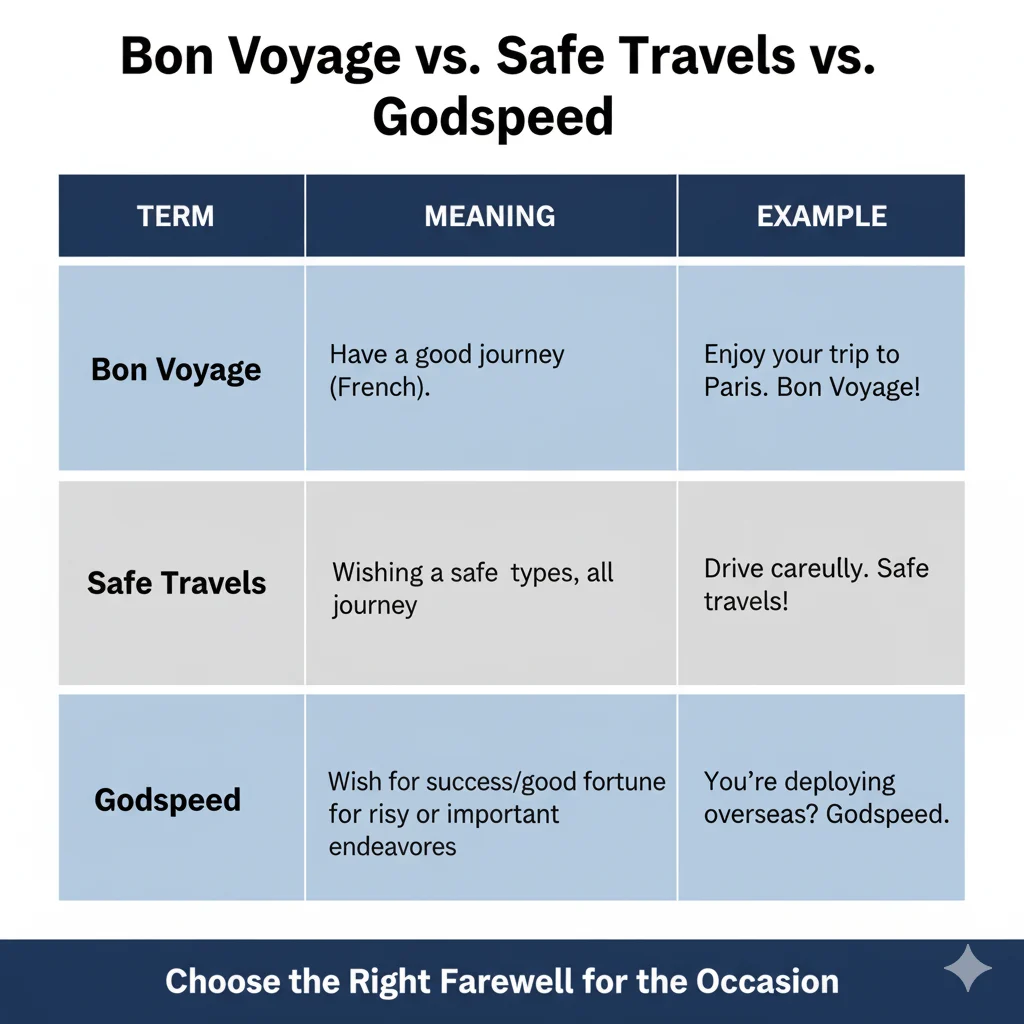
Here are some alternatives and related expressions to Bon Voyage that you can use depending on tone or formality:
| Phrase | Meaning | When to Use It |
|---|---|---|
| Safe travels | Wish for safety and comfort | Common in everyday speech |
| Have a great trip | Friendly and casual | Texts, chats, or goodbyes |
| Godspeed | Blessing for success or safety | Formal, emotional tone |
| Travel well | Poetic or gentle wish | Messages or posts |
| Journey mercies | Religious or spiritual tone | Faith-based or family use |
| Adieu | French for “goodbye forever” | Rarely used except in jokes or historical tone |
🧠 Fun fact: “Bon Voyage” is positive and upbeat, while “Adieu” historically implied a long or final farewell — very different vibes!
✅ How to Use “Bon Voyage” Correctly
Many people love saying “Bon Voyage” but aren’t sure when it fits naturally.
Here’s your quick do’s and don’ts guide:
✔️ DO:
- Use it before or at the start of someone’s journey.
- Include it in cards, captions, or well-wishing emails.
- Capitalize both words: Bon Voyage (it’s a phrase, not a casual term).
- Use emojis like ✈️🌍🧳 for warmth in informal settings.
- Say it sincerely — it’s meant as a kind wish, not sarcasm.
❌ DON’T:
- Don’t say it after someone’s already back (“Bon Voyage” means have a good trip, not hope you had one!).
- Don’t confuse it with “Adieu” — they’re not interchangeable.
- Avoid overusing it in casual everyday messages (it works best for travel-related contexts).
- Don’t write “bonvoyage” as one word — it’s always two words.
Correct Example: Bon Voyage, enjoy your cruise!
Incorrect Example: Bonvoyage on your trip!
⚠️ Common Mistakes and Misunderstandings
Even though it’s a simple phrase, “Bon Voyage” is often misused. Let’s clear a few misconceptions:
- “Bon Voyage” = Goodbye ❌
It’s not just goodbye; it’s a specific travel wish. Use it when the person is traveling, not just leaving your house. - It’s only for fancy occasions ❌
Nope! It works in simple chats too: “Bon Voyage, have fun in Dubai!” - It’s old-fashioned ❌
Actually, it’s making a comeback — especially on social media where French phrases sound aesthetic and elegant. - It’s religious or formal ❌
Not necessarily. “Bon Voyage” is neutral — suitable for both professional and casual use.
🌐 Cultural Significance Around the World
While French in origin, “Bon Voyage” has taken on different cultural shades:
🇫🇷 In France
Still used, but more naturally than in English-speaking countries. French people say “Bon voyage !” (with an exclamation mark) as a sincere, everyday expression before someone leaves.
🇬🇧 In the UK
Associated with elegance and travel etiquette — often used in farewell parties or travel cards.
🇺🇸 In the US
Seen as a classy, vintage expression, popular in travel-themed décor, cards, and captions.
🇵🇰 / 🇮🇳 / 🇵🇭 In South Asia
Used by English speakers to wish friends or relatives a safe flight abroad, especially for study or work trips.
🌏 On Social Media
Has become part of the “travel influencer” vocabulary, symbolizing wanderlust, positivity, and adventure.
✍️ Literary and Pop References
The phrase has also appeared across literature and entertainment:
- “Bon Voyage” (1962) — A Disney comedy about a family trip to Europe.
- “Bon Voyage” (BTS Song) — Korean pop group BTS used it as a series title for their travel reality show, celebrating adventure.
- Postcards and books — Themed collections like “Bon Voyage: A Traveler’s Journal.”
These references help keep the phrase alive in global culture.
🧳 Symbolic and Emotional Meaning
Beyond the literal translation, Bon Voyage carries emotional depth:
- It expresses care, love, and goodwill.
- It signifies a hopeful beginning — not an ending.
- It captures wanderlust and the excitement of exploring new places.
When you say “Bon Voyage,” you’re not just wishing safety — you’re celebrating new experiences.
That’s why it feels warm, optimistic, and timeless.
💡 How to Respond to “Bon Voyage”
If someone tells you Bon Voyage, here are natural ways to reply:
| Response | Tone / Use |
|---|---|
| “Thank you!” | Polite and simple |
| “Thanks! I’ll send pics!” | Friendly, casual |
| “Appreciate it! Can’t wait to explore!” | Excited tone |
| “Merci! I’m so looking forward to it.” | Bilingual, playful |
| “Thank you! Hope to see you when I’m back.” | Warm and personal |
❓ Frequently Asked Questions (FAQs)
1. What does “Bon Voyage” mean in English?
It means “have a good trip” or “safe travels.” It’s a French expression commonly used to wish someone well before traveling.
2. Is “Bon Voyage” formal or informal?
It’s neutral — polite enough for formal settings but friendly enough for casual chats.
3. How do you pronounce “Bon Voyage”?
It’s pronounced /bɔ̃ vwaˈjaʒ/ in French, or more simply in English as bon voy-ahj.
4. Can you text “Bon Voyage”?
Yes! It’s a popular way to wish someone safe travels in messages or social media captions.
5. What’s the difference between “Bon Voyage” and “Safe Travels”?
Both mean the same thing, but Bon Voyage feels more elegant and international, while Safe travels is more casual and modern.
6. When should you not use “Bon Voyage”?
Avoid saying it after someone’s trip or in everyday goodbyes — it’s travel-specific.
7. Is “Bon Voyage” still popular in 2025?
Absolutely! It’s trending again thanks to travel influencers, destination weddings, and Instagram travel captions.
🪄 Quick Grammar & Style Tips
- Always two words: “Bon Voyage,” not “BonVoyage.”
- Capitalize both words in English writing.
- Add commas or exclamation marks for emphasis: “Bon Voyage, my friend!”
- Works as both a sentence and an exclamation.
🌅 Conclusion
So, what does Bon Voyage really mean?
It’s more than just “have a good trip.” It’s a wish filled with warmth, hope, and adventure.
From its French roots to modern Instagram captions, the phrase continues to carry elegance and emotion — bridging centuries and cultures.
Next time a friend, colleague, or loved one is about to travel, you’ll know exactly how to say it with heart:
“Bon Voyage — may your journey be full of memories and magic!” ✈️✨
Now that you understand the true meaning, origin, and correct usage of Bon Voyage, you’ll never feel unsure again.
Keep exploring our site for more trending terms, internet slang, and cultural phrases explained simply and clearly

Claire Fuller is a word-meaning specialist at Meanovia.com. She explains complex words, phrases, and language trends in a clear, relatable way, helping readers quickly understand the exact meaning behind every term.