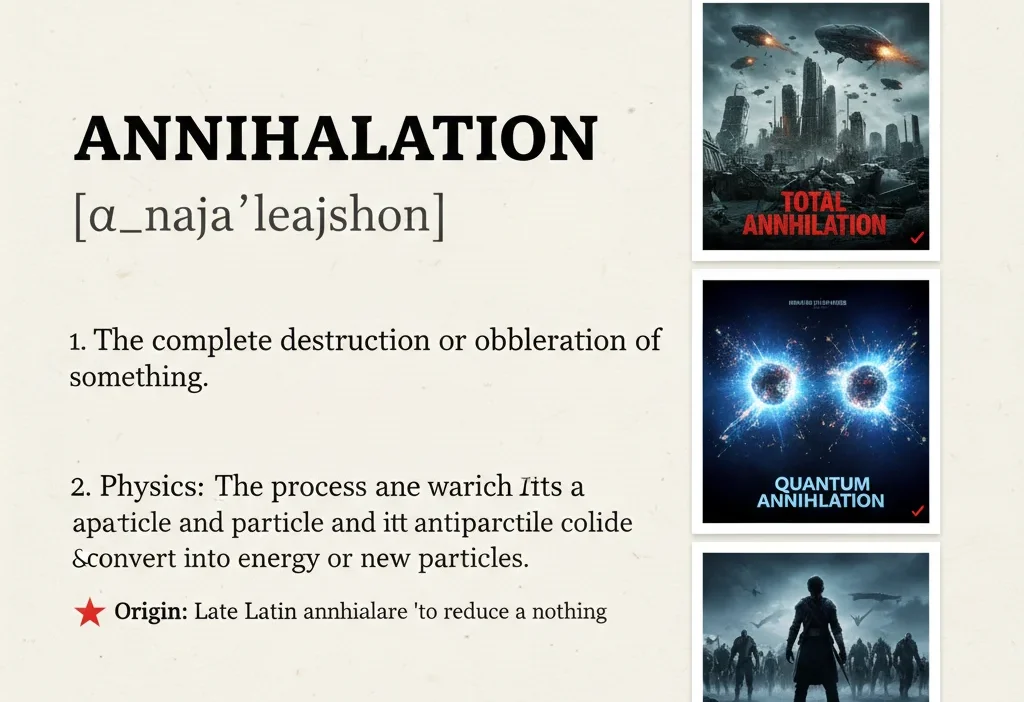
Annihilation means complete destruction, total elimination, or the act of wiping something out entirely.
People search for “annihilation meaning” when they encounter the word in news, movies, books, or academic contexts and want a clear explanation. Annihilation is often used to describe extreme destruction, whether physical, emotional, or abstract.
It can refer to the destruction of objects, the defeat of enemies, or the complete loss of something such as hope, identity, or power.
The word appears frequently in science fiction, military discussions, and philosophy, where it emphasizes finality and irreversibility. Understanding the meaning of annihilation helps readers grasp the seriousness and intensity behind the term and use it correctly in both writing and conversation.
What Does “Annihilation” Mean?
“Annihilation” means complete destruction or total obliteration of something.
It can describe physical destruction, emotional devastation, or the total defeat of an enemy or idea.
It’s a noun, often used in both formal and dramatic settings — from science and philosophy to movies and gaming.
Origin and Popularity
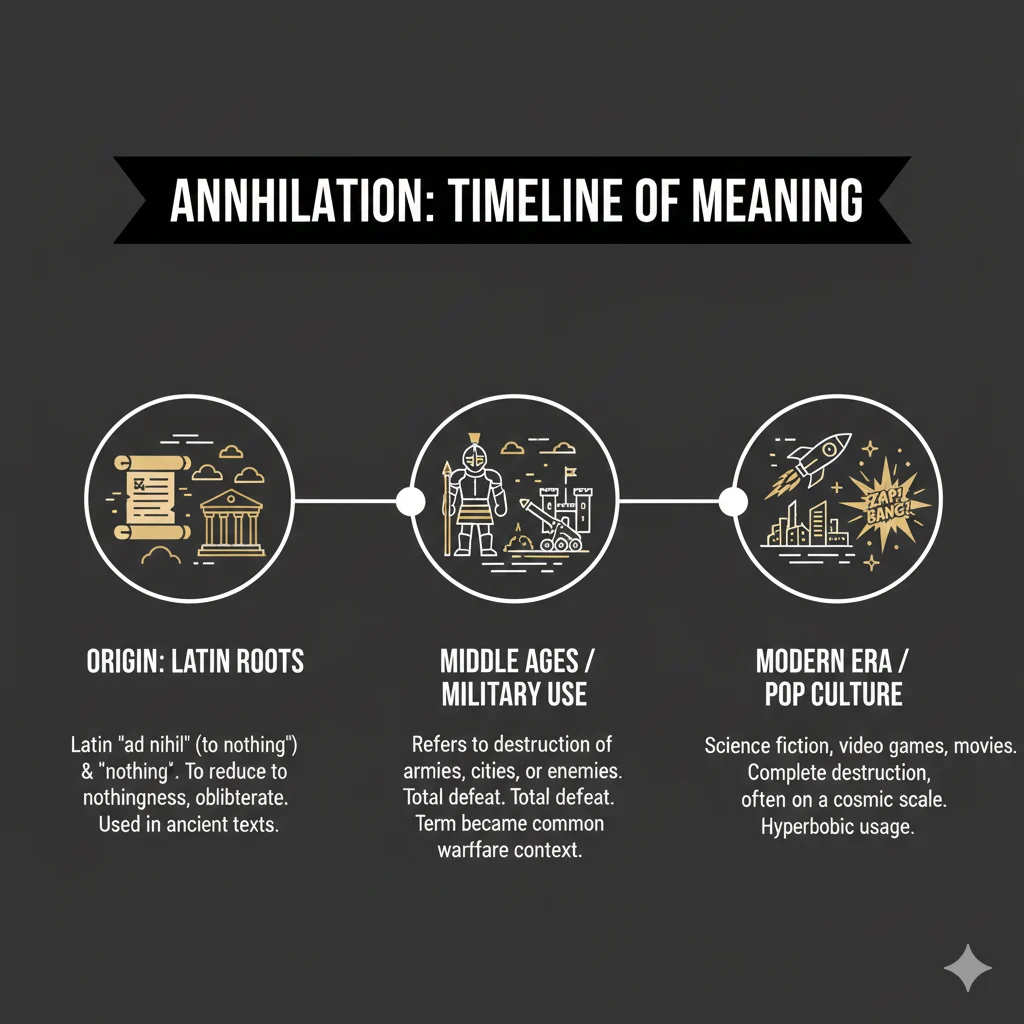
The word “annihilation” comes from the Latin term “annihilare,” meaning “to reduce to nothing.” It entered English in the 16th century and has since been used to express total ruin or eradication.
Over time, the term gained popularity in multiple contexts:
- Scientific (e.g., matter-antimatter annihilation in physics)
- Religious (e.g., annihilation of evil or sin)
- Pop culture (e.g., the 2018 sci-fi film Annihilation)
By the 21st century, “annihilation” also became common in gaming and online slang to describe total domination — like “That team got annihilated!”
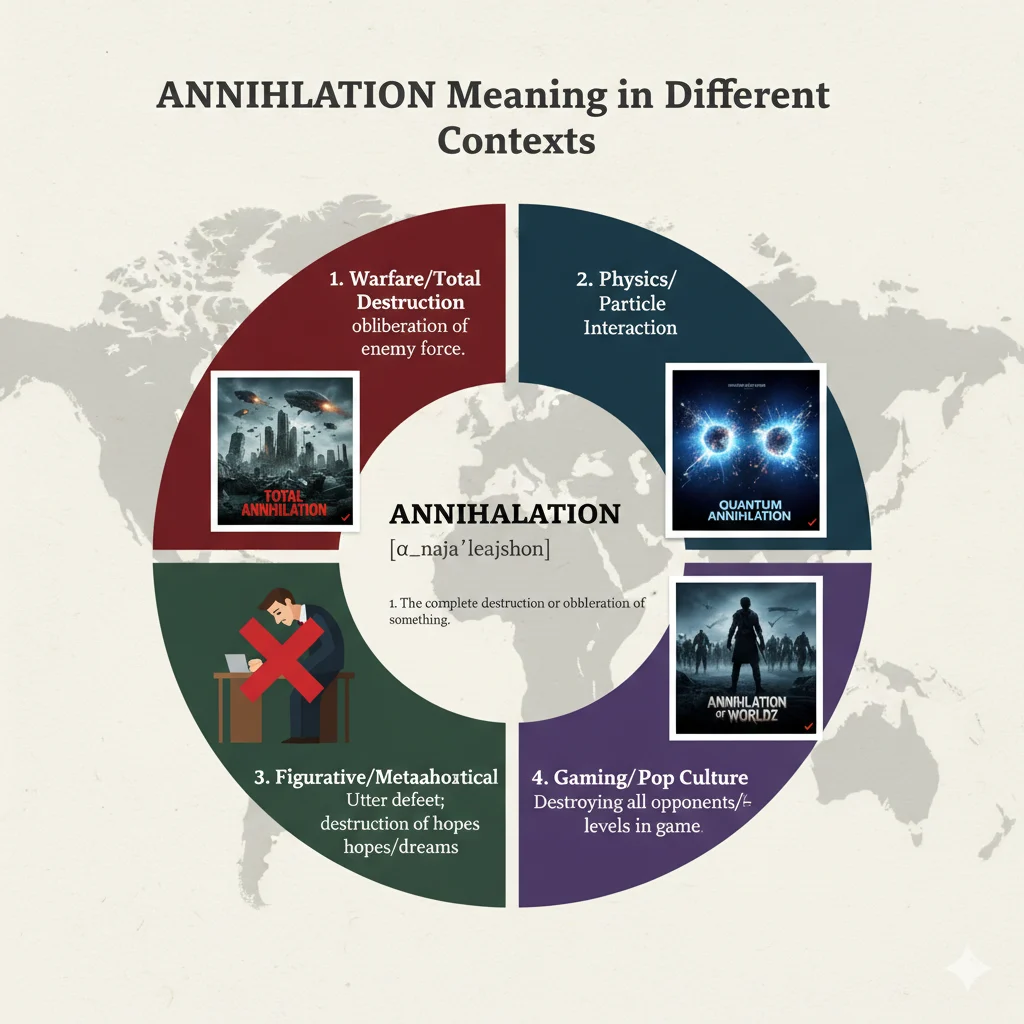
Annihilation Meaning in Different Contexts
🧬 In Science
In physics, annihilation refers to the process where a particle and its antiparticle collide and convert into energy.
Example: “When matter and antimatter meet, they undergo annihilation, releasing massive energy.”
⚔️ In Warfare or Conflict
Used to describe total destruction or defeat.
Example: “The army faced near annihilation during the final battle.”
💬 In Slang or Pop Culture
In modern slang, “annihilation” means completely defeating someone or something, often humorously.
Example: “We annihilated them in that video game match!”
🧠 In Philosophy or Religion
Represents the idea of being reduced to nothing or losing one’s existence.
Example: “Some philosophies view death as the annihilation of the self.”
| Context | Meaning | Example |
| Science | Particle-antiparticle destruction | “Electron annihilation” |
| Warfare | Complete defeat | “Troop annihilation” |
| Slang | Total domination | “We annihilated the competition!” |
| Religion | Erasure of existence | “Annihilation of the soul” |
Examples of “Annihilation” in Conversations
Example 1 (Casual):
👦 Friend 1: “How was your team’s match?”
👧 Friend 2: “Total annihilation! We won 10–0.”
Example 2 (Formal):
🧑💼 Manager: “The competitor’s strategy led to their own market annihilation.”
Example 3 (Pop Culture):
🎬 Fan: “Have you seen Annihilation? That ending blew my mind!”
Example 4 (Scientific):
👩🔬 Physicist: “Matter-antimatter annihilation is one of the most powerful reactions known.”
Similar or Related Terms
| Term | Meaning | Common Usage |
| Destruction | Act of ruining something | Everyday speech, news |
| Obliteration | Wiping out completely | Military, historical texts |
| Eradication | Removing something harmful | Disease control, social issues |
| Extermination | Killing off completely | Pest control, warfare |
| Decimation | Destroying a large part | Informal exaggeration |
These terms are often used interchangeably, but “annihilation” usually implies absolute or total destruction — nothing left behind.
How to Use “Annihilation” Correctly
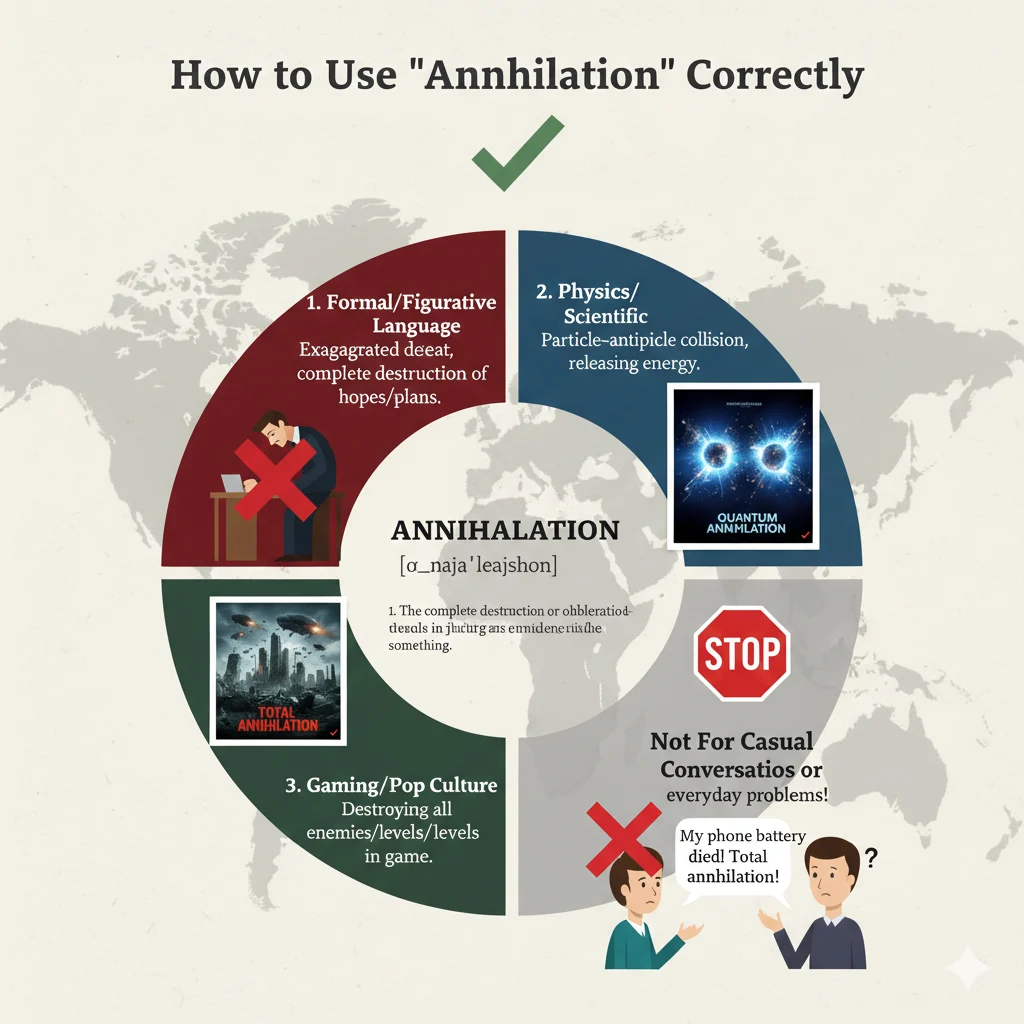
✅ Do’s:
- Use it when describing complete destruction or defeat.
- Use in formal writing, scientific contexts, or dramatic storytelling.
- Use metaphorically: “The storm brought economic annihilation to the region.”
❌ Don’ts:
- Don’t use it for minor losses or small issues.
Example: Instead of “I annihilated my sandwich,” say “I finished my sandwich.” - Avoid overusing it — it’s a strong word that loses impact if used casually.
Common Mistakes or Misinterpretations
- Confusing it with “Destruction.”
- While both imply damage, annihilation means complete and utter erasure, not partial damage.
- While both imply damage, annihilation means complete and utter erasure, not partial damage.
- Using it lightly.
- “Annihilation” is a powerful term — using it for trivial events can sound exaggerated.
- “Annihilation” is a powerful term — using it for trivial events can sound exaggerated.
- Mispronouncing it.
- Correct pronunciation: uh-nye-uh-LAY-shun.
- Correct pronunciation: uh-nye-uh-LAY-shun.
FAQ Section
1. What does “annihilation” mean in simple words?
It means total destruction or the act of completely wiping something out until nothing remains.
2. Is “annihilation” a positive or negative word?
Usually negative, since it implies destruction or loss. However, in games or competition, it can be used positively to mean a big win.
3. What’s the difference between “annihilation” and “destruction”?
“Destruction” means heavy damage; “annihilation” means total erasure — nothing left.
4. How is “annihilation” used in science?
In physics, it describes when a particle and its opposite (antiparticle) collide and vanish, releasing energy.
5. Can you use “annihilation” in casual speech?
Yes, but mostly for exaggeration or humor. Example: “We annihilated that pizza!”
6. Where is “annihilation” most used today?
In movies, gaming, science, and discussions of large-scale destruction or defeat.
Conclusion
The word “annihilation” carries immense power — symbolizing complete destruction, defeat, or disappearance. From physics to pop culture, it’s used to describe moments of total loss or victory.
Now that you know what “annihilation” really means, you’ll never misinterpret it again. Whether you’re reading science fiction, watching movies, or debating physics, you can confidently use it in the right context.
💡 Keep exploring our site for more word meanings, internet slang, and trending phrases — because language is always evolving!

Jon McGregor is a language and word-meaning expert at Meanovia.com. He specializes in explaining complex words, phrases, and modern language trends in a clear, approachable style. His mission is to help readers quickly grasp the true meaning behind every term, making language learning and understanding effortless and engaging.