
Ever heard someone say, “She has an allure about her,” and wondered what that really means?
You’re not alone — “allure” is one of those elegant words that appear in conversations, books, and even perfume ads, yet its full charm often goes unnoticed.
In this article, we’ll break down everything about the meaning of “allure” — its definition, origin, usage across contexts, examples, and related terms — so you’ll never second-guess its meaning again.
What Does “Allure” Mean?
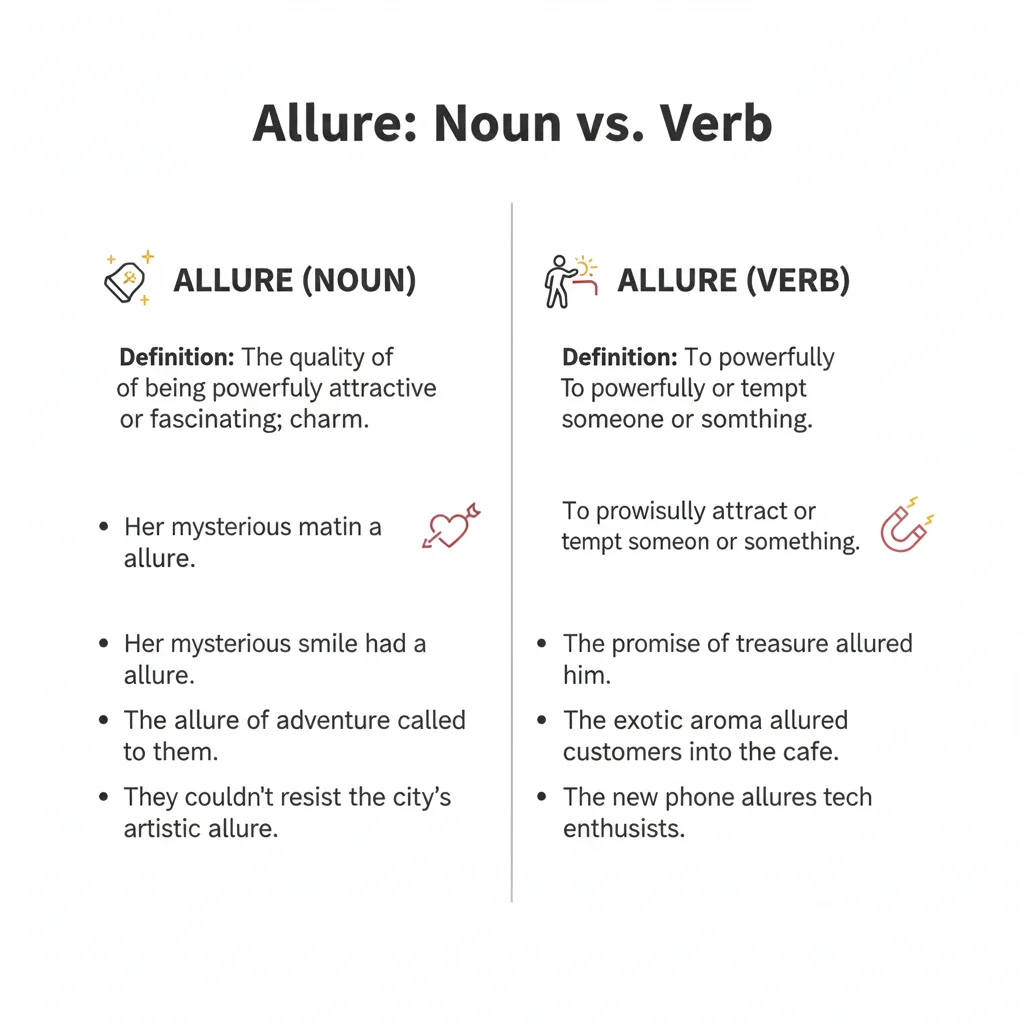
“Allure” means a powerful attraction or charm that draws people in, often in a mysterious or elegant way.
It can be used as both a noun and a verb:
- As a noun: “Her allure was undeniable.”
- As a verb: “The city allured travelers with its beauty.”
The term is common in literature, fashion, and everyday speech to describe something irresistibly appealing.
Origin and Popularity
The word “allure” comes from the Old French “aleurer”, meaning “to attract or entice.” It entered English around the 15th century and originally referred to tempting or luring someone.
Over time, its meaning softened — shifting from temptation to charm or appeal.
It gained popularity in romantic literature, advertising, and fashion culture, often used to describe beauty, mystery, or luxury.
Today, the word remains widely used across media — from magazine titles like “Allure” to social media captions like “Paris has its own allure.”
Allure Meaning in Different Contexts
| Context | Meaning / Use | Example |
| In Everyday Conversation | Describes a person’s charm or magnetism. | “He couldn’t resist her allure.” |
| In Literature | Symbolizes temptation, mystery, or beauty. | “The sea’s dark allure called to him.” |
| In Fashion & Advertising | Represents luxury, elegance, and seduction. | “The brand’s allure lies in its simplicity.” |
| As a Verb (Formal English) | To attract or fascinate someone deeply. | “The melody allured listeners with its softness.” |
Examples of “Allure” in Conversations
Example 1:
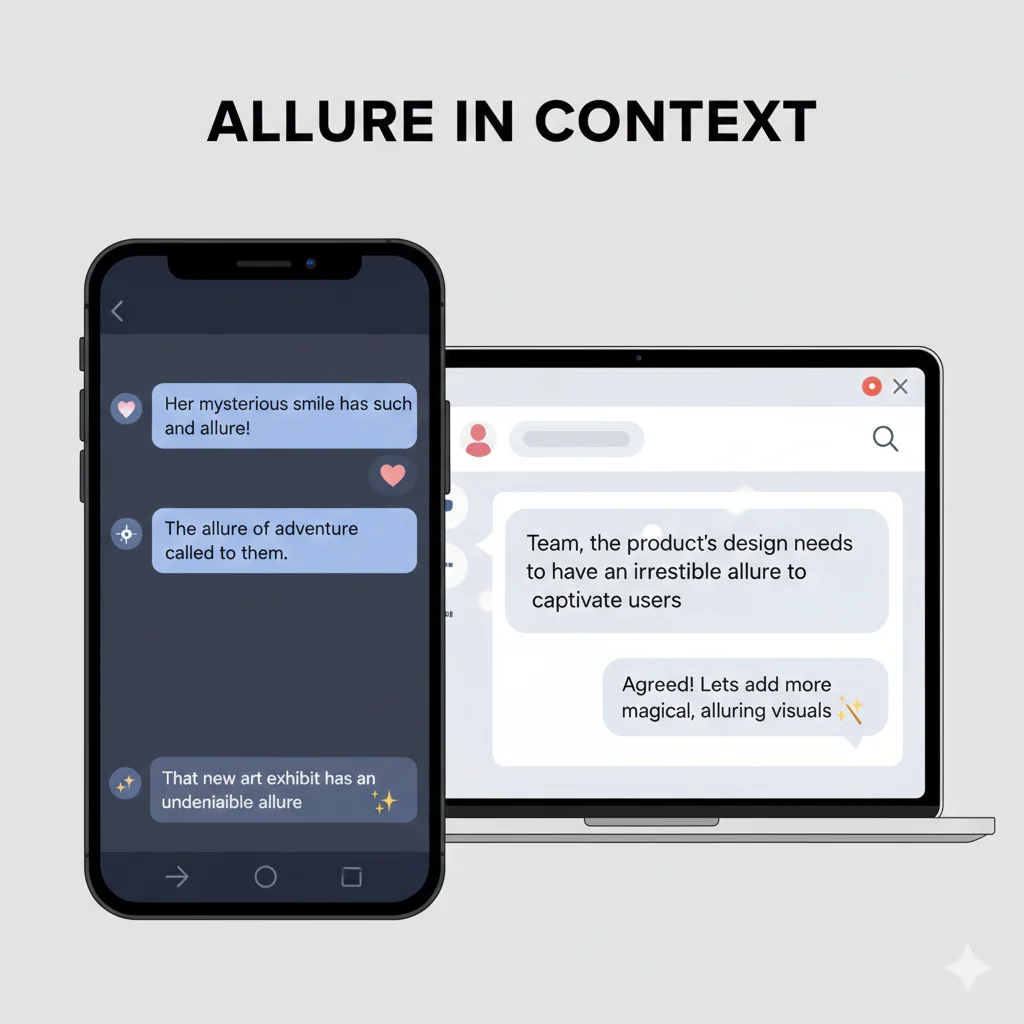
A: I can’t explain it, but Venice has this magical allure.
B: Totally! It’s like every corner tells a story.
Example 2:
Friend 1: She’s not just pretty — there’s an allure about her presence.
Friend 2: Yeah, it’s the confidence.
Example 3 (Formal Use):
“The CEO spoke about the allure of innovation in modern business.”
These examples show that “allure” can describe people, places, or ideas that naturally draw others in.
Similar or Related Terms
Here are a few words often used in place of or alongside “allure”:
| Word | Meaning | Difference from ‘Allure’ |
| Charm | Pleasant or attractive quality. | Simpler and more casual. |
| Appeal | Quality that makes something attractive. | Broader and less mysterious. |
| Attraction | Something that draws interest. | Neutral, can be physical or emotional. |
| Fascination | Strong interest or enchantment. | Focuses more on captivation. |
| Seduction | The act of tempting or enticing. | Has a romantic or sensual connotation. |
How to Use “Allure” Correctly
✅ Do’s
- Use it to describe elegance, beauty, or deep attraction.
- Employ it in storytelling, descriptions, or compliments.
- Use as a verb when describing something that draws someone in.
❌ Don’ts
- Don’t confuse it with physical attraction only — “allure” can describe ideas, art, or even a city.
- Avoid using it in overly casual contexts (e.g., “That burger has allure” sounds odd).
Example (Correct Use):
“The allure of the mountains made her extend her stay.”
Common Mistakes or Misinterpretations
- Confusing “allure” with “allurements” or “lure.”
While related, “lure” has a more manipulative tone, while “allure” suggests natural charm. - Using it only for appearance.
“Allure” can describe personality, energy, or experiences — not just looks. - Misusing verb form.
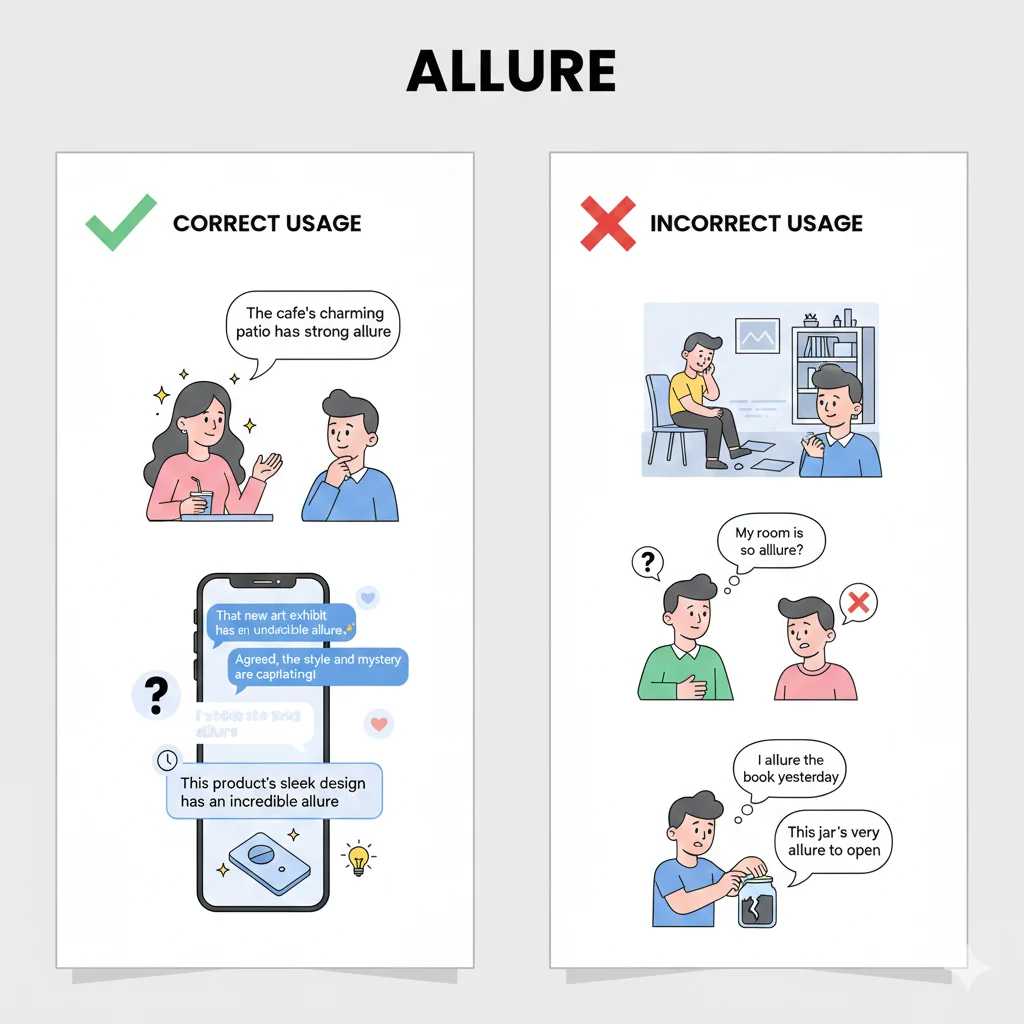
“She is allure” ❌ (Incorrect)
“She has allure” ✅ (Correct)
“She allured the crowd with her grace” ✅
FAQ: Allure Meaning and Usage
1. What does “allure” mean in simple terms?
“Allure” means a powerful attraction or charm — something or someone that draws attention in a captivating way.
2. Is “allure” a positive or negative word?
Mostly positive. It implies elegance and fascination, though in rare contexts it can suggest temptation.
3. Can “allure” be used to describe places or objects?
Yes! For example: “The allure of Paris never fades” or “The allure of gold has driven explorers for centuries.”
4. Is “allure” a noun or a verb?
It can be both — noun: “Her allure is timeless”; verb: “The ocean allured him.”
5. What’s the difference between “allure” and “charm”?
“Charm” is more casual and friendly; “allure” feels deeper, more mysterious, and elegant.
6. How do you pronounce “allure”?
It’s pronounced uh-LUR (əˈlʊr).
Conclusion
Now you know that “allure” means far more than just beauty — it’s about magnetism, mystery, and irresistible charm.
Whether describing a person’s charisma, a destination’s magic, or a brand’s appeal, the word adds a touch of elegance and depth.
So next time you come across the phrase “the allure of the unknown,” you’ll know exactly what it means — and maybe even feel it yourself.
✨ Now that you know the true allure meaning, explore more word guides on our site to keep expanding your vocabulary!

Evie Wyld is a word-meaning specialist at Meanovia.com. She simplifies complex words, phrases, and language trends, helping readers quickly grasp the exact meaning behind every term in a clear and approachable way.