

Truancy refers to the act of skipping school or being absent without permission. It is often linked to disciplinary issues, lack of engagement, or personal problems, and can have consequences for a student’s education and development.
Many people hear the term truancy and wonder what it specifically means and why it matters. Truancy isn’t just occasional absence—it refers to unauthorized or unexplained skipping of school, which can signal academic, social, or personal challenges. Understanding truancy helps parents, teachers, and students address the root causes and take steps to improve attendance and learning outcomes.
Beyond school, the concept can also highlight patterns of avoidance or neglect in responsibilities. Knowing its meaning clarifies discussions about education, discipline, and youth development.
Learn more about truancy, its causes, and consequences to understand its impact on education and society.
💡 What Does Truancy Mean?
Truancy means the act of staying away from school without permission or a valid reason.
It’s a noun used mainly in education and legal contexts. A student who skips school deliberately is often called a truant.
Example:
“The school is working to reduce truancy by engaging with parents and local communities.”
🕰️ Origin and Popularity
The word truancy comes from the Old French word “truand”, meaning beggar or rogue. Over time, English speakers began using “truant” to describe someone idle or neglectful, especially students avoiding school.
By the 16th century, the term truancy was widely used in education systems to describe unauthorized school absence.
Today, it appears in school policies, attendance laws, and news reports, especially when discussing student engagement or education reform.

🧩 Truancy Meaning in Different Contexts
🏫 In Education
- Refers to students who miss classes intentionally without valid reasons.
- Schools often track truancy rates to identify attendance issues.
“High truancy rates can lead to lower academic performance.”
⚖️ In Law and Policy
- Truancy can be considered a minor offense in some countries.
- Parents or guardians might face legal action if their children repeatedly skip school.
“The district court fined the parents due to their child’s chronic truancy.”
👨👩👧 In Parenting and Social Work
- Truancy is seen as a behavioral or social problem linked to family, motivation, or emotional factors.
“Counselors are addressing the root causes of student truancy.”
| Context | Meaning of ‘Truancy’ | Associated Action |
| Education | Skipping school without permission | School absence tracking |
| Law | Violation of attendance laws | Legal penalty or notice |
| Family/Social Work | Behavioral or emotional avoidance | Counseling or support |
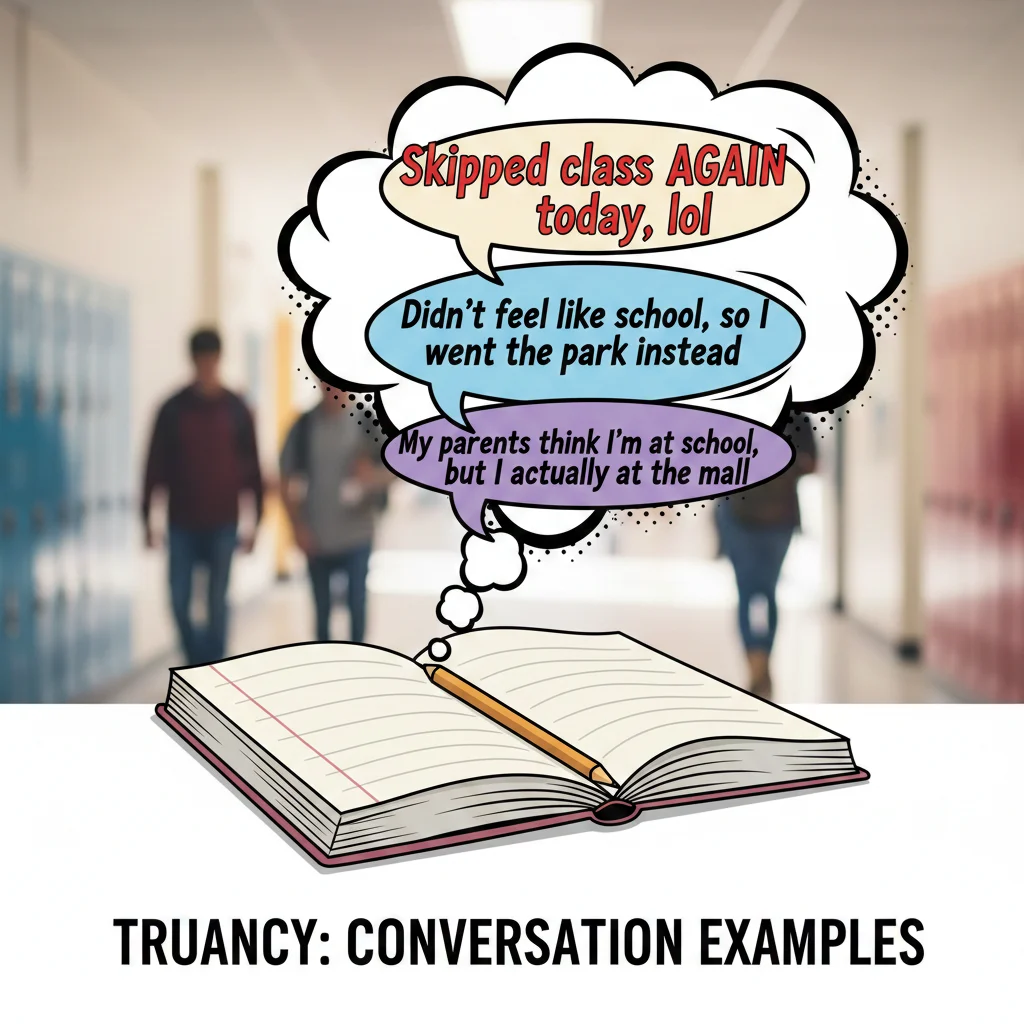
💬 Examples of ‘Truancy’ in Conversations
Example 1:
Teacher: Your attendance record shows several unexcused absences.
Student: Yeah, I guess that’s truancy, right?
Example 2:
Parent: The school called again — they said your truancy is getting serious.
Example 3 (Formal):
“Chronic truancy is a key factor linked to dropout rates and lower academic outcomes.”
🔍 Similar or Related Terms
Here are some words closely related to truancy:
| Term | Meaning | Relation to Truancy |
| Absenteeism | Repeated absence from work or school | Broader term; includes valid reasons |
| Skipping | Informal term for missing school | Synonym for truancy |
| Dropout | Permanently leaving school | Long-term consequence of truancy |
| Negligence | Failure to fulfill duty or responsibility | Can apply to parents or schools managing truancy |
🧠 How to Use ‘Truancy’ Correctly
✅ Do’s:
- Use it when talking about unauthorized school absence.
- Apply it in formal or educational settings.
❌ Don’ts:
- Don’t use it for work absences — that’s “absenteeism.”
- Don’t confuse it with “vacation” or “authorized leave.”
Examples:
✅ “The government launched a campaign to prevent truancy.”
❌ “He didn’t go to work — that’s truancy.” (Incorrect usage)
⚠️ Common Mistakes or Misinterpretations
- Mistaking truancy for illness absence
→ Truancy only applies when the absence is not approved by school authorities. - Using truancy for workplace absence
→ The correct term for missing work is absenteeism, not truancy. - Thinking truancy is minor
→ Chronic truancy can lead to legal penalties or academic failure.
❓ FAQ Section
1. What does truancy mean in school?
Truancy means a student misses school without a valid reason or permission. It’s usually intentional and considered a disciplinary issue.
2. Is truancy illegal?
In many regions, yes. Compulsory education laws require school attendance, and chronic truancy can lead to legal action against parents or guardians.
3. What causes truancy?
Common causes include lack of motivation, family problems, bullying, or disengagement from school. Some students skip due to emotional or mental health issues.
4. How can truancy be prevented?
Schools and parents can work together by improving communication, offering counseling, and creating a more engaging classroom environment.
5. What is the difference between truancy and absenteeism?
Truancy means unauthorized absence, while absenteeism includes any absence, even with a valid reason (like illness).
6. What happens if a child is truant repeatedly?
Chronic truancy can result in meetings with school authorities, counseling referrals, or in severe cases, court involvement.
🏁 Conclusion
In summary, truancy means deliberately skipping school without permission. Rooted in centuries-old language, it now represents a serious issue in modern education systems.
Understanding the meaning of truancy helps parents, teachers, and students recognize the importance of attendance, accountability, and education.
Now that you know the full truancy meaning, you’ll never mistake it again! Stay curious and keep learning about more academic and behavioral terms with us. 🎓✨

Patrick Gale is a word-meaning expert at Meanovia.com. He explains complex terms, definitions, and language trends with clarity and precision. His goal is to help readers understand the exact meaning behind every word they search.