At work or in school, you may hear words like subordinate, employee, or coworker. But what does subordinate really mean?
Quick answer: A subordinate is a person who works under a boss or leader.
If you ask “what does subordinate mean,” it means someone with a lower rank in a job, school, army, or team.
From my own work teaching simple English words to students, I often see people mix up subordinate, employee, and coworker. They are not the same.
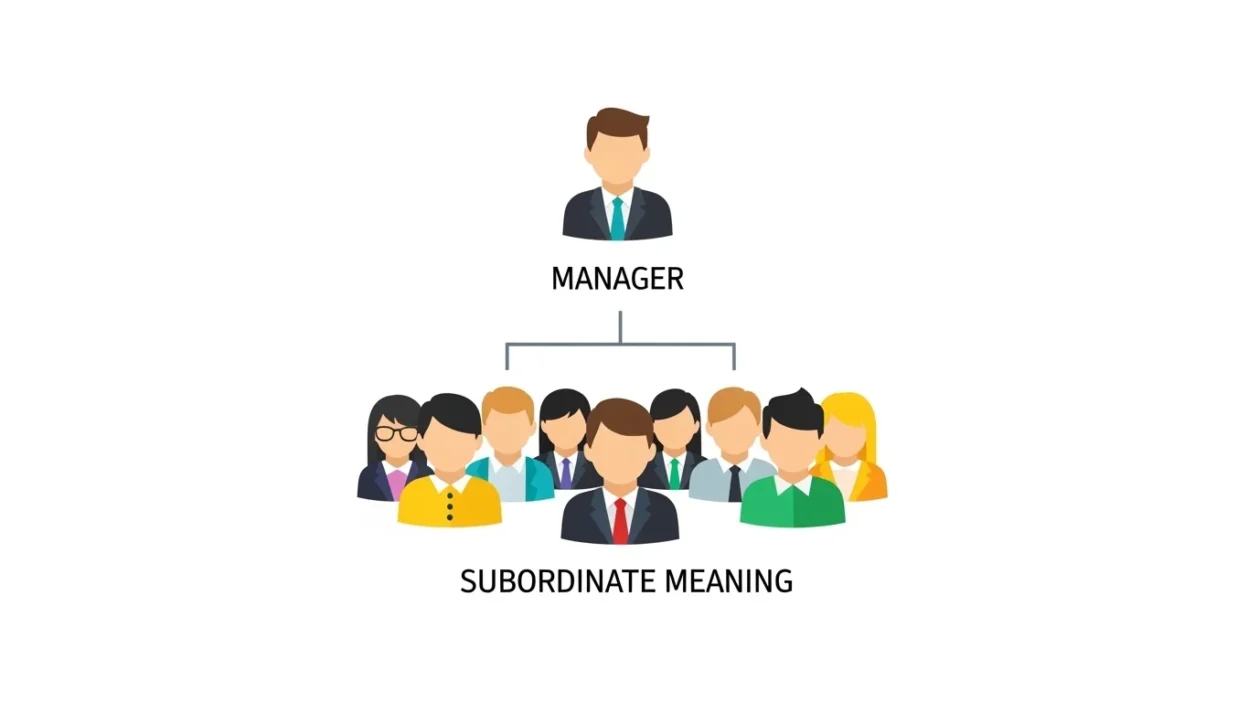
A subordinate works under you, an employee is anyone who works for a company, and a coworker is someone who works with you at the same place.
The word subordinate is used in offices, schools, the army, and team projects to show job levels clearly. People search for “what does subordinate mean” when they hear it in job talks, news, or lessons and want to understand who it describes.
Below, you will see easy examples, pronunciation help, and clear tips so you can use the word correctly.
📘 What Does Subordinate Mean?
Subordinate means a person who holds a lower position or rank in an organization or hierarchy.
It can also be used as an adjective to describe something or someone of less importance or authority.
In business contexts, it’s a formal term used to describe employees who report to a supervisor or manager.
Example: In the office hierarchy, team leads manage several subordinates who report directly to them.
Subordinate vs Employee vs Colleague
These words sound similar, but they are different.
Subordinate
A subordinate works under a boss or manager.
Example: A team lead has three subordinates.
Employee
An employee is anyone who works for a company.
Every subordinate is an employee, but not every employee is your subordinate.
Colleague
A colleague is someone who works with you at the same level.
Example: Two teachers in the same school are colleagues.
Easy Way to Remember
• Subordinate → works under you
• Employee → works in company
• Colleague → works with you
Real Example
A manager has five subordinates.
All of them are employees.
But the manager’s coworkers are his colleagues.
🕰️ Origin and Popularity
The word “subordinate” comes from Latin roots — sub (meaning “under”) and ordinare (meaning “to arrange or order”).
It was first recorded in English in the late 15th century, originally referring to something ranked below another in importance or order.
Over time, the word evolved into both noun and adjective forms, widely used in government, military, and business structures.
📈 Timeline Snapshot:
- 1400s: Derived from Latin subordinatus (“placed in a lower order”)
- 1700s–1800s: Commonly used in military and political hierarchies
- 1900s–Present: Adopted in business and organizational management
Today, the term remains popular in corporate settings, though modern workplaces increasingly prefer neutral alternatives like team member, direct report, or associate.
🔊 How to Pronounce Subordinate
Subordinate is pronounced:
suh-BOR-duh-nate
Say it slowly: suh-BOR-duh-nate.
The stress is on BOR.
🧩 Subordinate Meaning in Different Contexts
The term “subordinate” can carry slightly different meanings depending on context.

🏢 In Business or Corporate Settings
Used to describe an employee who reports to a higher-ranking person (supervisor, manager, or director).
Example: “Each subordinate is expected to submit reports to their manager by Friday.”
Tone: Neutral but formal.
Modern Alternative: “Direct report” or “junior employee.”
What Does Subordinate Mean in the Workplace
In the workplace, a subordinate is an employee who reports to a manager.
For example, a team leader may have five subordinates.
What Does Subordinate Mean in Business
In business, subordinate means a worker with a lower job rank.
A manager is not a subordinate, but their staff are.
⚔️ In Military or Government
Refers to someone ranked below another in an official chain of command.
Example: “Subordinate officers must follow the directives of their commanding officer.”
Tone: Strictly hierarchical and authoritative.
📚 In Grammar or Language
Used to describe a subordinate clause, which depends on a main clause for meaning.
Example: “I’ll call you when I arrive” → ‘when I arrive’ is a subordinate clause.
Tone: Academic and structural.
What Does Subordinate Mean in Grammar
In grammar, subordinate means a clause that depends on another clause.
Example:
“I stayed home because I was sick.”
“because I was sick” is a subordinate clause.
| Context | Meaning | Example | Tone |
| Business | Lower-ranking employee | “The manager evaluated all subordinates.” | Formal |
| Military | Lower in command | “Subordinates must obey orders.” | Authoritative |
| Grammar | Dependent clause | “She smiled because she was happy.” | Academic |
💬 Examples of Subordinate in Conversations
Example 1 (Workplace):
Manager: Please share the client list with your subordinates.
Assistant: Sure, I’ll send it to the team right away.
Example 2 (Military):
Officer: Subordinates are expected to act with discipline and respect.
Example 3 (Grammar Context):
Teacher: A subordinate clause can’t stand alone — it needs a main clause.
Example 4 (Modern Workplace):
HR Manager: Instead of “subordinate,” we prefer saying “direct report” to emphasize equality.
Subordinate Example Sentences
- The manager met all his subordinates.
- Each subordinate finished their task.
- The officer trained his subordinates.
🔄 Similar or Related Terms
Here are some related or alternative words to “subordinate”:
| Term | Meaning / Usage |
| Superior | A person of higher rank or authority |
| Direct Report | A modern, neutral synonym for subordinate |
| Assistant | A supporting role under a manager or executive |
| Junior Employee | A newer or lower-level worker in the organization |
| Team Member | A collaborative term often replacing “subordinate” |
Note: In modern HR and leadership communication, terms like team member and colleague are preferred for inclusivity and morale.
🧠 How to Use “Subordinate” Correctly
✅ Do’s:
- Use in formal documents or structured hierarchies.
- Use when describing organizational reporting lines.
- Appropriate in academic, legal, and military writing.
❌ Don’ts:
- Avoid using it casually with colleagues — it may sound authoritarian or outdated.
- Don’t use it to devalue someone’s role or contribution.
- Avoid in modern team cultures that focus on collaboration over hierarchy.
⚠️ Common Mistakes or Misinterpretations
- Thinking “subordinate” means unimportant – It doesn’t. It simply refers to hierarchical position, not value or ability.
- Using it in casual speech – It can sound overly formal or even condescending.
- Confusing “subordinate” with “submissive” – They are different. Submissive describes behavior, while subordinate describes position.
Is Subordinate a Bad Word?
Subordinate is not a bad word.
It only shows job level.
But in modern offices, people like words like “team member” because they sound kinder.
What Does Subordinate Mean in Real Estate or Mortgage
In real estate, subordinate means one loan comes after another loan.
Example:
If you have two home loans, the second loan is a subordinate loan.
What Does Subordinate Mean in the Bible
In the Bible, subordinate means someone who follows another person’s authority.
For example, followers obey leaders or kings.
It shows respect for order, not weakness.
❓ FAQ Section
1. What does “subordinate” mean in a job or office?
It refers to an employee who reports to a supervisor or manager, often one level lower in the company’s hierarchy.
2. Is “subordinate” a negative term?
Not inherently — it’s neutral and formal, but can sound outdated or impersonal in modern workplaces.
3. What is the difference between “subordinate” and “direct report”?
Both mean the same thing, but “direct report” is a more modern and inclusive way to describe an employee’s relationship to their supervisor.
4. What is a subordinate clause in grammar?
A subordinate clause is a dependent clause that adds information but cannot stand alone as a complete sentence.
5. Can you call your coworker a subordinate?
Only if there’s a clear reporting structure (e.g., they report directly to you). Otherwise, it’s better to say team member or colleague.
6. When should you not use “subordinate”?
Avoid in casual, peer, or collaborative environments — it may imply superiority instead of teamwork.
7. Can a colleague be a subordinate?
A: Yes, if they report to you in work, they are your subordinate.
🏁 Conclusion
To summarize, “subordinate” means someone ranked lower in position or authority, commonly used in business, government, and grammar.
Though it’s a perfectly correct term, it’s best used in formal or structured settings — and replaced with modern alternatives like direct report or team member in everyday conversation.
Now that you understand the meaning, origin, and correct usage of “subordinate,” you can communicate more clearly — whether in professional writing or daily work life.
✨ Keep exploring our site for more word meanings and workplace terminology explained simply and clearly!

Deborah Levy is a word-meaning expert at Meanovia.com. She explains complex terms, phrases, and language trends in a clear, relatable way, helping readers quickly understand the exact meaning behind every word.