
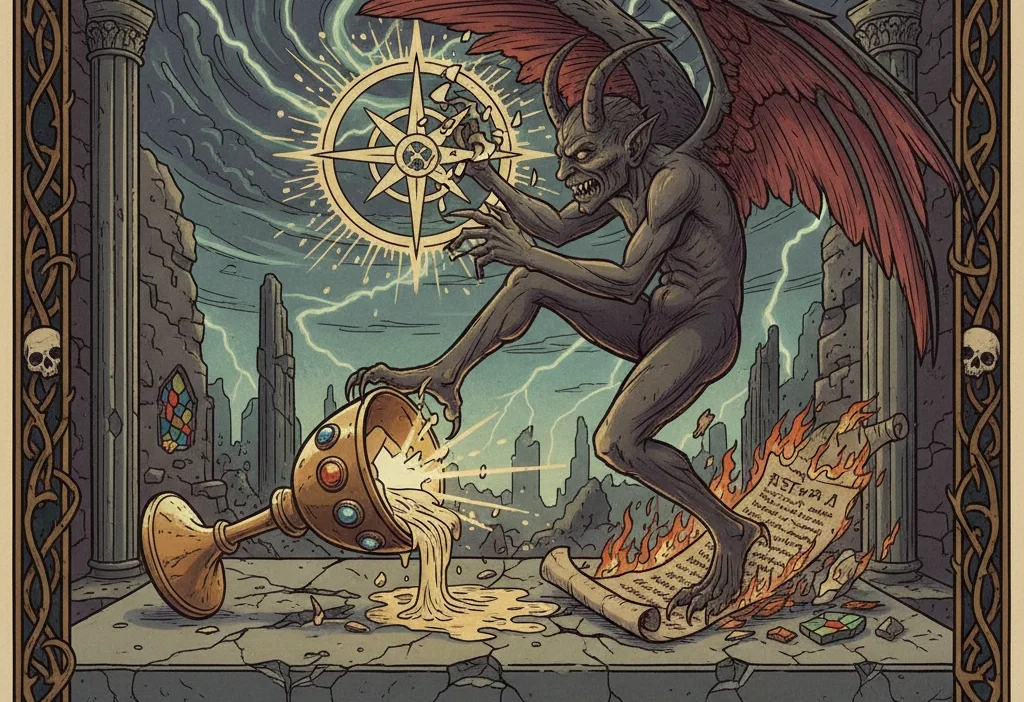
Have you ever heard someone say, “That’s pure sacrilege!” and wondered what exactly they meant? 😮 Whether it’s about disrespecting a holy place, mocking traditions, or treating something sacred with carelessness, the word sacrilege carries strong emotions and deep meaning.
In this guide, we’ll explore:
✅ The definition of sacrilege
📜 Its origin and evolution
💬 How it’s used in different contexts
🗣️ Examples in everyday and formal speech
⚡ Common confusions and FAQs
By the end, you’ll fully understand what sacrilege means — and how to use it the right way!
💡 What Does Sacrilege Mean?
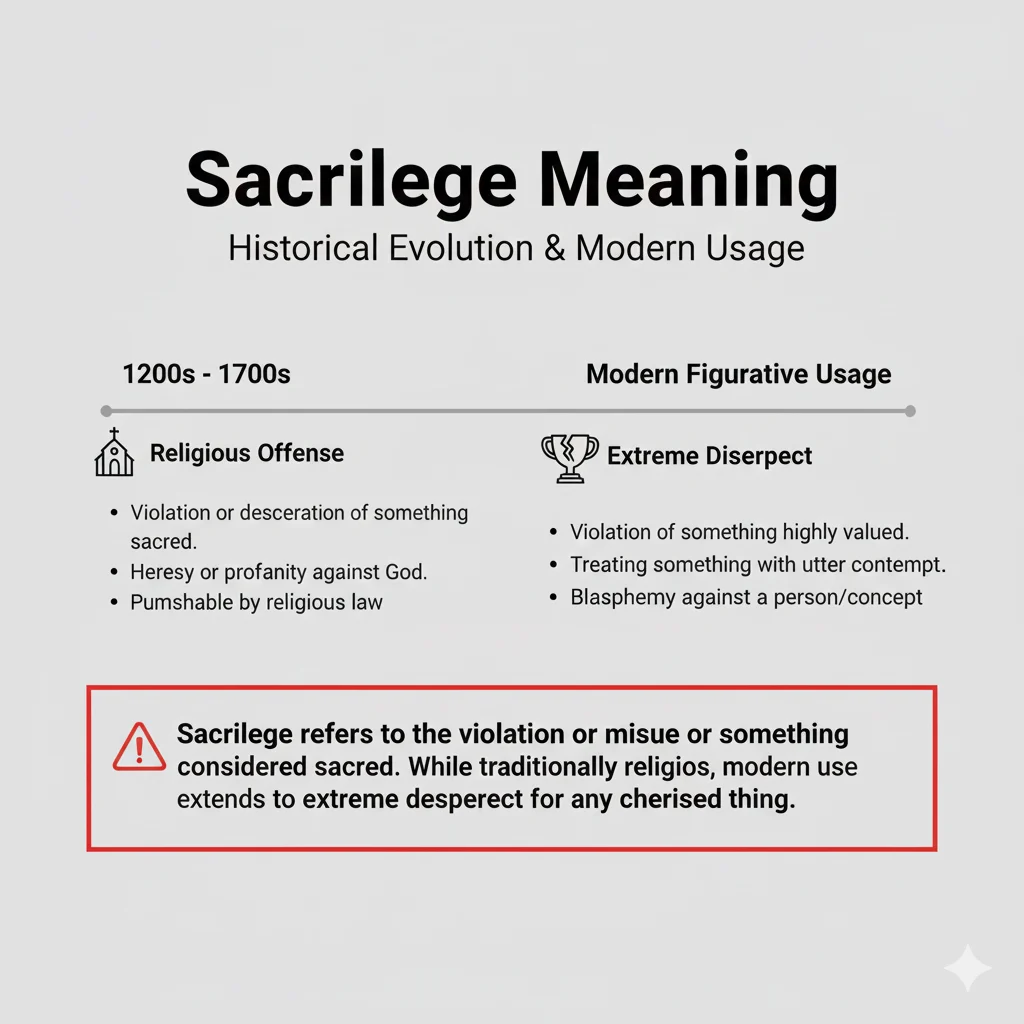
Sacrilege means the act of violating, disrespecting, or treating something sacred with irreverence.
It’s a noun, often used in religious, moral, or cultural contexts to describe an act that offends something considered holy or highly respected.
Example:
“Stealing from a church is considered an act of sacrilege.”
In simple terms, sacrilege = disrespecting the sacred.
🕰️ Origin and Popularity
The word sacrilege has deep historical roots. It comes from the Latin term “sacrilegium,” meaning “theft of sacred things.”
- Origin: Latin sacer (holy) + legere (to steal or take).
- First recorded use: Around the 13th century.
- Early meaning: Literally stealing from a temple or church.
- Modern meaning: Broader — includes any act showing disrespect toward religion, beliefs, or revered traditions.
Over time, “sacrilege” evolved from a religious crime into a word often used in everyday speech to express shock or moral disapproval — even humorously.
Example:
“Calling pineapple on pizza a crime is one thing, but saying you hate coffee? That’s sacrilege!” ☕😱
🌍 Sacrilege Meaning in Different Contexts
⛪ 1. In Religious Contexts:
- Used for acts that disrespect sacred places, objects, or beliefs.
- Example: “Destroying ancient temples is a grave sacrilege.”
- Tone: Serious and condemning.
🎭 2. In Cultural or Social Contexts:
- Used more lightly or figuratively to express disapproval toward something cherished.
- Example: “Forgetting your mom’s birthday? That’s social sacrilege!”
- Tone: Humorous or exaggerated.
💼 3. In Literature and Media:
- Often used to describe moral rebellion or cultural critique.
- Example: “The artist’s painting was seen as sacrilege by traditionalists.”
| Context | Meaning | Tone |
| Religious | Disrespecting something sacred | Serious |
| Cultural | Mocking or rejecting tradition | Light or humorous |
| Artistic | Challenging societal norms | Neutral to provocative |
🗣️ Examples of Sacrilege in Conversations
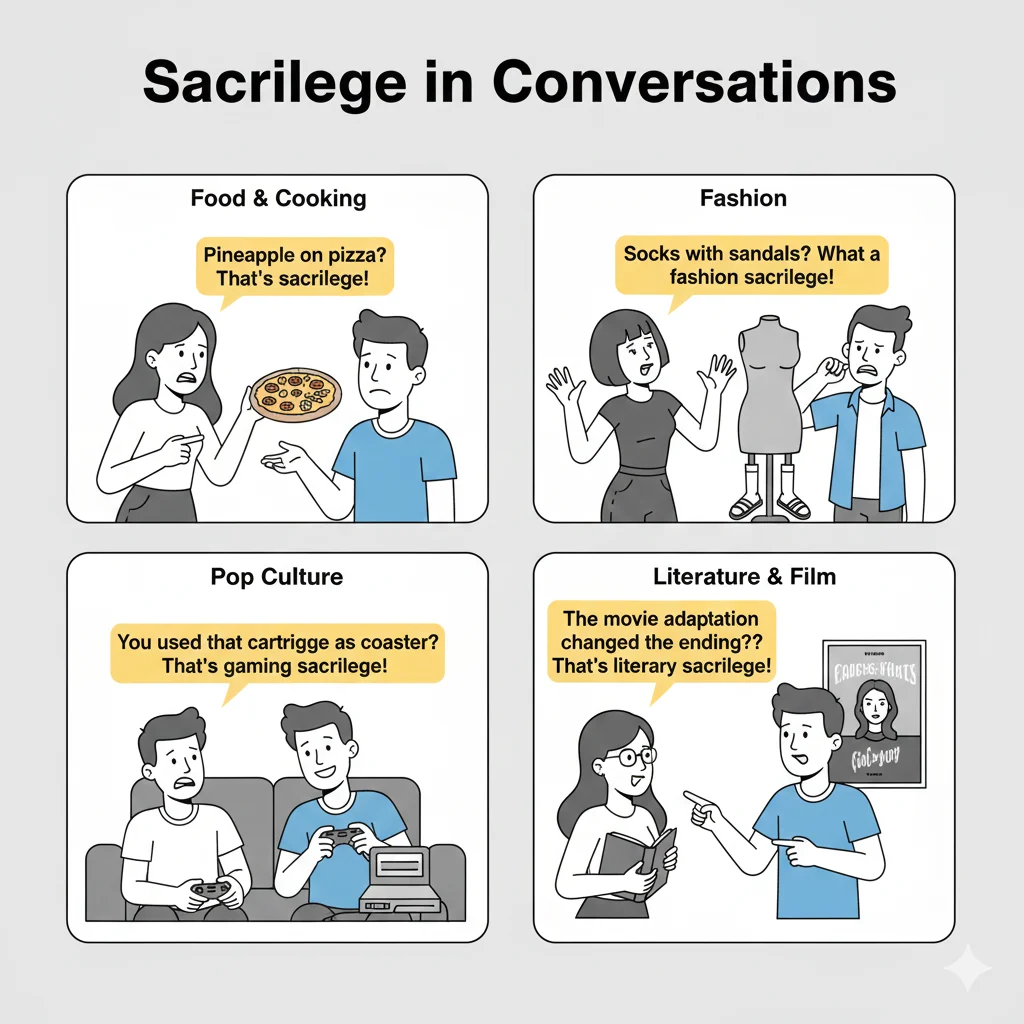
Example 1:
Friend 1: You don’t like chocolate?
Friend 2: I know, I know — total sacrilege, right? 🍫😅
Example 2:
Priest: Damaging sacred relics is an unforgivable sacrilege.
Example 3 (Formal):
“The author’s criticism of the ancient ritual was viewed as sacrilege by the community.”
Example 4:
Teacher: Skipping literature class to play video games? That’s academic sacrilege! 🎮📚
🔤 Similar or Related Terms
| Word | Meaning | Relation to Sacrilege |
| Blasphemy | Speaking disrespectfully about God or religion | Related but focuses on speech |
| Profanity | Irreverent or offensive language | Less severe, used casually |
| Heresy | Belief contrary to accepted doctrine | Intellectual or belief-based offense |
| Desecration | Physically damaging something sacred | A specific form of sacrilege |
Quick Tip:
- Sacrilege = Disrespecting what’s holy or valued.
- Blasphemy = Speaking against the divine.
- Desecration = Damaging sacred property.
🧭 How to Use Sacrilege Correctly
✅ Do’s:
- Use sacrilege for serious disrespect toward sacred or revered things.
- Apply it metaphorically for humorous exaggeration.
❌ Don’ts:
- Don’t use it in casual slang unless for playful exaggeration.
- Avoid mixing it with unrelated words like “crime” unless contextually relevant.
Examples:
✅ “Tearing up a national flag is an act of sacrilege.”
✅ “Skipping pizza night? That’s sacrilege!” 🍕
❌ “He made a sacrilege joke.” (Incorrect form — should say “a sacrilegious joke.”)
⚠️ Common Mistakes or Misinterpretations
- Confusing “sacrilege” with “sacrilegious.”
- Sacrilege = noun (the act).
- Sacrilegious = adjective (describing the act).
- Example: “That joke was sacrilegious.” / “He committed sacrilege.”
- Sacrilege = noun (the act).
- Assuming it’s always about religion.
- It can also apply to culture, art, or traditions.
- It can also apply to culture, art, or traditions.
- Overusing it casually.
- Saying “missing breakfast is sacrilege” is funny but informal — not literal.
- Saying “missing breakfast is sacrilege” is funny but informal — not literal.
❓ FAQ Section
1. What does sacrilege mean in simple terms?
Sacrilege means disrespecting something sacred or important, especially religious or moral values.
2. Is sacrilege a crime?
In some religions or countries, yes — sacrilege can be legally or socially condemned. In general usage, it’s a moral or cultural offense, not a legal one.
3. What’s the difference between sacrilege and blasphemy?
Blasphemy targets words or speech against God or religion, while sacrilege refers to actions or behaviors that violate the sacred.
4. Can sacrilege be used humorously?
Yes! People often use it jokingly to exaggerate disapproval, like saying “Putting ketchup on pasta is sacrilege!” 🍝😂
5. What is the adjective form of sacrilege?
The adjective is sacrilegious, meaning “showing disrespect for what is sacred.”
6. Where is the term most used?
It’s common in religious discussions, cultural debates, art criticism, and figurative speech.
🏁 Conclusion
To wrap up, sacrilege means showing disrespect or irreverence toward something sacred or deeply valued. From its Latin roots meaning “to steal holy things,” it has grown to describe any act — serious or humorous — that violates moral or cultural sanctity.
Whether used in religion, art, or everyday jokes, understanding the word sacrilege helps you appreciate the power of respect and the impact of words. 🙏✨
Now that you know the real sacrilege meaning, you’ll never misuse it again! Keep exploring our site for more insightful word meanings and language guides. 🌍📖