
Ever heard someone describe a plan, system, or person as “robust” and wondered what it really means?
You’re not alone — “robust” is one of those versatile words that shows up in everything from business reports to tech discussions and even casual conversations.
In this article, we’ll cover:
The definition of “robust”
Its origin and popularity
Different meanings in various contexts (business, tech, everyday use)
Examples and related terms
FAQs to clear up confusion
💬 What Does “Robust” Mean?
“Robust” means strong, sturdy, or capable of performing well under pressure.
It’s an adjective used to describe people, systems, or objects that are powerful, reliable, or resilient — especially in business, technology, or everyday life.
In short: “Robust” = strong, dependable, and able to handle challenges.
🧭 Origin and Popularity
The word “robust” comes from the Latin word robustus, meaning strong or hard like oak wood. It has been used in English since the 15th century, symbolizing strength and durability.
- 15th century: Initially used to describe people who were physically strong.
- 18th century: Adopted in engineering and science to describe strength in systems or designs.
- 20th–21st century: Widely used in business, technology, and data science to describe reliable systems and strategies.
Its popularity surged again in the digital era, as tech companies began using “robust” to describe secure and efficient software or networks.
🌍 Robust Meaning in Different Contexts
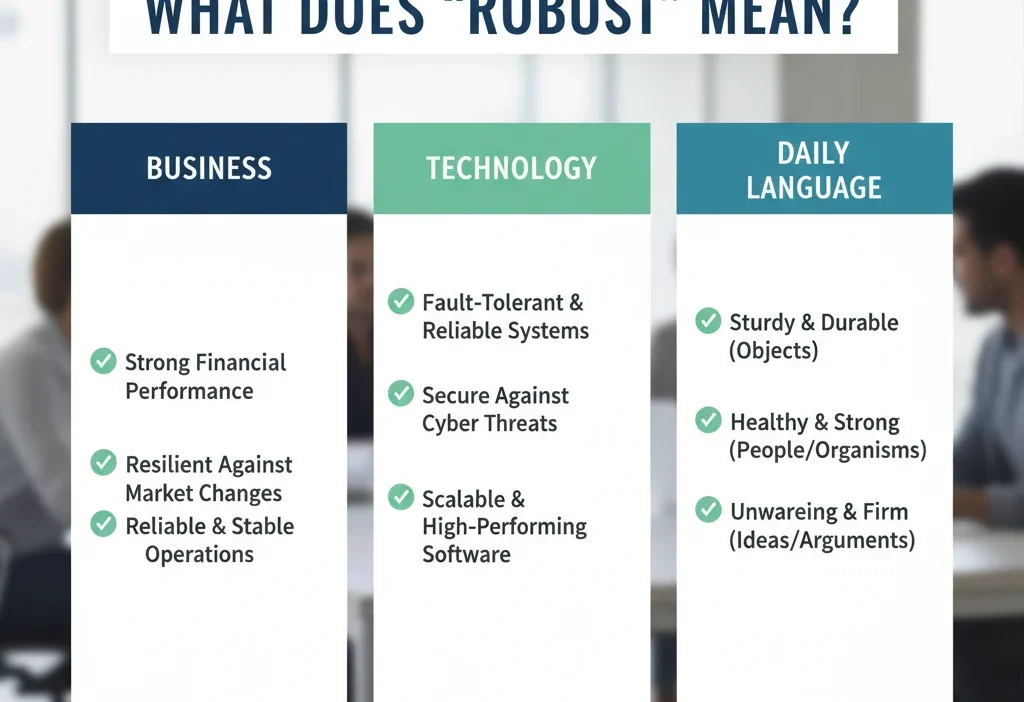
The word “robust” is flexible — its meaning slightly changes depending on where it’s used. Let’s break it down:
💼 In Business and Management
“Robust” describes strategies, plans, or systems that are effective, well-structured, and can handle unexpected challenges.
Example: “Our company has a robust business model that performs well even during market downturns.”
💻 In Technology
Used to describe software, algorithms, or networks that can function properly under stress or disruption.
Example: “The new cybersecurity system is robust enough to prevent data breaches.”
🧠 In Science or Data Analysis
Refers to methods or results that remain accurate and reliable, even with changes or errors in data.
Example: “The experiment produced robust results despite variations in conditions.”
🗣️ In Everyday Conversation
Means strong, vigorous, or full-bodied, often describing physical health, flavor, or personality.
Example: “She brewed a robust cup of coffee.”
Example: “He’s a robust speaker with a commanding presence.”
| Context | Meaning of Robust | Example |
| Business | Reliable and resilient system | “A robust financial plan.” |
| Technology | Strong and stable software | “A robust network design.” |
| Science | Accurate and dependable data | “Robust research findings.” |
| Everyday Use | Strong or full-bodied | “A robust flavor in the soup.” |
💬 Examples of “Robust” in Sentences
Here are some examples showing how “robust” is used in different scenarios:
Business Example:
“Our team developed a robust marketing strategy that increased sales by 40%.”
Technology Example:
“Engineers built a robust operating system that can recover from crashes quickly.”
Science Example:
“The study’s robust methodology ensures reliable conclusions.”
Everyday Example:
“The mountain climbers needed robust gear to survive the harsh weather.”
Health Example:
“She has a robust immune system that rarely lets her fall sick.”
🔄 Similar or Related Terms
Here are some synonyms and related terms for “robust” to expand your vocabulary:
| Term | Meaning | Context |
| Resilient | Able to recover quickly | Business, Psychology |
| Sturdy | Physically strong and durable | Everyday use |
| Vigorous | Energetic or forceful | Speech, Personality |
| Solid | Reliable and dependable | General |
| Tough | Strong and durable | Everyday or informal |
Each word has a slightly different nuance, but all share the essence of strength and dependability.
✅ How to Use “Robust” Correctly
Do’s:
- ✅ Use “robust” to describe something strong, stable, or effective.
- ✅ Use it in formal and professional writing, especially in business or tech.
- ✅ Use it when highlighting reliability or high performance.
Don’ts:
- ❌ Don’t use it to describe something small or weak (“a robust pencil” sounds odd).
- ❌ Avoid using it in casual slang — it’s a formal adjective.
- ❌ Don’t confuse it with “rapid” or “complex” — it means strong, not fast.
⚠️ Common Mistakes or Misinterpretations
- Misuse: Thinking “robust” only applies to people.
→ Reality: It applies to systems, products, data, or ideas too. - Overuse in Business Jargon:
→ Words like “robust solution” are sometimes overused — make sure it adds real meaning. - Confusion with “Resilient”:
→ “Resilient” focuses on bouncing back, while “robust” focuses on enduring strength.
❓ FAQ Section
1. What does “robust” mean in business?
In business, “robust” means strong, reliable, and effective — often describing plans, systems, or growth models that can withstand pressure or change.
2. What does “robust” mean in software or tech?
It refers to systems that continue working even under stress, such as when handling heavy user loads or security threats.
3. Is “robust” formal or informal?
“Robust” is a formal adjective, commonly used in professional writing, reports, and academic discussions.
4. What is a synonym for “robust”?
Words like resilient, sturdy, strong, and vigorous are good synonyms, depending on context.
5. How do you use “robust” in a sentence?
Example: “The startup has a robust financial plan that ensures long-term growth.”
6. What’s the difference between “robust” and “resilient”?
“Robust” means strong and hard to break; “resilient” means able to recover after being broken or challenged.
🏁 Conclusion
To sum up, “robust” means strong, effective, and reliable — whether you’re describing a system, business plan, or even a cup of coffee. Its roots in strength and endurance make it a powerful word for both formal and everyday communication.
Now that you know the true meaning of “robust”, you can use it confidently in your writing, speeches, or business meetings to sound clear, professional, and precise.
💡 Keep exploring our language guides to unlock the meanings of more impactful words and phrases!

Jon McGregor is a language and word-meaning expert at Meanovia.com. He specializes in explaining complex words, phrases, and modern language trends in a clear, approachable style. His mission is to help readers quickly grasp the true meaning behind every term, making language learning and understanding effortless and engaging.