RIF stands for “Reduction in Force.”
Ever seen the term “RIF” pop up in a workplace email or news headline and wondered what it means? You’re not alone. This short abbreviation often appears in professional settings and HR communications — and it’s more serious than it looks.
In this guide, we’ll break down everything you need to know about RIF meaning, including:
- The definition and full form of RIF
- Its origin and usage in business contexts
- RIF meaning in HR, corporate, finance, and government
- RIF meaning in slang and texting
- Examples of how it’s used in real life
- Related terms like layoff and downsizing
- Step-by-step guide on what happens during a RIF
- Real case studies
- FAQs and tips for understanding it properly
What Does RIF Mean?
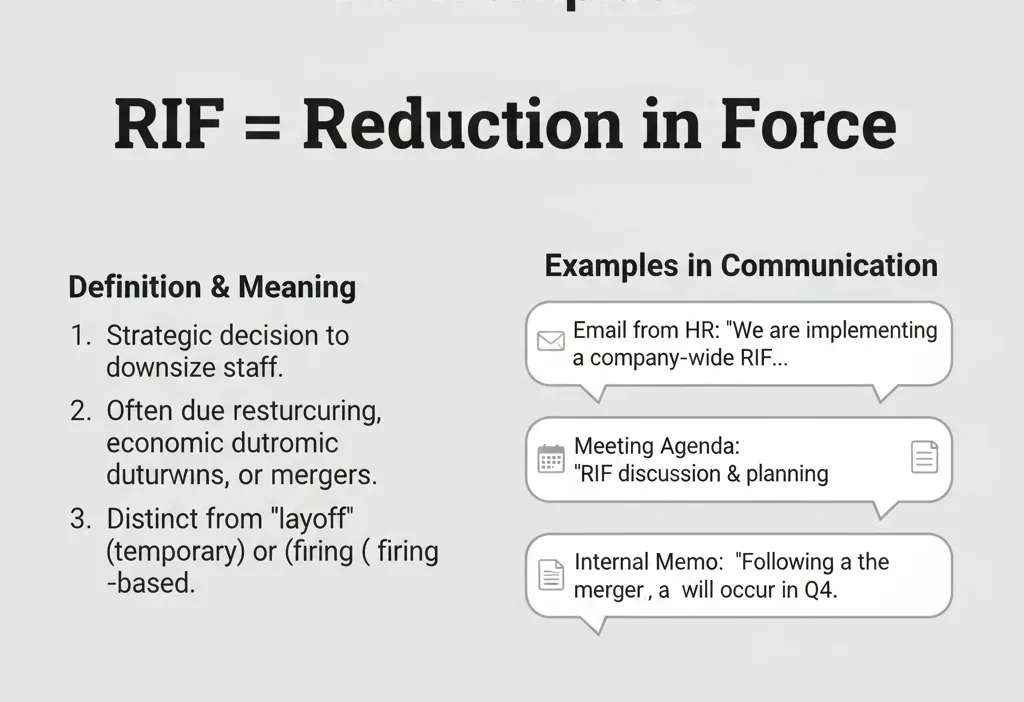
RIF stands for “Reduction in Force.”
It is a business abbreviation used to describe a permanent workforce reduction. This usually happens when a company eliminates certain positions to cut costs or restructure its operations.
In simple terms, a RIF means job cuts. These cuts often happen because of financial challenges, mergers, or big organizational changes.
RIF Full Form
The full form of RIF is Reduction in Force. You may also see it written as R.I.F. or R.I.F in formal documents.
What Is a RIF?
A RIF is when a company or government agency decides to permanently remove certain jobs. This is not about firing someone for doing something wrong. It is a business decision. The company may no longer need certain roles, or it may not have enough money to keep all its employees.
What Does RIF Stand For in Business?
In business, RIF stands for Reduction in Force. It is used in HR departments, company announcements, and news articles to describe job cuts. When a company goes through a RIF, it means some positions are being permanently eliminated.
Is RIF a Word?
Yes, RIF is used as both an acronym and a verb in business language. For example, people say “he was RIF’d” meaning he lost his job due to a Reduction in Force. So “RIF” can function as a word in professional conversations.
Origin and Popularity of the RIF Acronym
The term “Reduction in Force” has been used in the corporate and government sectors since the mid-20th century, particularly in the United States. It started as a formal, bureaucratic phrase to describe layoffs in a less emotional and more administrative tone.
- 1950s–1980s: The U.S. government and large corporations began using “RIF” in official HR documents.
- 2000s–2020s: The abbreviation became very common in business news, HR memos, and LinkedIn discussions.
- Today: “RIF” is widely recognized as a polite and professional term for layoffs or downsizing.
💡 Fun Fact: Some companies use “RIF” instead of “layoff” because it sounds less harsh and more strategic. It makes a painful decision sound like a business process.
RIF Meaning in Different Contexts
While “RIF” mostly appears in business and HR conversations, its tone and implication can vary depending on where it is used.
1. RIF Meaning in Business
In business, RIF refers to the permanent elimination of positions. It usually involves organizational restructuring or budget reductions. The goal is to make the company leaner and more efficient.
Example: “The company announced a RIF to align its workforce with new strategic goals.”
2. RIF Meaning in HR (Human Resources)
In HR, a RIF is a very specific and formal process. It involves careful planning, legal reviews, and communication strategies. HR teams are responsible for deciding which roles to eliminate, how to notify employees, and what severance packages to offer.
RIF meaning in HR also includes:
- Documentation of which positions are being cut
- Following labor laws and employment rules
- Offering outplacement services to affected employees
Example: “The HR team worked for weeks preparing the RIF process to make sure it was fair and legal.”
3. RIF Meaning in Corporate Settings
In corporate language, a RIF is often part of a bigger strategy. Companies may announce a RIF when they are merging with another company, when they are shifting their business model, or when they need to reduce spending quickly.
Corporate RIF meaning is closely tied to terms like restructuring, downsizing, and rightsizing. All of these describe ways companies reduce their workforce for strategic reasons.
Example: “The corporate RIF affected over 2,000 employees across three departments.”
4. RIF Meaning in Government
In government, a RIF is a formal HR process, often guided by strict rules, seniority, and merit systems. Government employees have specific protections and rights when a RIF happens.
Government RIF meaning includes:
- Priority placement programs for displaced workers
- Veterans’ preference rules (see SCD and veterans preference section below)
- Appeal rights for affected employees
Example: “Federal employees affected by the RIF will receive placement assistance from the agency.”
5. RIF Meaning in Finance
In finance, a RIF is often connected to cost-cutting strategies. When a company is trying to improve its profit margins or reduce operating costs, it may conduct a RIF. Investors and analysts watch for RIF announcements because they can signal financial trouble or a major strategic shift.
RIF meaning in finance often comes up in:
- Quarterly earnings reports
- Annual restructuring plans
- Merger and acquisition announcements
Example: “The finance team projected that the RIF would save the company $50 million annually.”
6. RIF Meaning in Education
In education, a RIF can happen when school districts face budget cuts. Teachers and staff members can be “RIF’d” meaning their positions are eliminated due to lack of funding.
Example: “Due to state budget cuts, the district issued RIF notices to 30 teachers.”
7. RIF Meaning in Software and Tech Industry
In the tech and software industry, RIFs have become very common, especially after periods of rapid hiring. Tech companies often conduct large RIFs when growth slows down or when investor pressure increases.
Example: “The software company announced a 15% RIF after missing its quarterly revenue targets.”
RIF Meaning in Slang and Texting
What Does RIF Mean in Slang?
In slang, RIF is sometimes used humorously or casually to mean getting fired or laid off. People might say “I got RIF’d today” in a casual text message or social media post.
RIF Slang Urban Dictionary
On platforms like Urban Dictionary, RIF in slang means being laid off or fired from a job. It is used in a slightly sarcastic or dark humor way to describe losing your job due to company cuts.
Example in slang: “Heard the whole marketing team got RIF’d. That’s rough.”
What Does RIF Mean in Texting?
In texting, RIF is not as common as other acronyms. But when used, it usually means “Reduction in Force” or simply refers to being laid off.
Example in texting: Person 1: “Why wasn’t Jake at work today?” Person 2: “He got RIF’d last week. The whole team got cut.”
RIF Definition Slang vs. Formal Use
| Context | RIF Meaning |
|---|---|
| Formal (HR/Business) | Reduction in Force — permanent job elimination |
| Slang/Texting | Getting fired or laid off due to company cuts |
| Casual Speech | Losing your job in a round of company cuts |
What Is the Difference Between RIF, Layoff, Furlough, and Downsizing?
Many people confuse these terms. Here is a simple comparison:
| Term | Meaning | Duration | Context |
|---|---|---|---|
| RIF | Reduction in Force (permanent job cut) | Permanent | HR/Corporate/Government |
| Layoff | Temporary or permanent job cut | Often temporary | General |
| Furlough | Unpaid leave or temporary suspension | Temporary | Corporate/Government |
| Downsizing | Reducing workforce size for efficiency | Permanent | Broader business term |
| Termination | Ending employment (for any reason) | Permanent | Includes voluntary and involuntary |
| Restructuring | Reorganizing teams or roles | Varies | May or may not include a RIF |
RIF Meaning vs. Layoff
A layoff can be temporary or permanent. For example, a company might lay off workers during a slow season and bring them back later. A RIF, however, is almost always permanent. The position is gone and will not come back.
RIF Meaning vs. Furlough
A furlough is when an employee is temporarily told not to work, usually without pay, but they still have their job. A RIF means the job is gone permanently.
RIF Meaning vs. “Riffed”
“Riffed” or “RIF’d” is the past tense verb form of RIF. It means someone was affected by a Reduction in Force. “He was riffed” = He lost his job due to a RIF.
RIF Meaning: A Step-by-Step Guide
What Happens During a RIF?
Understanding a RIF step-by-step can help both employees and managers navigate the process more confidently.
Step 1: Leadership Makes the Decision Senior management or the board of directors decides that a workforce reduction is necessary. This is usually due to budget issues, a merger, or a strategic shift.
Step 2: HR Plans the Process The HR department works with legal teams to figure out which positions will be eliminated. They must follow employment laws and make sure the process is fair and non-discriminatory.
Step 3: Notifications Are Sent Affected employees are notified, usually in a private meeting with their manager and an HR representative. In the U.S., the WARN Act requires companies with 100+ employees to give 60 days’ notice before a mass layoff or plant closing.
Step 4: Severance Packages Are Offered Most companies offer a severance package to employees affected by a RIF. This may include a certain number of weeks of pay, health insurance continuation, and job placement assistance.
Step 5: Transition Period Affected employees may be asked to work during a transition period to help hand off their work. Some may be asked to leave immediately.
Step 6: Company Rebuilds After the RIF, the company reorganizes remaining employees into new roles or teams. The goal is to become more efficient with fewer people.
RIF Costs: What Does a RIF Actually Cost a Company?
A RIF may seem like a cost-saving move, but it also comes with significant costs:
- Severance pay: Many companies pay 1–2 weeks of salary per year of service.
- Legal fees: Companies need lawyers to review the process and make sure it is compliant with employment laws.
- Unemployment insurance: When employees are laid off, companies often see an increase in unemployment insurance costs.
- Lost productivity: Remaining employees may feel scared or unmotivated, leading to lower productivity.
- Rehiring costs: If the company hires again later, it will spend time and money on recruiting and training.
- Reputation damage: A large RIF can hurt a company’s reputation, making it harder to attract top talent in the future.
Company-Wide RIF Meaning
A company-wide RIF means the job cuts affect employees across all departments and locations, not just one team or office. This is more serious than a department-level RIF and usually signals a major financial or strategic problem.
Example: “The company announced a company-wide RIF that would affect 20% of its total workforce.”
SCD RIF Meaning and Veterans Preference for RIF
What Is SCD in a RIF?
SCD stands for Service Computation Date. It is a date used by the U.S. government to calculate how long an employee has been working. During a RIF, SCD plays an important role in deciding who gets laid off first.
Employees with a longer SCD have more protection during a RIF because they have worked longer for the government.
Veterans Preference for RIF
In the U.S. federal government, veterans receive special protection during a RIF. This is called “Veterans Preference.” Veterans are given extra points or rankings that help protect them from being the first to be laid off during a Reduction in Force.
There are different types of veterans preference:
- 5-Point Preference: For veterans who served during specific periods
- 10-Point Preference: For veterans with service-connected disabilities
These preferences are very important during government RIFs because they determine the order in which employees are affected.
RIF Meaning: Real Case Studies
Case Study 1: Tech Company RIF (2023)
In early 2023, several major tech companies announced large RIFs. One well-known software company cut about 10,000 jobs, citing slower revenue growth and the need to become more efficient. The company offered severance packages and career support to affected employees.
Lesson: Even large and successful companies conduct RIFs when business conditions change.
Case Study 2: Government Agency RIF
A federal agency announced a RIF after Congress reduced its budget. Using seniority rules and veterans preference, the agency determined which positions would be eliminated. Affected employees were given 60 days’ notice and offered placement assistance.
Lesson: Government RIFs follow strict rules that protect long-term employees and veterans.
Case Study 3: Small Business RIF
A small manufacturing company with 50 employees was forced to conduct a RIF after losing its biggest client. The owner eliminated 10 positions, mainly in production. Because the company had fewer than 100 employees, the WARN Act did not apply, but the owner still gave employees two weeks’ notice and a small severance package.
Lesson: RIFs do not only happen at big companies. Small businesses can also go through this process.
RIF Meaning: Impact on Business
A RIF can have both positive and negative effects on a business:
Positive Effects
- Lower costs: Reducing the number of employees lowers payroll expenses.
- Improved efficiency: With fewer people, the company may focus on its most important work.
- Investor confidence: Showing financial discipline can boost investor trust.
Negative Effects
- Low employee morale: Remaining employees may feel scared about their own job security.
- Loss of knowledge: Experienced employees who are let go take valuable knowledge with them.
- Customer impact: If service teams are cut, customer satisfaction can suffer.
- Brand reputation: A poorly handled RIF can damage the company’s reputation.
How to Use RIF Correctly
✅ Do’s
- Use “RIF” in professional or HR contexts.
- Clarify that it refers to permanent job elimination, not temporary layoffs.
- Use it in formal writing or business discussions.
- Always explain the term to people who may not know it.
❌ Don’ts
- Avoid using “RIF” casually with affected employees — it can sound cold and impersonal.
- Do not confuse it with “furlough” or “temporary layoff.”
- Do not use it in emotional or personal communications.
- Do not use it as a joke in the workplace.
Examples: ✅ “The company is implementing a small RIF as part of a restructuring plan.” ❌ “I think they’re going to RIF everyone next week!”
Common Mistakes and Misinterpretations of RIF
1. Confusing RIF with Layoff Layoffs can be temporary. A RIF is usually permanent. Do not use them interchangeably.
2. Thinking RIF Means Firing for Performance A RIF is NOT about poor performance. It is a strategic or financial decision. The employee’s work quality is not usually the reason.
3. Believing RIFs Only Happen in Big Companies Even small startups and family businesses may perform a RIF to manage costs.
4. Using RIF Informally It is a formal HR term. Avoid using it in jokes or casual chats at work.
5. Confusing “RIF” with “RIFF” In business, “RIF” and “RIFF” can both appear. “RIF” means Reduction in Force. “RIFF” in music means a repeated phrase. In business, “riff” can also mean to improvise or brainstorm ideas — very different from a RIF!
What Does Riff Mean in Business? In business, “riffing” or “to riff” means to brainstorm or speak freely about ideas. For example, “Let’s riff on some new marketing ideas.” This is completely different from a RIF (Reduction in Force).
What Is a RIF in Business? — Full Summary
| Question | Answer |
|---|---|
| What is RIF? | Reduction in Force — permanent job cuts |
| What does RIF stand for? | Reduction in Force |
| What does RIF mean in HR? | A formal process of permanently eliminating positions |
| What does RIF mean in corporate? | Workforce reduction due to restructuring or budget cuts |
| What does RIF mean in government? | A formal layoff process with strict seniority and veterans rules |
| What does RIF mean in finance? | Cost-cutting strategy through workforce reduction |
| What does RIF mean in slang? | Getting fired or laid off from a job |
| Is RIF permanent? | Yes, usually permanent |
| What is a company-wide RIF? | Job cuts across the entire organization |
Examples of RIF in Conversations
💬 Example 1 (Workplace Chat) Manager: We’ll have a company-wide meeting about the upcoming RIF next week. Employee: I hope the HR team clarifies how roles will be affected.
💬 Example 2 (News Headline) “Software giant announces 10% RIF amid restructuring plan.”
💬 Example 3 (Internal Email) “Due to financial realignment, the company will undergo a limited RIF affecting select departments.”
💬 Example 4 (Casual Discussion) Colleague 1: Did you hear about the RIF at the marketing team? Colleague 2: Yeah, a few roles got cut to reduce costs.
💬 Example 5 (Government Setting) HR Officer: The agency RIF will follow seniority rules and veterans preference guidelines. Employee: Does my SCD date affect my position on the RIF list?
💬 Example 6 (Finance Meeting) CFO: The RIF will reduce our annual payroll costs by 12%. Board Member: How many positions are being eliminated?
💬 Example 7 (Small Business) Owner: I hate to do it, but we need a small RIF to keep the business alive. Manager: How many employees will be affected?
Similar and Related Terms
| Term | Definition | Key Difference from RIF |
|---|---|---|
| Layoff | Temporary or permanent job cut due to budget issues | May allow rehiring later |
| Furlough | Temporary unpaid leave | Employee still has their job |
| Downsizing | Reducing workforce size for efficiency | Broader term |
| Termination | Ending employment for any reason | Includes voluntary exits |
| Restructuring | Reorganizing teams or roles | May or may not involve a RIF |
| Rightsizing | Adjusting workforce to the right size | Often a polite word for RIF |
| Outsourcing | Moving jobs to outside companies | Different from eliminating jobs |
What Is RIF Day?
RIF Day is the day when a company officially announces or carries out a Reduction in Force. It is the day employees find out if their jobs are being eliminated. RIF Day is often a stressful and emotional time for everyone in the company, including the managers delivering the news.
Some companies try to handle RIF Day with care by:
- Giving employees as much notice as possible
- Offering one-on-one meetings instead of mass emails
- Providing mental health and career support resources
RIF Meaning in Employment Law
From a legal perspective, a RIF must follow certain rules:
- Non-discrimination: The RIF cannot target employees based on race, age, gender, disability, or other protected characteristics.
- WARN Act (USA): Companies with 100+ employees must give 60 days’ notice before a mass layoff.
- ADEA (Age Discrimination in Employment Act): If older employees are disproportionately affected by a RIF, the company may face legal challenges.
- Severance agreements: Employees are often asked to sign a release of claims in exchange for severance pay.
Understanding RIF employment meaning helps employees know their rights and take action if the process was handled unfairly.
FAQs About RIF Meaning
1. What does RIF mean in business?
RIF stands for “Reduction in Force,” referring to a permanent reduction of staff positions due to restructuring, budget cuts, or strategic realignment.
2. Is RIF the same as a layoff?
Not exactly. A layoff can be temporary or permanent, but a RIF usually means permanent job elimination.
3. What is the full form of RIF?
The full form of RIF is Reduction in Force.
4. What does RIF mean in HR?
In HR, a RIF is a formal process where certain positions are permanently eliminated. HR teams manage notifications, severance, and legal compliance.
5. What does RIF mean in government?
In government, a RIF follows strict seniority and veterans preference rules. Affected employees receive placement assistance and appeal rights.
6. What does RIF mean in slang?
In slang, RIF means getting fired or laid off from your job. Someone might say “I got RIF’d” to mean they lost their job in a company round of cuts.
7. What does RIF stand for in layoffs?
In layoffs, RIF stands for Reduction in Force. It means the layoff is permanent and the position will not be refilled.
8. How do companies decide who is affected by a RIF?
Typically, HR and leadership teams evaluate roles based on business priorities, redundancy, or performance metrics. In government, seniority and veterans preference are used.
9. How should employees respond if a RIF is announced?
Stay calm, stay informed, review your severance package, and update your resume and LinkedIn profile. You can also consult an employment lawyer if you think the RIF was handled unfairly.
10. What is a company-wide RIF?
A company-wide RIF means job cuts affect the entire organization, not just one department.
11. What is SCD in a government RIF?
SCD stands for Service Computation Date. It is used to determine how long a government employee has worked, which affects their order of retention during a RIF.
12. What does RIF mean in finance?
In finance, RIF is a cost-reduction strategy that involves permanently cutting positions to lower payroll and operating expenses.
13. What does RIF mean in education?
In education, a RIF occurs when school districts eliminate teacher or staff positions due to budget cuts.
14. What does RIF mean in the tech/software industry?
In tech, a RIF refers to large-scale job cuts that tech companies make when growth slows or costs need to be reduced quickly.
15. What is RIF Day?
RIF Day is the day when a company carries out or announces its Reduction in Force, affecting the employees whose positions have been eliminated.
16. Where is the term RIF most commonly used?
RIF is primarily used in corporate HR departments, government agencies, business journalism, and finance.
17. When should you not use the term RIF?
Avoid using “RIF” in casual or emotional conversations. It is better suited for formal, organizational communication. Using it too casually can seem cold or disrespectful to people who have been affected.
18. What does “riffed” mean?
“Riffed” or “RIF’d” means someone was laid off due to a Reduction in Force. It is the past tense verb form of the acronym RIF.
19. What is the RIF meaning for small businesses?
Small businesses can also conduct a RIF when they face financial challenges. Even though the term is formal, any business — large or small — can reduce its workforce permanently.
20. What does RIF mean in trends?
In business trends, RIF is frequently discussed in connection with economic downturns, tech layoffs, and corporate restructuring waves.
Conclusion
To sum it up, RIF meaning stands for “Reduction in Force” — a formal term for permanent job cuts in business, government, and corporate contexts. While it may sound very technical, understanding it helps professionals navigate company news, workplace changes, and HR decisions with confidence.
Whether you are an employee worried about your job, an HR professional managing the process, or a business student learning about corporate terms, knowing what RIF means — and how it works — is essential knowledge in today’s professional world.
From RIF meaning in HR to RIF slang in texting, from government RIF rules to company-wide RIF impacts, this guide has covered everything you need to know about this important business term.
Now that you know what RIF really means, you will never be confused by HR memos, business headlines, or workplace conversations again. Stay informed, know your rights, and always be prepared!
Stay tuned for more clear explanations of modern business and workplace terms.