Ever seen the term “RIF” pop up in a workplace email or news headline and wondered what it means? You’re not alone. This short abbreviation often appears in professional settings and HR communications — and it’s more serious than it looks.
In this guide, we’ll break down everything you need to know about RIF meaning, including:
- The definition and full form of RIF
- Its origin and usage in business contexts
- Examples of how it’s used in real life
- Related terms like layoff and downsizing
- FAQs and tips for understanding it properly
What Does RIF Mean?
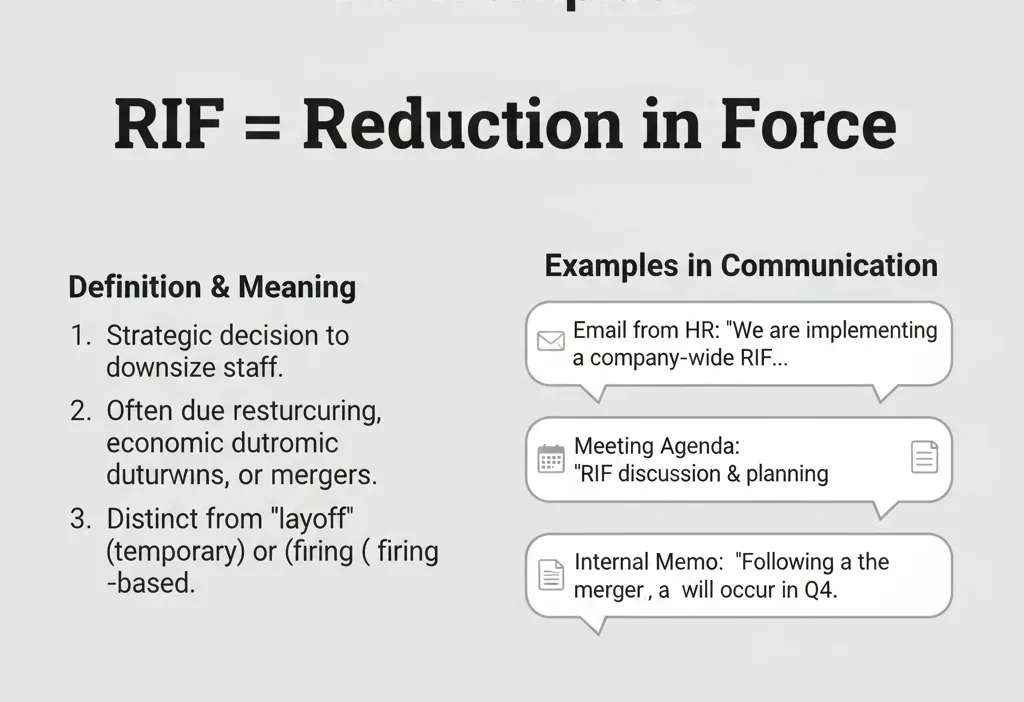
RIF stands for “Reduction in Force.”
It’s a business abbreviation used to describe a permanent workforce reduction, typically when a company eliminates certain positions to cut costs or restructure operations.
In simple terms, a RIF means job cuts, often due to financial challenges or organizational changes.
Origin and Popularity
The term “Reduction in Force” has been used in the corporate and government sectors since the mid-20th century, particularly in the United States. It originated as a formal, bureaucratic phrase to describe layoffs in a less emotional, more administrative tone.
- 1950s–1980s: The U.S. government and large corporations began using “RIF” in official HR documents.
- 2000s–2020s: The abbreviation became common in business news, HR memos, and LinkedIn discussions.
- Today: “RIF” is widely recognized as a polite, professional term for layoffs or downsizing.
💡 Fun Fact: Some companies use “RIF” instead of “layoff” because it sounds less harsh and more strategic.
Lapis Lazuli Meaning: The Hidden Power of the Blue Stone
RIF Meaning in Different Contexts
While “RIF” mostly appears in business and HR conversations, its tone and implication can vary depending on where it’s used.
1. In Business and HR
- Refers to the permanent elimination of positions.
- Usually involves organizational restructuring or budget reductions.
- Example: “The company announced a RIF to align its workforce with new strategic goals.”
2. In Government
- A formal HR process, often guided by strict rules or seniority.
- Example: “Federal employees affected by the RIF will receive placement assistance.”
3. In Casual or News Conversations
- Used as shorthand when discussing layoffs.
- Example: “Tech firms are facing another round of RIFs this quarter.”
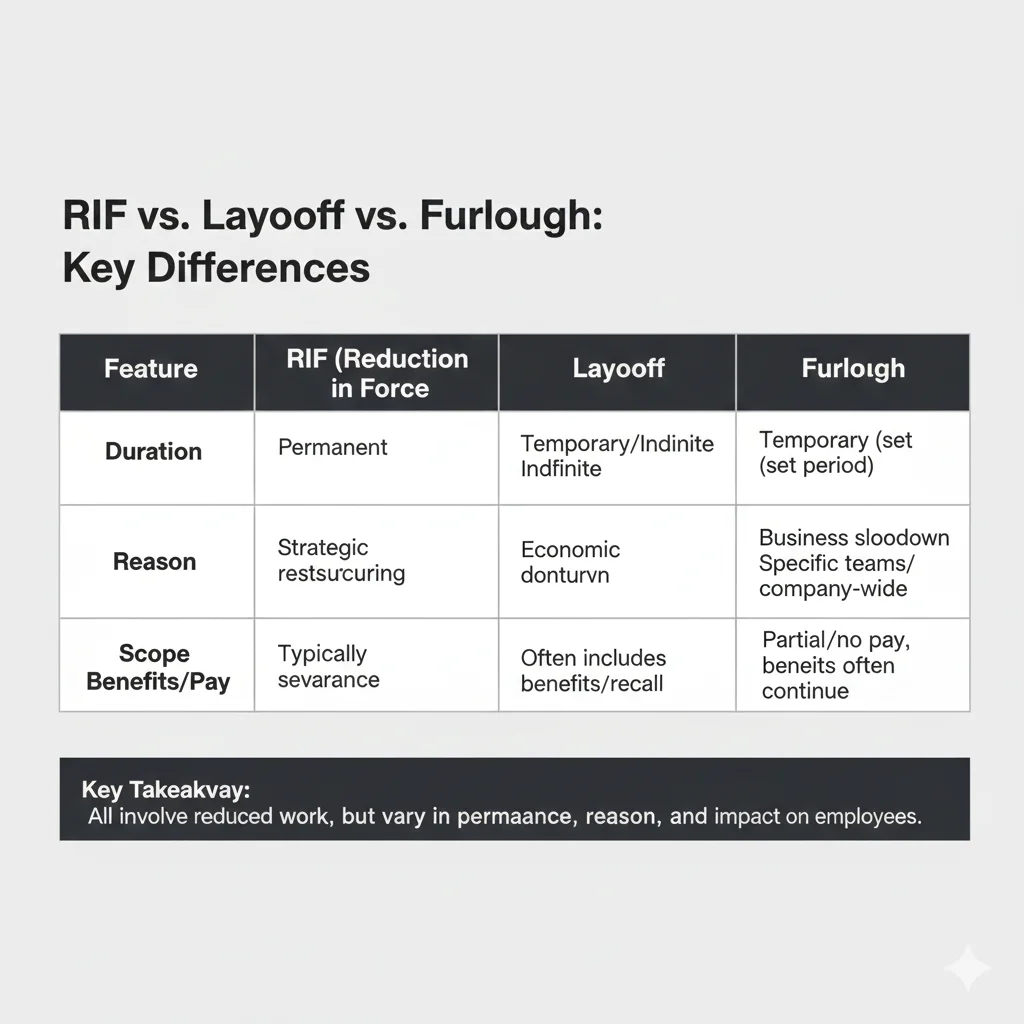
A simple table comparing “RIF,” “Layoff,” and “Furlough.”
| Term | Meaning | Duration | Context |
| RIF | Reduction in Force (permanent job cut) | Permanent | HR/Corporate |
| Layoff | Temporary or permanent job cut | Often temporary | General |
| Furlough | Unpaid leave or temporary suspension | Temporary | Corporate/Government |
Shiesty Meaning: What It Really Means in Street Slang
Examples of RIF in Conversations
💬 Example 1 (Workplace Chat)
Manager: We’ll have a company-wide meeting about the upcoming RIF next week.
Employee: I hope the HR team clarifies how roles will be affected.
💬 Example 2 (News Headline)
“Software giant announces 10% RIF amid restructuring plan.”
💬 Example 3 (Internal Email)
“Due to financial realignment, the company will undergo a limited RIF affecting select departments.”
💬 Example 4 (Casual Discussion)
Colleague 1: Did you hear about the RIF at the marketing team?
Colleague 2: Yeah, a few roles got cut to reduce costs.
Similar or Related Terms
Understanding RIF meaning becomes easier when compared to similar HR terms.
| Term | Definition | Key Difference |
| Layoff | Temporary or permanent job cut due to budget issues | May allow rehiring later |
| Furlough | Temporary unpaid leave | Employee still retains job |
| Downsizing | Reducing workforce size for efficiency | Broader term |
| Termination | Ending employment (for any reason) | Includes voluntary and involuntary |
| Restructuring | Reorganizing teams or roles | May or may not involve a RIF |
How to Use RIF Correctly
✅ Do’s
- Use “RIF” in professional or HR contexts.
- Clarify that it refers to permanent job elimination, not temporary layoffs.
- Use it in formal writing or business discussions.
❌ Don’ts
- Avoid using “RIF” casually with affected employees — it can sound impersonal.
- Don’t confuse it with “furlough” or “temporary layoff.”
- Don’t use it in emotional or personal communications.
Example:
✅ “The company is implementing a small RIF as part of a restructuring plan.”
❌ “I think they’re going to RIF everyone next week!”
Common Mistakes or Misinterpretations
- Confusing RIF with Layoff:
- Layoffs can be temporary; a RIF is usually permanent.
- Layoffs can be temporary; a RIF is usually permanent.
- Assuming RIF Means Firing for Performance:
- A RIF isn’t about poor performance — it’s a strategic or financial decision.
- A RIF isn’t about poor performance — it’s a strategic or financial decision.
- Believing RIFs Only Happen in Big Companies:
- Even small startups may perform a RIF to manage costs.
- Even small startups may perform a RIF to manage costs.
- Using RIF Informally:
- It’s a formal HR term, not slang — so avoid using it in jokes or casual messages.
- It’s a formal HR term, not slang — so avoid using it in jokes or casual messages.
FAQs About RIF Meaning
1. What does RIF mean in business?
RIF stands for “Reduction in Force,” referring to a permanent reduction of staff positions due to restructuring, budget cuts, or strategic realignment.
2. Is RIF the same as a layoff?
Not exactly. A layoff can be temporary or permanent, but a RIF usually means permanent job elimination.
3. How do companies decide who is affected by a RIF?
Typically, HR and leadership teams evaluate roles based on business priorities, redundancy, or performance metrics.
4. How should employees respond if a RIF is announced?
Stay informed, review your severance package, and update your resume and LinkedIn profile for new opportunities.
5. Where is the term RIF most commonly used?
It’s primarily used in corporate HR departments, government agencies, and business journalism.
6. When should you not use the term RIF?
Avoid using “RIF” in casual or emotional discussions — it’s better suited for formal, organizational communication.
Conclusion
To sum it up, RIF meaning stands for “Reduction in Force” — a formal term for permanent job cuts in business or government contexts. While it may sound technical, understanding it helps professionals navigate corporate news and workplace changes confidently.
Now that you know what RIF really means, you’ll never be confused by HR memos or business headlines again! Stay tuned for more clear explanations of modern business and workplace terms.

Jon McGregor is a language and word-meaning expert at Meanovia.com. He specializes in explaining complex words, phrases, and modern language trends in a clear, approachable style. His mission is to help readers quickly grasp the true meaning behind every term, making language learning and understanding effortless and engaging.