
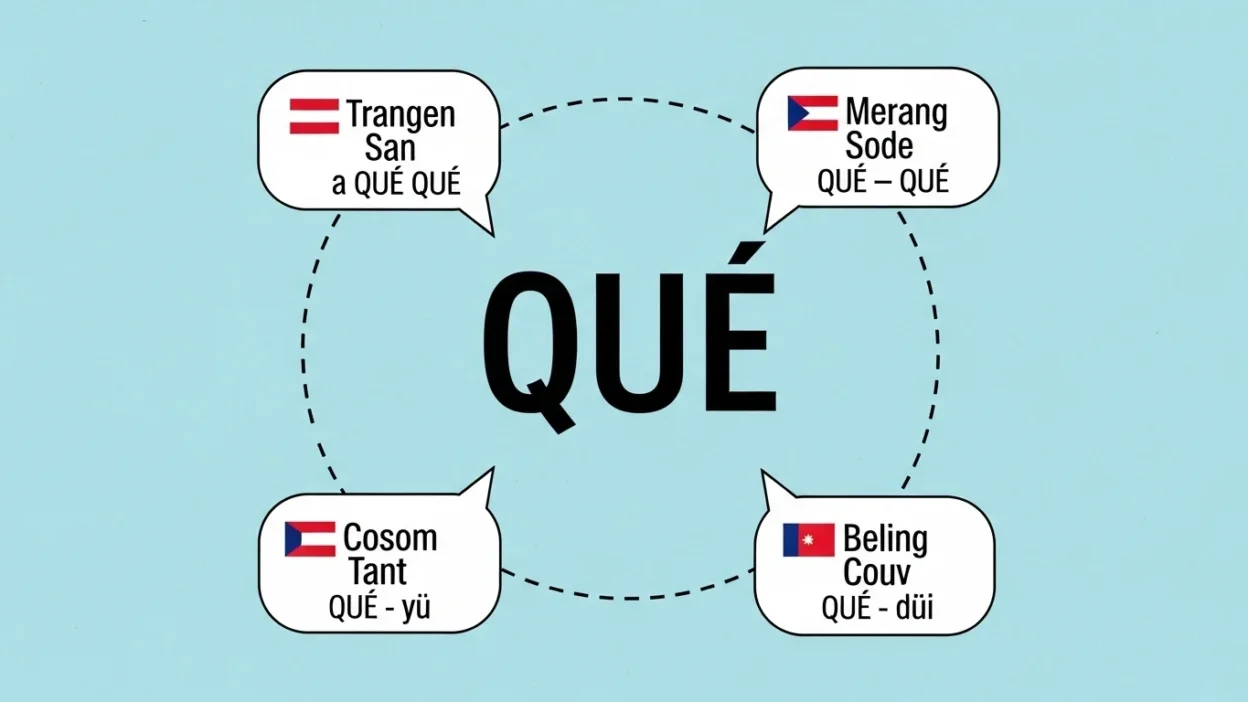
Que is a word used in Spanish, French, and Latin. In Spanish, it usually means “what,” “that,” or “which.” In French, it often means “that” or “what.” In Latin, it can mean “and.” In texting, “que” sometimes means “what?” in a casual way. Its meaning depends on language and context.
🧠 Word Entity Information
Word: Que
Type: Multilingual connector word
Languages: Spanish, French, Latin
Also Used In: Internet slang and chat
Search Intent: Informational (translation, slang meaning, grammar explanation)
Common Contexts: Language learning, texting, memes, songs, grammar rules
Why So Many People Search “Que Meaning”
One day, a student sent me a message that said, “Que?” He was confused. He saw this word in a song, in a Spanish class, and also in a chat message. He asked, “Is que English? Is it slang? Is it Spanish?”
This is why many people search:
- que meaning
- que meaning in English
- que meaning Spanish
- what does que mean in text
- por que meaning
- que lo que meaning
- que meaning slang
- que meaning in chat
The truth is simple: Que is not one simple word. It changes meaning depending on the language.
In this full guide, we will explain every important meaning in very easy English.
2️⃣ Que Meaning in Spanish
Deep Spanish Grammar Mini-Guide: How “Que” Really Works
The word “que” is one of the most important words in Spanish grammar. If someone wants to understand Spanish properly, they must understand how “que” works. It appears in questions, statements, exclamations, and many common phrases.
Let’s break it down step by step in simple English.
1️⃣ “Qué” With an Accent – Used in Questions
When qué has an accent mark (é), it usually means:
- What
- Which
It is used in direct and indirect questions.
Examples:
¿Qué haces?
= What are you doing?
¿Qué quieres comer?
= What do you want to eat?
No sé qué pasa.
= I don’t know what is happening.
👉 Rule: If it asks a question or introduces an indirect question, use qué with an accent.
The accent mark is very important because it changes the meaning.
2️⃣ “Que” Without Accent – Used as a Connector
When there is no accent, “que” usually means:
- That
- Which
It connects two parts of a sentence.
Examples:
El libro que leo es interesante.
= The book that I am reading is interesting.
La casa que compré es grande.
= The house that I bought is big.
In these examples, “que” connects two ideas together. It works like the English word “that.”
3️⃣ “Que” After Verbs
In Spanish, when you say things like:
- I think that…
- I believe that…
- I know that…
You almost always use que.
Examples:
Creo que es verdad.
= I think that it is true.
Sé que estás aquí.
= I know that you are here.
Pienso que es buena idea.
= I believe that it is a good idea.
In these cases, “que” means “that.”
This is one of the most common grammar uses.
4️⃣ “Qué” in Exclamations
When expressing strong emotion, Spanish uses qué with an accent.
Examples:
¡Qué bonito!
= How beautiful!
¡Qué sorpresa!
= What a surprise!
¡Qué interesante!
= How interesting!
Here, “qué” shows emotion like surprise, happiness, or shock.
5️⃣ Very Important Difference: Qué vs Que
This is one of the biggest grammar mistakes learners make.
| Word | Meaning | Example |
|---|---|---|
| Qué | What | ¿Qué haces? |
| Que | That | Sé que vienes |
Example comparison:
No sé qué quieres.
= I don’t know what you want.
Sé que quieres venir.
= I know that you want to come.
One small accent changes everything.
6️⃣ Common Spanish Grammar Phrases With “Que”
There are many fixed phrases using “que.” These are extremely common.
Tener que
Means: Have to
Tengo que estudiar.
= I have to study.
Hay que
Means: One must / It is necessary
Hay que respetar a los demás.
= One must respect others.
Ya que
Means: Since / Because
Ya que estás aquí, ayúdame.
= Since you are here, help me.
Lo que
Means: What / That which
Lo que quiero es paz.
= What I want is peace.
Por qué vs Porque
¿Por qué lloras?
= Why are you crying?
Porque estoy triste.
= Because I am sad.
These forms are very important in Spanish grammar.
🎵 Song & Pop Culture Usage of “Que”
The word “que” appears everywhere in Spanish music, movies, and pop culture.
1️⃣ “Que” in Spanish Songs
Many Spanish songs use “que” because it connects emotions and ideas.
Common song patterns:
- Porque te amo
= Because I love you - Lo que siento
= What I feel - Qué bonito
= How beautiful
Spanish songs often express feelings, so “qué” and “que” appear very often.
2️⃣ “Que” in Famous Song Titles
You will often see “que” in song titles.
Examples of common patterns:
- ¿Qué pasó?
= What happened? - Lo que pasó
= What happened - Por qué
= Why
Because it is such a common word, it appears in many Latin pop, reggaeton, and romantic songs.
3️⃣ “Que” in Reggaeton and Latin Pop
In reggaeton music, artists use “que” naturally in lyrics because it is basic Spanish grammar.
For example:
- “Porque tú me gustas”
= Because I like you - “Lo que tú quieras”
= Whatever you want
Understanding “que” helps you understand Spanish music better.
4️⃣ “Que” in Movies and TV Shows
In Spanish movies and shows, characters use “que” constantly.
Example:
¿Qué quieres?
= What do you want?
Sé que mientes.
= I know that you are lying.
This shows how important this word is in real conversations.
5️⃣ “Que” in Internet Memes
Online, sometimes people use “que?” in a funny way to show confusion.
Example:
Friend 1: I just won 1 million dollars.
Friend 2: Que???
It means “What???” in a dramatic way.
It is playful, informal, and often used for humor.
3️⃣ Por Qué vs Porque vs Por Que vs Porqué
Many learners get confused here.
There are FOUR different versions:
1. ¿Por qué?
Means: Why
Example: ¿Por qué lloras? = Why are you crying?
2. Porque
Means: Because
Example: Porque estoy triste. = Because I am sad.
3. Por que
Means: For which / For that
Less common.
4. Porqué
Means: The reason
Example: No entiendo el porqué. = I do not understand the reason.
Small changes make big differences.
4️⃣ Lo Que Meaning
“Lo que” means:
- what
- that which
Example:
Lo que quiero es paz.
= What I want is peace.
“Lo que” connects ideas.
5️⃣ Que Lo Que Meaning
This is popular in Dominican Spanish.
“Que lo que” means:
- What’s up?
- What’s going on?
Example:
Que lo que bro?
= What’s up bro?
It is informal and friendly.
6️⃣ Tener Que Meaning
“Tener que” means:
- Have to
Example:
Tengo que estudiar.
= I have to study.
It shows responsibility.
7️⃣ Hay Que Meaning
“Hay que” means:
- One must
- It is necessary
Example:
Hay que respetar.
= One must respect.
It talks about general rules.
8️⃣ Ya Que Meaning
“Ya que” means:
- Since
- Because
Example:
Ya que estás aquí.
= Since you are here.
9️⃣ Que Meaning in French
In French, “que” means:
- That
- Which
Example:
Le livre que je lis.
= The book that I read.
🔟 Qu’est-ce que Meaning (French)
“Qu’est-ce que” means:
- What
Example:
Qu’est-ce que tu fais?
= What are you doing?
1️⃣1️⃣ Est-ce que Meaning (French)
“Est-ce que” helps make questions.
Example:
Est-ce que tu manges?
= Do you eat?
1️⃣2️⃣ Que Meaning in Latin
In Latin, “que” means:
- And
Example:
Senatus Populusque Romanus
= The Senate and the People of Rome
Here, “que” connects two words.
1️⃣3️⃣ Que Meaning in English Slang and Text
In English texting, some people use “que” to mean:
- What?
- Huh?
Example:
Friend 1: I won the prize.
Friend 2: Que???
It shows surprise.
Sometimes people write:
Queeee
This shows excitement or confusion.
1️⃣4️⃣ Que Meaning in Chat
In chat apps, “que” is used casually.
Example:
Person 1: I lost my phone.
Person 2: Que??
It is informal and not correct English grammar.
1️⃣5️⃣ What Does Que Mean in English?
If someone asks, “What does que mean in English?”
The answer is:
It depends on language.
Spanish que → what / that
French que → that
Latin que → and
Text slang → what?
Always check context.
1️⃣6️⃣ Example Sentences Using Que
- ¿Qué pasa?
- Que lo que amigo?
- Tengo que dormir.
- Hay que trabajar.
- Lo que necesito es amor.
- Ya que viniste.
- Que sorpresa!
- Que calor!
- Que frío!
- Que miedo!
- Que bonito!
- Que interesante!
- Que problema!
- Que historia!
- Que talento!
- Que emoción!
- Que aventura!
- Que noticia!
- Que sueño!
- Que desastre!
Formal vs Informal Use
| Informal | Formal Equivalent |
|---|---|
| Que? | What? |
| Que lo que | What’s up |
| Por qué | Why |
| Porque | Because |
Use formal English in school and office.
When Not to Use “Que”
Do not use “que” in:
- English exams
- Business emails
- Formal writing
Use full English words instead.
Comparison Table
| Language | Meaning |
|---|---|
| Spanish | What / That |
| French | That |
| Latin | And |
| Slang | What? |
FAQ Section
What does que mean?
It means what or that depending on language.
Is que English?
No, it comes from Spanish and French.
What does por qué mean?
It means why.
Is que slang?
Sometimes in texting.
Final Conclusion
“Que” is a small word but very powerful. It is used in Spanish, French, Latin, and internet slang. Its meaning changes with accent, language, and context. Always check where it is used before deciding its meaning.
Learning multilingual words like “que” helps you understand global communication better.

Evie Wyld is a word-meaning specialist at Meanovia.com. She simplifies complex words, phrases, and language trends, helping readers quickly grasp the exact meaning behind every term in a clear and approachable way.


