
Ever read someone say, “That’s not pertinent to the discussion,” and paused for a second — what does pertinent actually mean? You’re not alone. The term “pertinent” is often used in conversations, writing, and professional contexts, but its meaning goes beyond just “relevant.”
In simple terms, pertinent means something that is directly related or applicable to a particular matter.
In this article, we’ll explore:
- The definition of “pertinent”
- Its origin and evolution
- How it’s used in different contexts (everyday, academic, and business)
- Real-world examples
- Similar terms and FAQs
📖 What Does Pertinent Mean?
Pertinent means relevant or directly related to the subject being discussed or considered.
It’s a formal English adjective often used in writing, academic, and business communication.
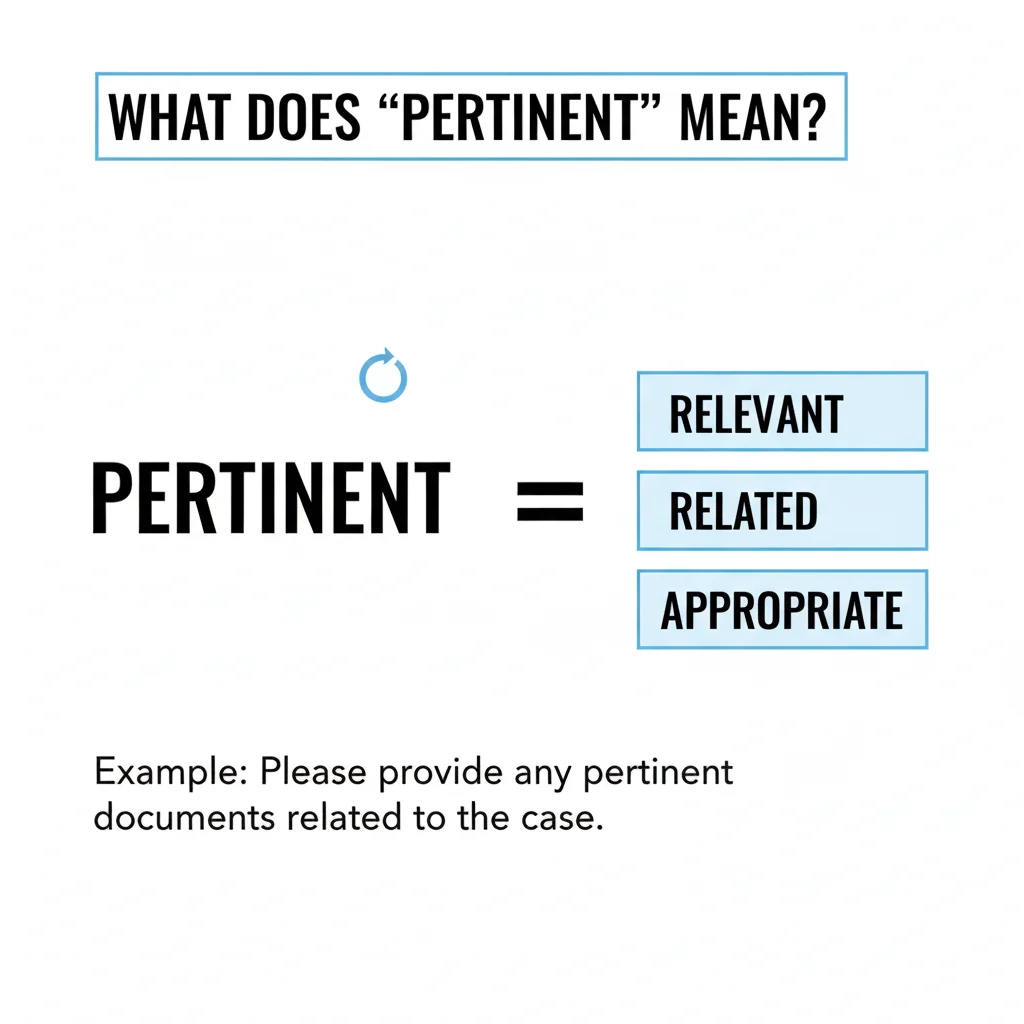
🪶 Example (Featured Snippet Optimized Definition):
“Pertinent” means clearly connected or applicable to a specific topic or situation — something that has a direct bearing on what’s being discussed.
🕰️ Origin and Popularity
The word pertinent originates from the Latin word pertinēre, which means “to relate to” or “to belong.”
It entered Middle English through Old French (pertinent) around the 14th century, used mainly in legal and academic contexts to describe something “relevant to the case or subject.”
Quick Timeline:
| Era | Language | Meaning |
|---|---|---|
| 1300s | Latin (pertinere) | To relate, to belong |
| 1400s | Old French (pertinent) | Appropriate or related |
| 1500s | English Usage | Directly related or applicable |
Over time, it became a staple in formal English, especially in law, academia, and business writing, where precision and relevance are essential.
💬 Pertinent Meaning in Different Contexts
The meaning of pertinent can slightly vary depending on the context in which it’s used. Here’s how it’s typically interpreted:
🗣️ In Everyday English
Used to describe something that’s relevant or important to a topic.
“Her question was quite pertinent to the issue we were discussing.”
💼 In Business or Legal Contexts
Used for information or evidence that directly supports a case or decision.
“Only submit documents pertinent to the investigation.”
🎓 In Academic Writing
Refers to relevant data, research, or arguments that contribute meaningfully to a study or paper.
“The researcher included only the most pertinent sources in the literature review.”
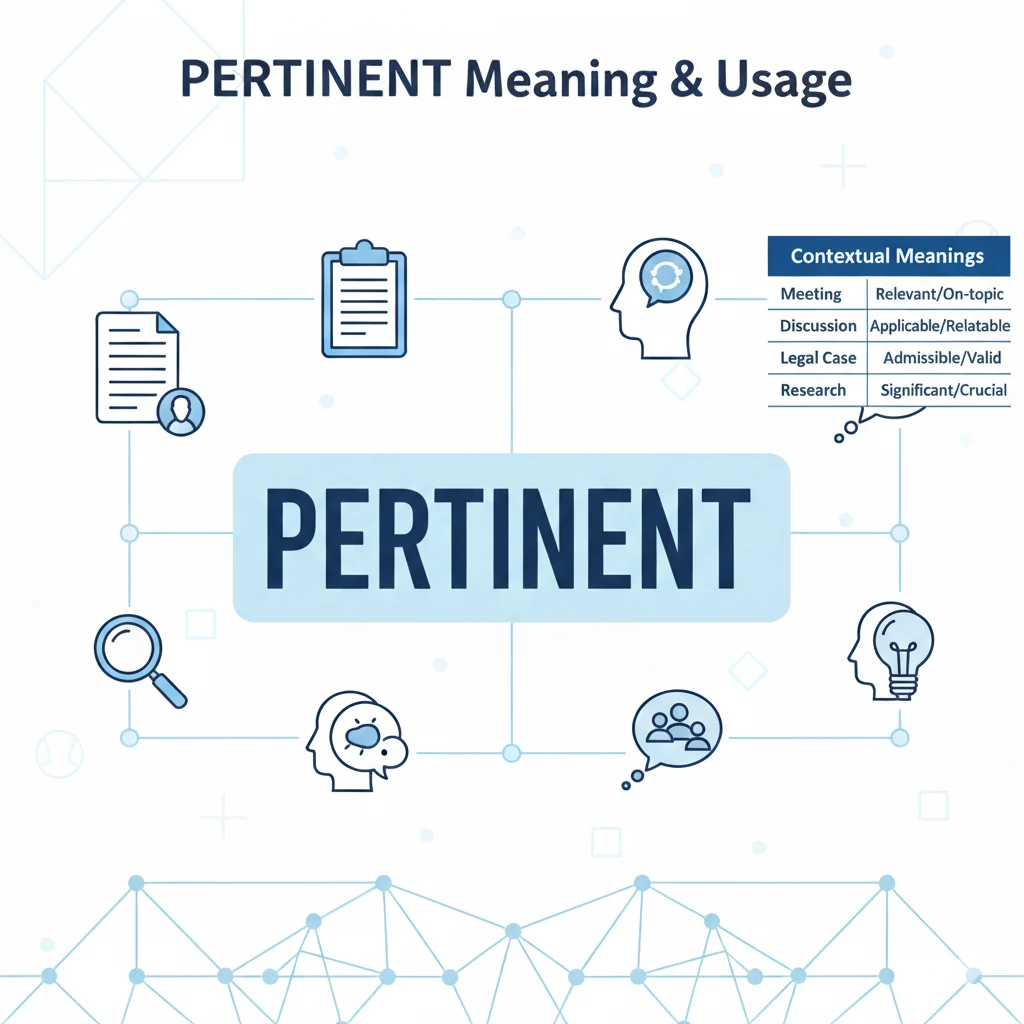
| Context | Meaning | Example |
|---|---|---|
| Everyday | Related or connected | “That comment was not pertinent.” |
| Business | Relevant to a goal or issue | “Share only pertinent details in meetings.” |
| Academic | Supporting evidence | “The study includes pertinent findings.” |
🧾 Examples of “Pertinent” in Sentences
Here are a few realistic examples showing how pertinent is used in conversation or writing:
🗣️ Conversation Example:
Alex: “Should I include this personal story in my report?”
Maya: “Only if it’s pertinent to your main point.”
🧑💼 Business Example:
“The manager emphasized sharing only pertinent updates during the meeting.”
🎓 Academic Example:
“The article provides pertinent insights into climate policy.”
📰 Formal Writing Example:
“The journalist excluded details not pertinent to the investigation.”
🔄 Similar or Related Terms
Here are some words closely related to pertinent, useful for boosting your vocabulary (and SEO relevance!):
| Term | Meaning | Difference |
|---|---|---|
| Relevant | Closely connected | Most common synonym |
| Appropriate | Suitable for a purpose | Focuses on suitability, not connection |
| Apropos | At the right time; relevant | Slightly more casual or literary |
| Applicable | Can be applied to a case | More action-based usage |
| Connected | Linked to something | Broader and less formal |
✅ How to Use “Pertinent” Correctly
Do’s:
✅ Use “pertinent” when describing relevance, importance, or direct relation.
✅ Ideal for formal writing such as essays, business reports, or legal documents.
✅ Pair with nouns like information, question, comment, evidence, or details.
Don’ts:
❌ Avoid using it in casual texting — it can sound overly formal.
❌ Don’t confuse it with impertinent, which actually means rude or irrelevant.
Example Usage:
✅ “Please include only pertinent details in your summary.”
❌ “That was a pertinent joke!” (Incorrect – jokes aren’t usually described as pertinent.)
⚠️ Common Mistakes or Misinterpretations
Many people confuse pertinent with impertinent — even though they sound similar, their meanings are opposite.
- Pertinent = relevant, appropriate
- Impertinent = rude, disrespectful, or irrelevant
🔹 Example:
“She asked a pertinent question about the topic.” ✅
“She asked an impertinent question about his salary.” ❌ (means rude or intrusive)
Also, pertinent isn’t slang — it’s a formal English word commonly used in academic or professional communication.
❓ FAQ: Pertinent Meaning
1. What does “pertinent” mean in English?
“Pertinent” means relevant or directly related to a particular subject or issue. It’s used to describe information or actions that matter to the discussion.
2. Is “pertinent” a formal word?
Yes. “Pertinent” is generally used in formal writing or professional contexts, such as essays, business meetings, or reports.
3. What’s the difference between pertinent and relevant?
They are synonyms, but pertinent sounds more formal and precise, while relevant is more general and commonly used in daily conversation.
4. What is an example of a pertinent statement?
“The lawyer presented only pertinent facts related to the case.”
5. What’s the opposite of pertinent?
The antonyms of “pertinent” include irrelevant, inappropriate, and impertinent.
6. When should I avoid using the word pertinent?
Avoid it in casual texting or informal speech, where simpler terms like relevant or related feel more natural.
🪶 Conclusion
In summary, “pertinent” means something that is relevant, connected, or directly applicable to a given topic or situation. Its origins trace back to Latin, and it remains one of the most precise and respectful ways to express relevance in formal English.
Now that you understand the pertinent meaning, you’ll be able to use it confidently in writing, business, or academia — without mixing it up with “impertinent.” Keep exploring our site for more word meanings and communication tips that make your English shine!

Evie Wyld is a word-meaning specialist at Meanovia.com. She simplifies complex words, phrases, and language trends, helping readers quickly grasp the exact meaning behind every term in a clear and approachable way.