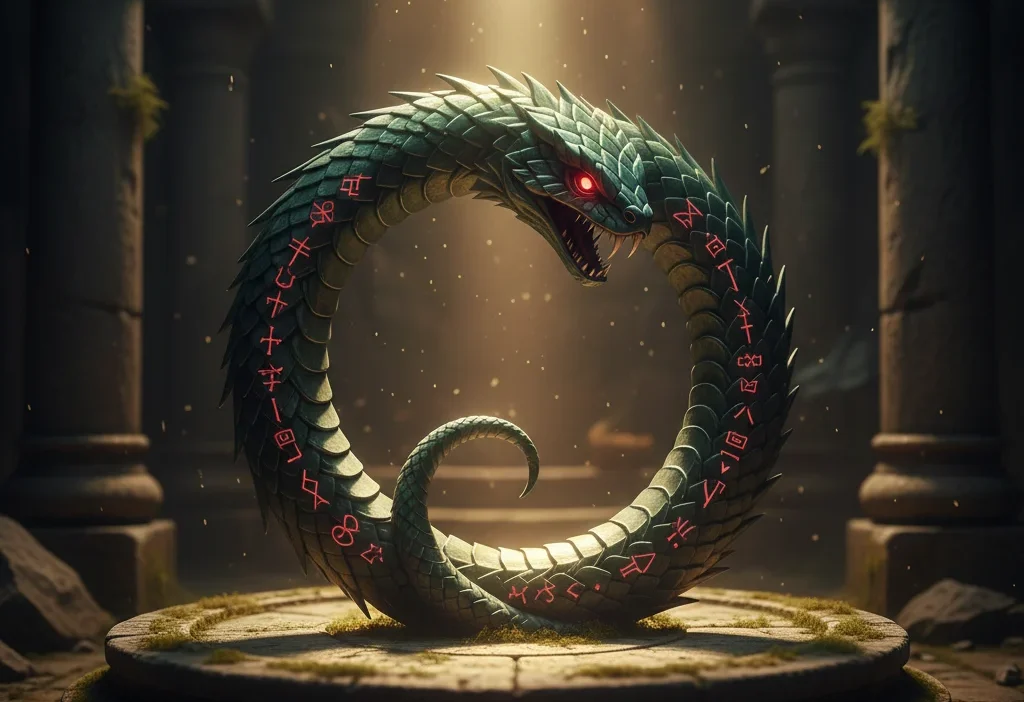
Ever seen a circular snake eating its own tail and wondered what it means? That ancient, mesmerizing symbol is called the Ouroboros — and it’s far more than just a cool tattoo or mystical emblem.
The Ouroboros represents infinity, rebirth, and the eternal cycle of life and death. But its meaning has evolved across cultures, religions, and even pop culture — from ancient Egypt to modern philosophy and movies.
In this guide, you’ll learn:
- What the Ouroboros symbol truly means
- Its deep historical and spiritual origins
- How it’s used today in art, science, and media
- Real-life examples and interpretations
- Common misconceptions and FAQs
🧩 What Does Ouroboros Mean?
Ouroboros (pronounced “or-oh-bor-os”) literally means “tail-eater.”
It depicts a snake or dragon eating its own tail — symbolizing eternity, unity, and the cyclical nature of existence.
The term comes from ancient Greek, where oura means “tail” and boros means “eating.”
You’ll often see it in philosophy, alchemy, religion, and pop culture to express endless renewal or self-sustaining life.
🏺 Origin and Popularity
The Ouroboros is one of the oldest symbols in human history, appearing in multiple ancient civilizations:
- Ancient Egypt (1600 BCE): Found on the tomb of Tutankhamun, where it symbolized the sun’s eternal cycle.
- Greek Philosophy: Adopted by philosophers like Plato to represent the universe’s self-sufficiency.
- Alchemy (Middle Ages): Used to express the cycle of creation and destruction, often paired with the phrase “One is All.”
In modern times, the Ouroboros has become popular in:
- Psychology (Carl Jung): As a symbol of self-reflection and transformation.
- Pop culture: Seen in TV shows, tattoos, literature, and science fiction, often symbolizing infinite loops or rebirth.
🕰️ Timeline example:
1600 BCE – First Egyptian depiction → 400 BCE – Greek adaptation → 1500 CE – Alchemical symbolism → 21st century – Modern media & tattoos.
🌐 Ouroboros Meaning in Different Contexts
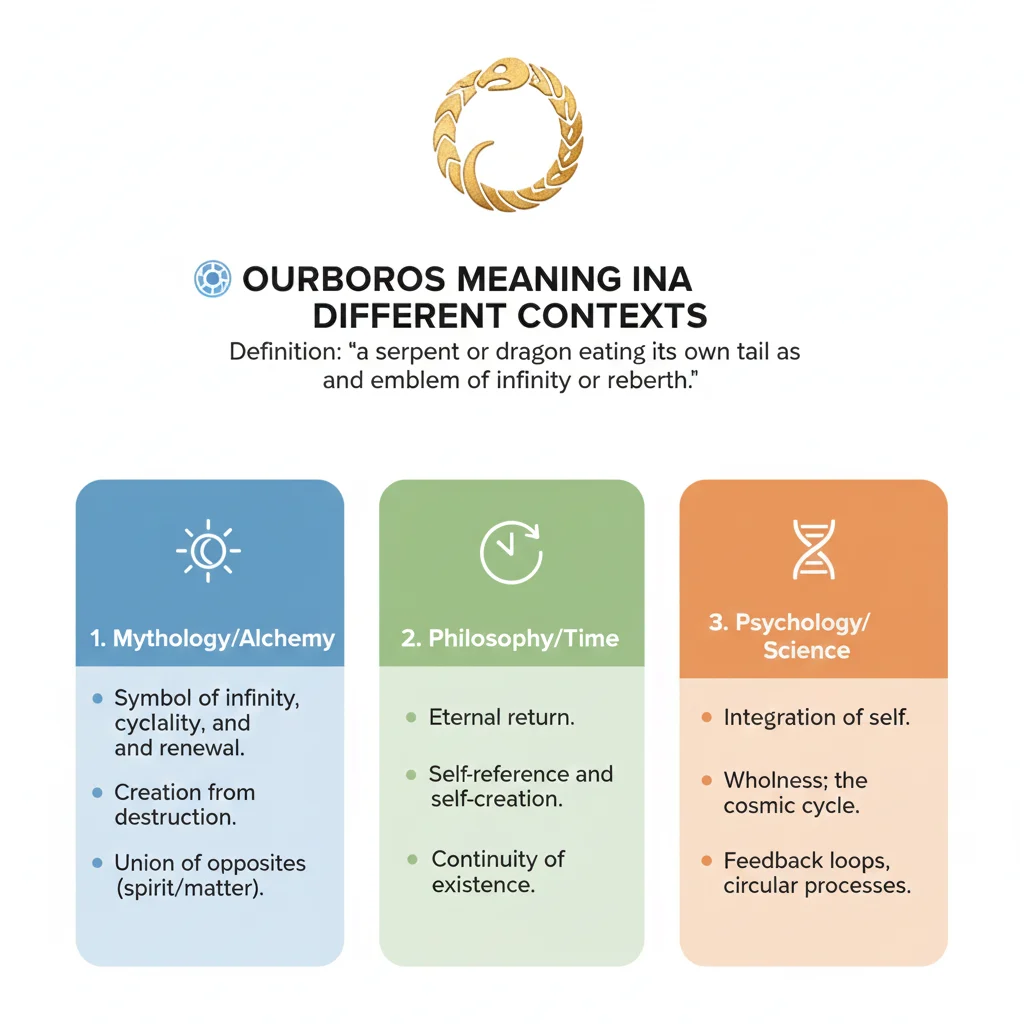
🔮 In Mythology and Religion
Represents eternity, rebirth, and cosmic balance.
- Egyptian mythology: The sun god Ra’s endless journey.
- Norse mythology: Jörmungandr, the world serpent encircling Earth.
🧪 In Alchemy and Science
Symbolizes the cycle of matter and transformation.
- Alchemists used it to represent unity of opposites — creation and destruction.
- In chemistry and physics, it’s used metaphorically for self-sustaining systems.
💭 In Psychology and Philosophy
Carl Jung interpreted the Ouroboros as the process of self-realization, where one must “devour” their past self to grow.
It reflects wholeness, introspection, and transformation.
🎬 In Pop Culture
Appears in films, series, and books:
- Fullmetal Alchemist (anime): The Ouroboros tattoo represents human ambition and moral cycles.
- The NeverEnding Story: Symbol of eternal narrative and imagination.
- Marvel Universe: Linked to immortality and cosmic rebirth.
: Table comparing meanings across fields.
| Context | Symbolism | Example |
| Religion | Eternity & creation | Egyptian and Norse myths |
| Alchemy | Life-death cycle | “All is one” concept |
| Psychology | Self-transformation | Jungian individuation |
| Pop Culture | Infinite story loop | Fullmetal Alchemist |
💬 Examples of Ouroboros in Conversations
Example 1 (Art & Symbolism):
“I got an Ouroboros tattoo to remind myself that every ending is just a new beginning.”
Example 2 (Philosophy):
“The Ouroboros perfectly explains the cycle of existence — destruction and creation are one.”
Example 3 (Pop Culture):
“The Ouroboros in that movie represents time looping endlessly.”
Example 4 (Science Discussion):
“In chemistry, it’s like an Ouroboros — a reaction that sustains itself continuously.”
🔗 Similar or Related Terms
| Term | Meaning | Relation to Ouroboros |
| Infinity Symbol (∞) | Endless continuity | Represents the same concept visually |
| Phoenix | Rebirth from ashes | Shares the renewal aspect |
| Yin & Yang | Duality and balance | Reflects cyclical harmony |
| Möbius Strip | One continuous surface | Mathematical version of infinity |
These related symbols all echo the theme of continuity, unity, and transformation.
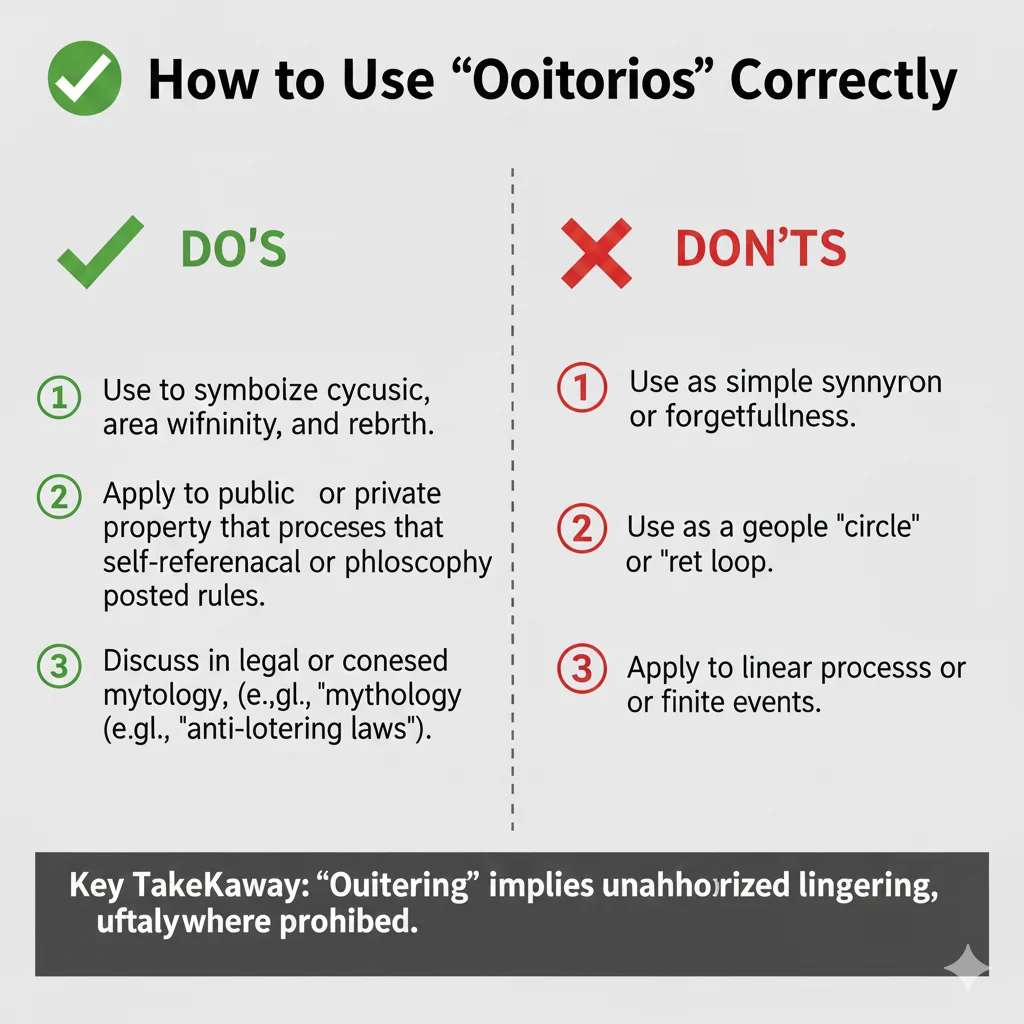
✅ How to Use Ouroboros Correctly
Do’s:
- Use it when discussing cycles, self-renewal, or infinite loops.
- Great for tattoos, spiritual discussions, or art interpretation.
- Can be used metaphorically in writing or conversation.
Don’ts:
- Don’t use it as a casual slang term — it’s symbolic, not conversational.
- Avoid mixing it up with “infinity symbol” unless contextually linked.
💡 Tip: Think of the Ouroboros as the philosophical parent of all cyclical symbols.
⚠️ Common Mistakes or Misinterpretations
- Mistake 1: Thinking it only means “infinity.”
→ Actually, it’s deeper — representing the process of eternal renewal, not just endlessness. - Mistake 2: Confusing it with the infinity symbol (∞).
→ The Ouroboros is alive and transformative, while infinity is mathematical and static. - Mistake 3: Using it out of context in pop culture or spirituality without understanding its depth.
❓ FAQ: Ouroboros Meaning & Usage
1. What does Ouroboros mean in simple terms?
It’s a symbol of a snake eating its own tail, representing life, death, and rebirth — the endless cycle of existence.
2. Is Ouroboros a religious symbol?
Yes, but it spans multiple faiths — Egyptian, Norse, and Gnostic traditions all used it to express divine eternity.
3. What’s the difference between Ouroboros and the infinity symbol?
The infinity symbol (∞) represents mathematical infinity, while the Ouroboros represents living, cyclical transformation.
4. What does the Ouroboros tattoo symbolize?
It often symbolizes personal growth, renewal, and overcoming life’s cycles.
5. Where is the Ouroboros most used today?
In tattoos, art, literature, psychology, and pop culture — especially in fantasy and philosophical media.
6. When should you not use the Ouroboros?
Avoid using it casually or without context — it’s a spiritual and philosophical symbol, not slang or text shorthand.
🌀 Conclusion
The Ouroboros is far more than a mythological snake — it’s a timeless reminder that life moves in cycles. From ancient Egypt to modern philosophy, it symbolizes rebirth, unity, and transformation.
Now that you know what the Ouroboros means, you’ll recognize its presence everywhere — in art, science, stories, and even personal journeys.
So next time you see that serpent forming a perfect circle, remember: the end is always the beginning.