

Ever heard someone say “be objective” or “that’s the objective meaning” and wondered what they actually mean?
This phrase pops up everywhere — from academic essays and business meetings to online debates and everyday conversations. But what does “objective meaning” really refer to?
Objective refers to a goal, purpose, or target someone aims to achieve, or it can describe being unbiased and based on facts rather than opinions.
The word objective is commonly used in education, business, and everyday life, which is why many people search for its meaning. It can describe a specific goal or desired outcome, such as completing a project or achieving a milestone. Alternatively, objective can refer to being impartial, factual, and free from personal bias, often used in reporting, research, or analysis.
Understanding the meaning of objective helps readers and speakers communicate goals clearly, make informed decisions, and maintain fairness. Using the term correctly allows you to express purpose, set measurable targets, and approach situations logically, whether in professional, academic, or personal contexts.
🧩 What Does “Objective Meaning” Mean?
Objective meaning refers to a meaning or interpretation that is based on facts, evidence, and reality — not personal feelings or opinions.
In simple terms, it’s the unbiased, factual meaning of something, independent of how anyone feels about it.
It’s commonly used in academia, journalism, business communication, and logic-based discussions.
📜 Origin and Popularity of “Objective Meaning”
The term “objective” comes from the Latin word objectum, meaning “something presented to the mind.” It began appearing in English during the 14th century, originally in philosophical contexts to describe things existing outside of personal perception.
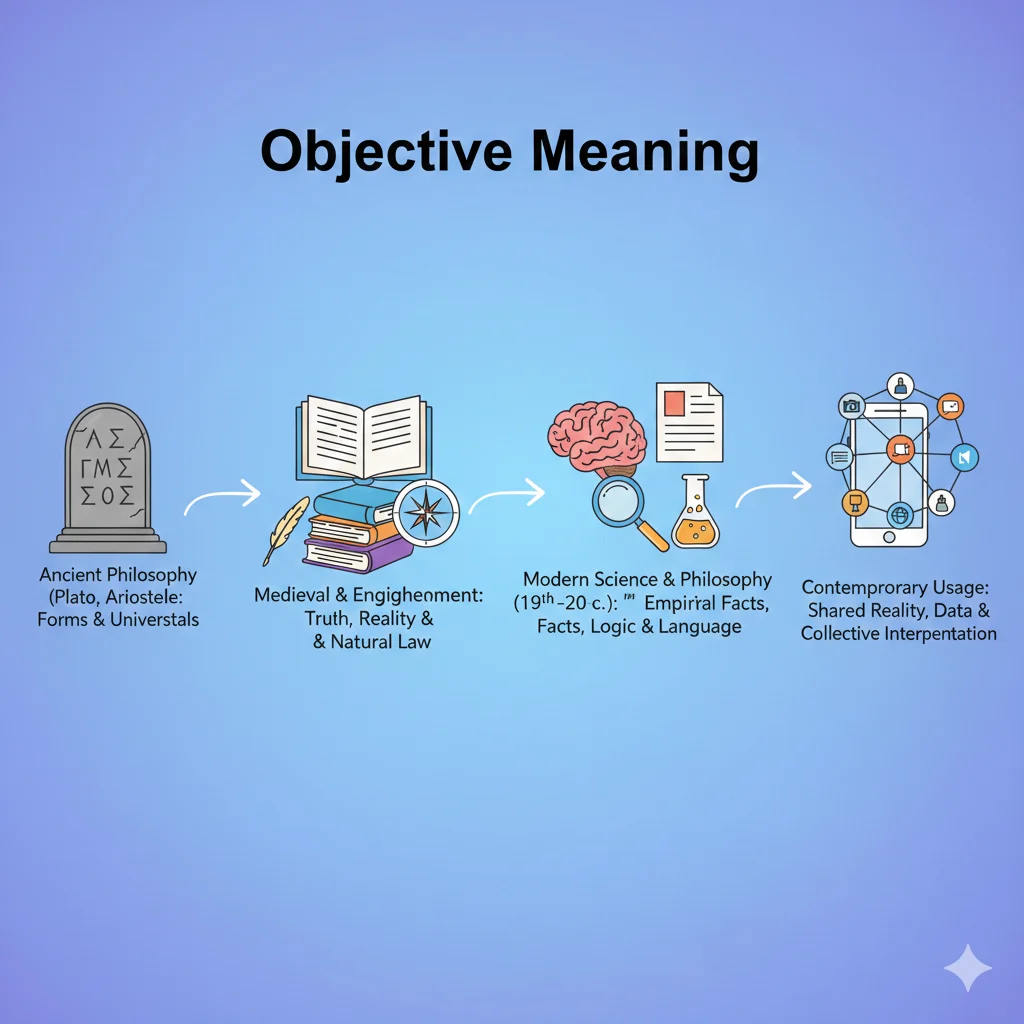
Over time, especially in the 20th century, “objective meaning” gained traction in education, media, and analytical fields — emphasizing neutrality and factual interpretation.
Today, you’ll hear it in settings like:
- Academic writing (“Provide an objective meaning of the poem.”)
- Newsrooms (“We must report with objective meaning.”)
- Business presentations (“Let’s focus on the objective meaning of our data.”)
Essence Meaning: Why It’s More Than Just a Concept
🌐 Objective Meaning in Different Contexts
📝 In Education or Literature
When teachers say “find the objective meaning,” they want you to explain what the text literally means — not your opinion about it.
Example:
“The objective meaning of Shakespeare’s sonnet is about the passage of time, not love or loss.”
🗞️ In Journalism
Reporters aim for objective meaning in stories — presenting facts without bias or emotional spin.
Example:
“The article maintains an objective meaning by sticking to verified data.”
💼 In Business and Professional Settings
Business leaders often emphasize objective meaning when discussing performance metrics or strategies.
Example:
“We should focus on the objective meaning of these results rather than emotional reactions.”

| Context | Objective Meaning | Subjective Meaning |
| Literature | Literal or factual interpretation | Personal feelings or emotional take |
| Journalism | Neutral reporting | Opinion-based commentary |
| Business | Data-driven insight | Gut-feeling or bias |
💬 Examples of “Objective Meaning” in Sentences
Here are a few realistic ways “objective meaning” appears in conversations or writing:
In Academia:
Professor: “Focus on the objective meaning of the text, not what you personally feel about it.”
In the Workplace:
Manager: “Let’s analyze the data for its objective meaning, not assumptions.”
In Daily Use:
Friend 1: “I think this movie is boring.”
Friend 2: “That’s your opinion. The objective meaning of the story is about survival.”
🔍 Similar or Related Terms
To understand “objective meaning” better, here are some related terms and how they compare:
| Term | Definition | Relation |
| Subjective Meaning | Based on personal opinion or emotion | Opposite of objective meaning |
| Literal Meaning | The exact, factual meaning of words | Often overlaps with objective meaning |
| Neutral Interpretation | Analysis without emotional bias | Synonymous in many contexts |
| Analytical Meaning | Derived through logic and reasoning | Similar but often academic |
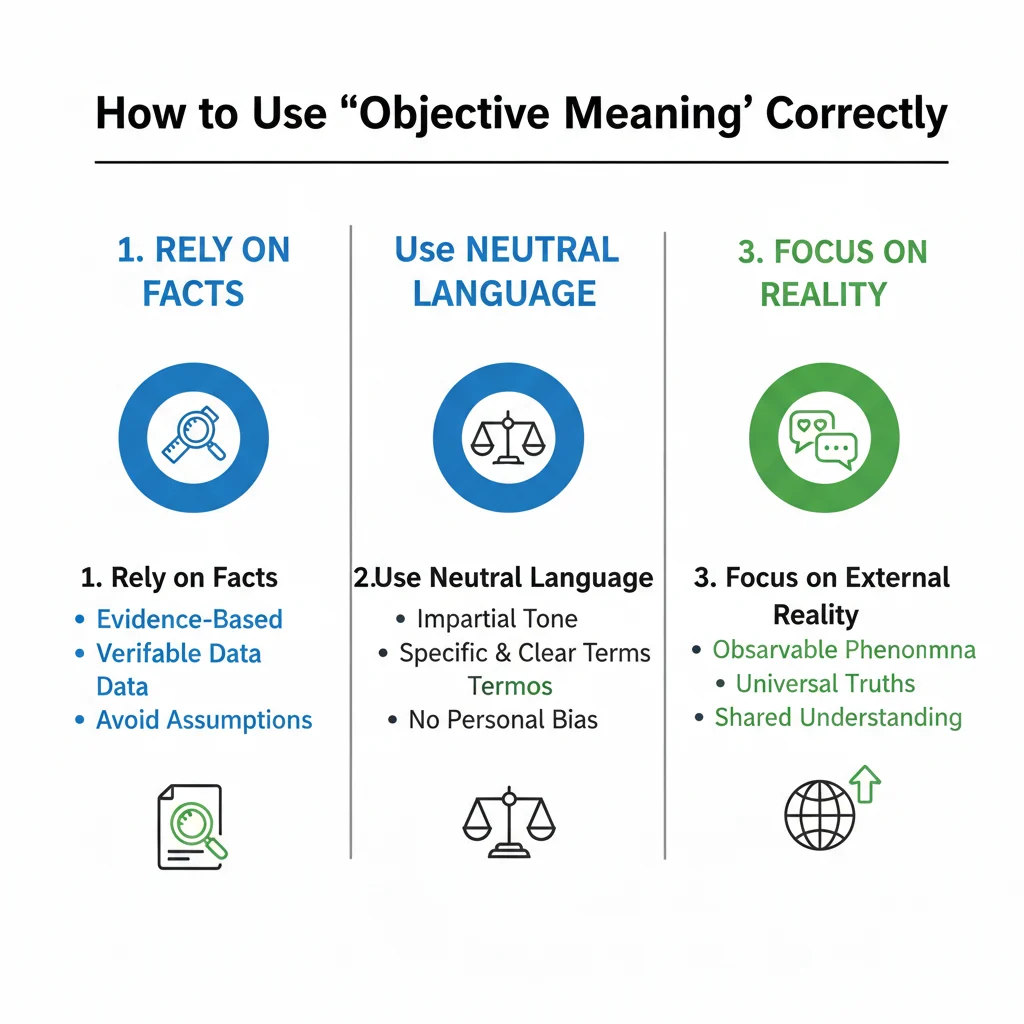
🧠 How to Use “Objective Meaning” Correctly
✅ Do:
- Use it when emphasizing facts, evidence, or neutrality.
- Apply it in essays, reports, and discussions requiring logical interpretation.
- Pair it with analysis or context (“The objective meaning of this data is clear.”)
❌ Don’t:
- Use it for opinions, emotions, or personal views.
- Confuse it with “literal” when interpretation involves deeper analysis.
⚠️ Common Mistakes or Misinterpretations
Many people confuse objective meaning with literal meaning — but there’s a subtle difference.
- Literal meaning = the direct definition of words.
- Objective meaning = the unbiased interpretation based on facts and logic.
Another mistake: thinking “objective” means “emotionless.”
It doesn’t remove feeling entirely — it just separates facts from opinions for clarity.
❓FAQs
1. What does “objective meaning” mean in simple terms?
It means understanding something based on facts and evidence, not personal feelings. It’s about seeing things as they are, not how we wish them to be.
2. Is “objective meaning” the same as “literal meaning”?
Not exactly. The literal meaning is the word-for-word definition, while the objective meaning considers factual context without bias.
3. What’s the difference between objective and subjective meaning?
Objective meaning = factual and unbiased.
Subjective meaning = emotional or personal interpretation.
4. How do I use “objective meaning” in a sentence?
Example: “In research, it’s essential to interpret data based on its objective meaning.”
5. Where is “objective meaning” most used?
It’s commonly used in academia, journalism, law, and business — any field where accuracy and fairness matter.
6. When should you avoid using “objective meaning”?
Avoid it when discussing personal beliefs, emotions, or creative interpretations, where subjectivity is more appropriate.
🧭 Conclusion
The objective meaning of something is its factual, unbiased interpretation, free from personal opinions or emotions. It helps ensure clarity, fairness, and understanding — whether in writing, business, or daily communication.
Now that you know what “objective meaning” truly stands for, you’ll recognize it everywhere — from classrooms to news reports. Keep exploring our site for more insights into language, terms, and meanings that shape everyday conversations.

Jon McGregor is a language and word-meaning expert at Meanovia.com. He specializes in explaining complex words, phrases, and modern language trends in a clear, approachable style. His mission is to help readers quickly grasp the true meaning behind every term, making language learning and understanding effortless and engaging.