
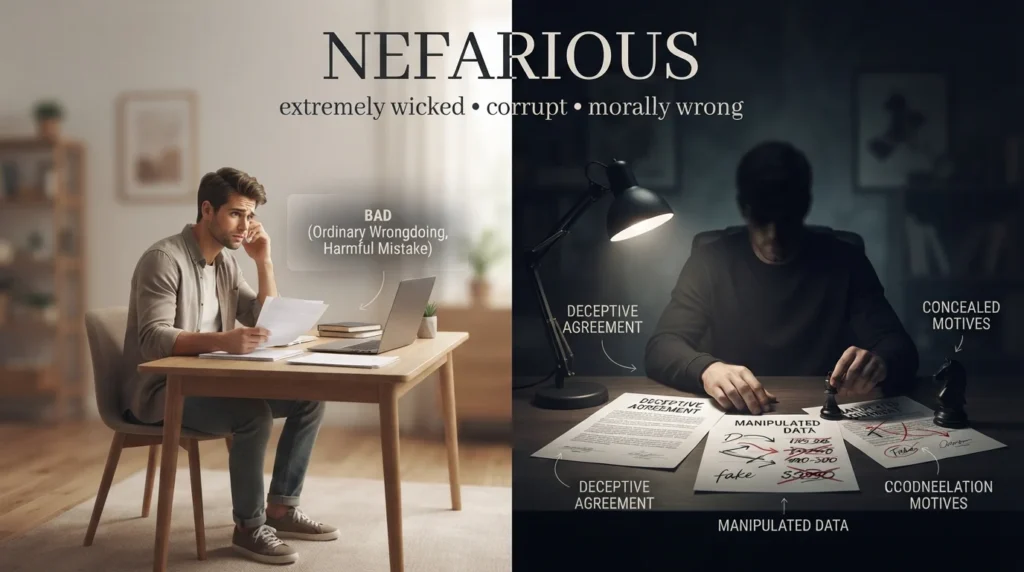
What does “nefarious” mean, and how is it different from simply calling something “bad”? Nefarious means wicked, evil, or seriously immoral, and it is usually used for actions, plans, or activities that are deliberately wrong or harmful.
Unlike the broad word “bad,” nefarious carries a much stronger sense of serious wrongdoing, corruption, or villainy. You may see it in phrases such as “nefarious activities,” “nefarious schemes,” and “nefarious plot,” especially when describing criminal, dishonest, or morally corrupt behavior.
The word can also be used humorously when someone describes an ordinary mischievous act in an exaggerated, villain-like way—for example, calling a plan to secretly eat the last piece of cake a “nefarious scheme.” So, depending on the context, nefarious can sound genuinely serious or deliberately playful.
This guide explains what nefarious means, how to use it naturally, where the word comes from, and how it differs from related words such as evil, wicked, malicious, and sinister.
What Does Nefarious Mean?
Nefarious means flagrantly wicked, corrupt, evil, or morally reprehensible.
It is an adjective, meaning it describes a person or thing rather than naming the person or thing itself.
Nefarious = extremely wicked or seriously wrong.
For example:
The criminals created a nefarious scheme to deceive their victims.
The word suggests more than ordinary bad behavior. It emphasizes conduct that is seriously immoral, corrupt, or intentionally harmful.
What Does Nefarious Mean in a Person?
When nefarious describes a person, it means that the person is associated with seriously wicked, corrupt, dishonest, or harmful behavior.
The detective suspected that the nefarious businessman was hiding evidence.
Calling someone nefarious is much stronger than calling them rude, unpleasant, or troublesome. In fiction, it is especially common for villains or characters with deliberately evil intentions.
Nefarious Pronunciation
Nefarious is commonly pronounced:
nih-FAIR-ee-us
The American English pronunciation is represented as /nɪˈferiəs/. Pronunciation can vary slightly among English-speaking regions.
The main stress falls on the second syllable:
ne-FAR-i-ous
Nefarious is a formal English word, not slang or profanity.
Its related forms include:
- nefariously — adverb
- nefariousness — noun
Nefarious Origin and Etymology
The word nefarious comes from Latin nefarius, which is derived from nefas, referring to wrongdoing or something contrary to divine or moral law.
Its Latin components are often explained as:
- ne- — not
- fas — right, lawful, or divinely permitted
- nefas — what is contrary to right or divine law
- nefarius — wicked or criminal
- nefarious — extremely wicked or corrupt
English has used nefarious since the 16th century. Merriam-Webster records its first known use as 1567.
This history helps explain the word’s strong moral tone. Nefarious is not simply a fancy synonym for bad; it has long been associated with serious wrongdoing and conduct regarded as morally unacceptable.
What Is Nefarious Behavior?
Nefarious behavior is conduct that is seriously wicked, corrupt, dishonest, harmful, or morally reprehensible.
For example:
The investigation revealed years of nefarious behavior.
The phrase can describe deliberate deception, exploitation, corruption, harmful schemes, or other seriously unethical conduct.
However, nefarious does not automatically mean legally criminal. It is a descriptive word, not the name of a particular offense.
Nefarious Meaning and Sentence Examples
Here are original examples showing how nefarious naturally works in sentences:
- The detective uncovered a nefarious scheme to defraud investors.
- The hackers used the stolen data for nefarious purposes.
- The company was accused of engaging in nefarious business practices.
- The villain developed a nefarious plan to control the kingdom.
- Investigators examined the organization’s nefarious activities.
- She suspected that her business partner had nefarious intentions.
- The journalist exposed the politician’s alleged nefarious dealings.
- The character’s nefarious behavior made him the story’s main antagonist.
A Simple Sentence Pattern
A useful way to use the word is:
nefarious + plan, scheme, purpose, activity, intention, deed, or behavior
For example:
The group created a nefarious plan to manipulate the market.
Common Phrases With Nefarious
Nefarious frequently appears with nouns connected to wrongdoing, including:
- nefarious scheme
- nefarious plan
- nefarious purposes
- nefarious activities
- nefarious intentions
- nefarious deeds
- nefarious behavior
- nefarious dealings
- nefarious means
- nefarious practices
These combinations are particularly common in formal writing, journalism, fiction, and discussions of corruption or wrongdoing.
Nefarious Meaning Synonyms
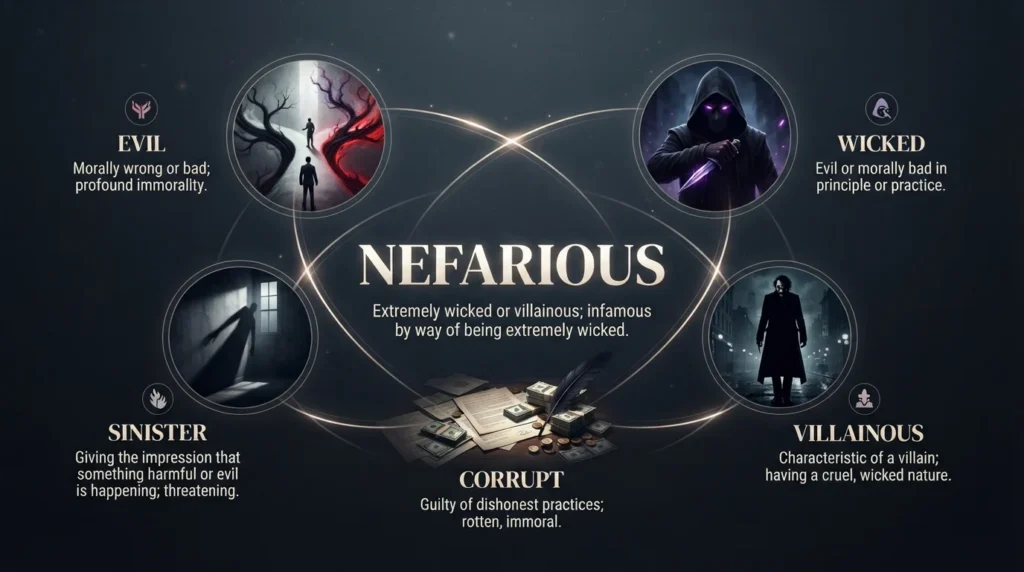
Common nefarious meaning synonyms include:
| Synonym | What it emphasizes |
|---|---|
| Evil | Broad, serious moral wrong |
| Wicked | Morally bad or evil conduct |
| Villainous | Behavior characteristic of a villain |
| Sinister | A threatening or harmful quality |
| Corrupt | Dishonesty or loss of moral integrity |
| Vicious | Cruel, violent, or destructive behavior |
| Vile | Extremely unpleasant or morally despicable |
| Depraved | Seriously morally corrupt behavior |
| Iniquitous | Extreme injustice or wickedness |
What Is the Best Synonym for Nefarious?
There is no single perfect synonym for every sentence.
Wicked and evil are good general alternatives. Villainous works especially well for fictional characters. Corrupt is better when dishonesty or abuse of power is central. Sinister emphasizes a threatening appearance or harmful intention.
For example:
- nefarious scheme → wicked or corrupt scheme
- nefarious villain → evil or villainous character
- nefarious business practices → corrupt or dishonest practices
- nefarious intentions → sinister or harmful intentions
This difference matters because replacing nefarious with a synonym can slightly change the meaning or tone.
Nefarious vs. Evil: What Is the Difference?
Evil is broader and more common, while nefarious is more formal and often emphasizes flagrant wickedness or corruption.
Compare:
The villain is evil.
This gives a broad description of the character.
The villain created a nefarious scheme.
This focuses on the particularly wicked or corrupt nature of the scheme.
So, evil is the wider everyday term, while nefarious often gives writing a more formal, deliberate, and dramatic tone.
Nefarious vs. Villainous vs. Sinister vs. Mischievous
These words overlap, but they are not interchangeable.
- Nefarious: flagrantly wicked, corrupt, or seriously wrong.
- Villainous: characteristic of a villain or evil character.
- Sinister: suggesting danger, evil, or harmful intentions.
- Mischievous: playfully troublesome or mildly naughty.
For example, a child who hides your keys may be mischievous. Calling the child nefarious would normally be humorous exaggeration.
What Does Nefarious Mean in Law?
Nefarious is not a specific legal offense or technical legal classification.
In legal, political, or news writing, it may be used to describe conduct as extremely wicked, corrupt, dishonest, or morally reprehensible.
For example:
The report described the company’s practices as nefarious.
That sentence expresses a strong negative characterization. It does not, by itself, establish that a court has found the company guilty of a particular crime.
This distinction is important: nefarious describes the character of conduct; it does not name a specific criminal charge.
Nefarious Meaning in the Bible and KJV
The nefarious meaning in the Bible is connected with ideas such as wickedness, ungodliness, immorality, and conduct opposed to moral law.
However, there is an important point for anyone searching “nefarious meaning in the Bible KJV.”
The word nefarious does not appear in the King James Version wording of 2 Peter 2:7, a passage sometimes associated with this search. The KJV describes Lot as being troubled by the “filthy conversation of the wicked,” while some modern translations use wording that conveys the idea of nefarious conduct.
Therefore, nefarious should not be presented as a standard KJV vocabulary word. In a biblical discussion, its meaning is best understood as extremely wicked, immoral, or morally corrupt.
Nefarious Meaning in the Bible: Pronunciation
The pronunciation remains:
nih-FAIR-ee-us
The religious context does not change the pronunciation of the English word.
Nefarious Meaning in Urdu
A useful nefarious meaning in Urdu can be expressed with context-based terms such as:
بدکار، شرپسند، بدکردار، یا نہایت بُرا
There is not always a perfect one-word equivalent because the best Urdu choice depends on whether nefarious describes a person, plan, action, or intention.
Nefarious Meaning in Urdu With Example
He was involved in a nefarious scheme.
A natural contextual rendering is:
وہ ایک بدکار اور دھوکہ دہی پر مبنی منصوبے میں ملوث تھا۔
The important idea is serious wrongdoing or corrupt intent, rather than forcing a literal one-word translation.
Nefarious Meaning in Punjabi
In Punjabi, context-based equivalents may include expressions conveying wicked, corrupt, evil, or morally wrong behavior, such as بدکار, ਦੁਸ਼ਟ, or ਬਹੁਤ ਬੁਰਾ, depending on the sentence.
For example:
A nefarious plan can be understood as a very wicked or corrupt plan.
The most natural translation can change according to context.
Nefarious Meaning in Arabic
Possible Arabic equivalents depend on context. For example:
- شرير — wicked or evil
- فاسد — corrupt
- آثم — sinful
A translator would choose the word that best fits the person, action, intention, or behavior being described.

Nefarious Meaning in Bengali, Malayalam, Tamil, Chinese and Farsi
These are useful approximate contextual equivalents, rather than guaranteed one-to-one translations:
| Language | Approximate meaning |
|---|---|
| Bengali | দুষ্ট, জঘন্য, কুকর্মপূর্ণ |
| Malayalam | ദുഷ്ടമായ, അധാർമികമായ |
| Tamil | தீய, கொடிய, அநியாயமான |
| Chinese | 邪恶的, 恶劣的 |
| Farsi | شرور، خبیث، بدکار |
The exact translation should change according to the sentence and intended shade of meaning.
What Does “Moderately Nefarious” Mean?
“Moderately nefarious” is not a separate dictionary definition.
It simply means somewhat wicked, corrupt, or morally questionable.
Because nefarious is already a strong word, the phrase is sometimes used humorously to exaggerate harmless behavior.
My moderately nefarious plan is to eat the last slice of cake.
Here, the speaker is joking rather than accusing someone of serious wrongdoing.
What Does Nefarious Mean in the Movie?
If you searched “nefarious meaning movie,” you may be looking for Nefarious, the title of a 2023 psychological thriller.
The title uses the ordinary meaning of the word: wicked, evil, or morally corrupt.
This creates two different search intents:
- “nefarious meaning” → the English vocabulary word
- “Nefarious movie” → the film
- “nefarious meaning in the Bible” → religious or translation context
Understanding this distinction helps explain why search results for nefarious can vary considerably.
Common Mistakes When Using Nefarious
Mistake 1: Using it for ordinary bad behavior
❌ He forgot his homework, so he is nefarious.
This is normally far too strong unless the speaker is joking.
✅ The company was involved in nefarious business practices.
Mistake 2: Treating nefarious as a noun
Nefarious is an adjective.
❌ The nefarious stole the money.
✅ The nefarious businessman stole the money.
Mistake 3: Assuming nefarious always means criminal
The word can describe seriously immoral or corrupt conduct without functioning as a legal classification.
Mistake 4: Confusing nefarious with mischievous
Mischievous often describes playful trouble. Nefarious suggests much more serious wickedness.
Mistake 5: Treating all synonyms as identical
Evil, sinister, villainous, corrupt, and nefarious overlap, but each has a different emphasis.
Frequently Asked Questions About Nefarious
What does nefarious mean in simple words?
Nefarious means extremely wicked, evil, corrupt, or seriously morally wrong.
What does nefarious mean in a person?
It describes someone associated with serious wickedness, corruption, dishonesty, or harmful intentions.
What is nefarious behavior?
Nefarious behavior is seriously wicked, corrupt, dishonest, harmful, or morally reprehensible conduct.
What is a synonym for a nefarious person?
Depending on context, villain, evildoer, wrongdoer, or corrupt person may express a similar idea. Nefarious itself remains an adjective.
Is nefarious a bad word?
It is a strongly negative formal adjective, but it is not profanity or slang.
Can nefarious be used humorously?
Yes. Speakers sometimes use it jokingly to make harmless behavior sound dramatically evil.
Is nefarious stronger than evil?
Often, nefarious sounds more formal and specifically emphasizes flagrant wickedness or corruption. Evil is broader and more common.
Is nefarious formal or informal?
Nefarious is generally formal. It is common in literature, journalism, essays, formal descriptions, and discussions of wrongdoing.
Final Takeaway
The simplest nefarious meaning is:
Nefarious means flagrantly wicked, corrupt, or morally wrong.
It is a formal adjective used to describe people, plans, schemes, actions, intentions, behavior, activities, and deeds associated with serious wrongdoing.
Remember the difference:
Mischievous → playfully troublesome
Bad → generally wrong
Nefarious → seriously wicked or corrupt
Its Latin roots connect the word with conduct contrary to what is morally or divinely right, which helps explain its unusually strong tone.
So, when you read about a nefarious scheme, nefarious person, or nefarious plan, think beyond ordinary bad behavior. The word signals something deliberately and flagrantly wrong.

Nora Ellison is a digital language writer specializing in emoji meanings, internet slang, symbols, and online communication, creating clear, accurate, and reader-friendly content.