Ever heard someone say “We’ll take an iterative approach” in a meeting or project discussion and wondered what it really means? You’re not alone. The word iterative pops up often in business, software development, education, and design—but its exact meaning can be confusing if you’re new to the term.
In this article, you’ll learn:
✅ The definition of “iterative”
✅ Its origin and evolution
✅ How it’s used in different professional contexts
✅ Examples to clarify its meaning
✅ Related terms and FAQs to expand your understanding
💡 What Does Iterative Mean?
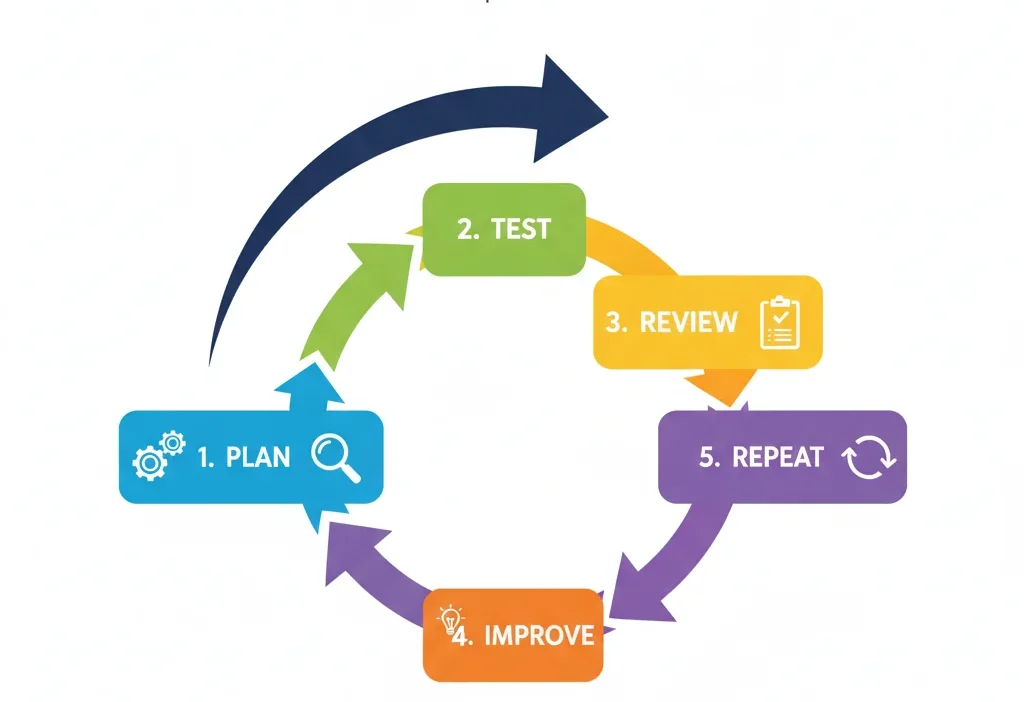
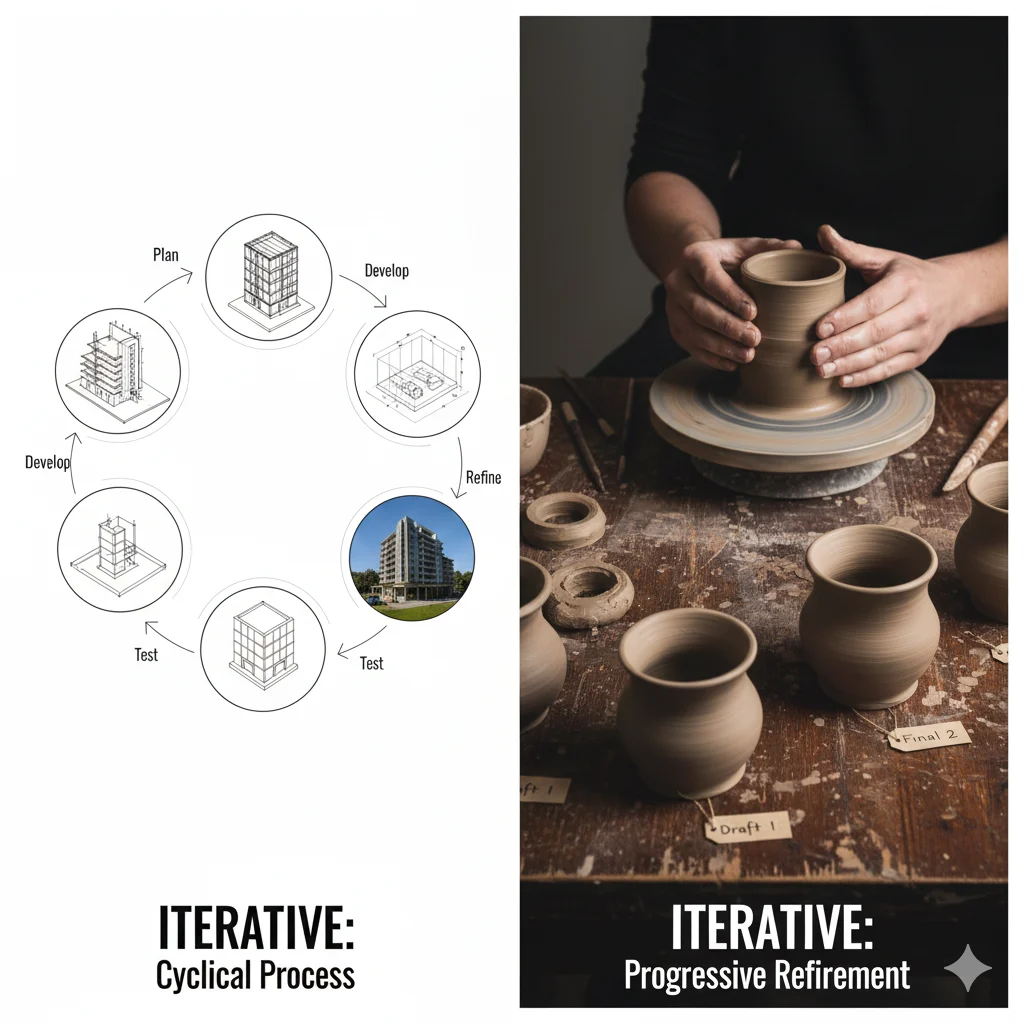
Iterative means repetitive or cyclical — a process that involves repeating steps multiple times to improve a result.
In simple terms, something is iterative when it’s done again and again, each time refining and enhancing the outcome.
It’s not slang or an acronym; it’s a formal term widely used in business, technology, and education.
🕰️ Origin and Popularity
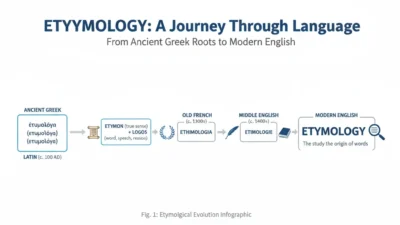
The term “iterative” originates from the Latin word “iterare,” meaning “to repeat.”
It first appeared in the 19th century in mathematics and science, where iterative methods were used to solve complex equations through repeated calculations.
Over time, its meaning expanded beyond math to describe any process of continuous improvement—especially in fields like software development, project management, and product design.
📈 Timeline Snapshot:
- 1800s: Used in mathematics to describe repeated problem-solving methods.
- 1900s: Adopted in computing and engineering.
- 2000s–Present: Popularized by the Agile and Design Thinking movements, emphasizing iteration for innovation.
⚙️ Iterative Meaning in Different Contexts
“Iterative” can take on slightly different shades of meaning depending on where it’s used. Let’s break it down:
🧠 In Business
Refers to a strategy or process that evolves through feedback and testing.
Example: “We’re taking an iterative approach to improve our marketing strategy each quarter.”
💻 In Software Development
Describes repeated cycles of design, testing, and refinement—a key principle of Agile methodology.
Example: “Our app development follows an iterative model—each version is better than the last.”
🎓 In Education or Research
Means learning or experimenting repeatedly to achieve more accurate results.
Example: “Students refined their projects through an iterative learning process.”
| Context | Meaning of Iterative | Example Use |
| Business | Repeated process for improvement | “Iterative strategy meetings refine outcomes.” |
| Software | Cycles of testing and development | “Iterative updates make the app smoother.” |
| Education | Learning through repetition | “Iterative feedback improved their thesis.” |
🗣️ Examples of Iterative in Conversations
Example 1 (Business Context):
Manager: “Let’s not aim for perfection in one go. We’ll use an iterative model to improve step by step.”
Example 2 (Software Development):
Developer: “This is version 2.0 of the app — part of our iterative release plan.”
Example 3 (Research Setting):
Professor: “Your experiment will be iterative — test, analyze, adjust, and repeat.”
Example 4 (Design Thinking):
“Our team works iteratively, building prototypes, testing with users, and refining based on feedback.”
🔍 Similar or Related Terms
Understanding “iterative” is easier when compared to related terms:
| Term | Meaning | Relation to Iterative |
| Incremental | Adding small improvements over time | Often used alongside iterative methods |
| Cyclical | Occurring in regular cycles | Similar, but not always focused on improvement |
| Progressive | Moving forward in stages | Related, but more linear than repetitive |
| Agile | A flexible, iterative project management method | “Iterative” is a core Agile principle |
✅ How to Use “Iterative” Correctly
Do’s:
- ✅ Use it to describe repeated improvement processes.
- ✅ Ideal for professional, academic, and technical settings.
- ✅ Use in sentences about refinement, testing, or ongoing development.
Don’ts:
- ❌ Don’t confuse “iterative” with “repetitive” when there’s no improvement involved.
- ❌ Avoid using it in casual or slang contexts (it’s a formal term).
- ❌ Don’t use it for one-time actions — it implies multiple cycles.
⚠️ Common Mistakes or Misinterpretations
- Mistake: Thinking iterative means doing the same thing over and over without change.
→ Reality: Each iteration should involve learning and improvement. - Mistake: Using iterative interchangeably with “incremental.”
→ Reality: “Iterative” focuses on repetition and refinement, while “incremental” focuses on adding pieces gradually. - Mistake: Believing it applies only to software.
→ Reality: It’s widely used in education, business, research, and design too.
❓ FAQ Section
1. What does iterative mean in business?
It refers to a process of continuous improvement where strategies, products, or projects are refined through repeated cycles of testing and feedback.
2. What is an iterative process example?
Developing a new app, testing it with users, making improvements, and releasing updated versions—each stage builds on the last.
3. What’s the difference between iterative and incremental?
“Iterative” means refining through repetition, while “incremental” means adding parts in small steps. Many modern methods use both.
4. Why is iteration important in project management?
It allows teams to learn from feedback, fix errors early, and adapt quickly, resulting in better outcomes and reduced risks.
5. Is iterative a formal or informal term?
It’s formal and professional, commonly used in workplaces, academic writing, and technical fields.
6. How can I use iterative in a sentence?
Example: “Our company takes an iterative approach to innovation, learning from each project cycle.”
🧭 Conclusion
In essence, “iterative” means a repetitive, improvement-focused process where each cycle builds upon the previous one. It’s a cornerstone concept in business innovation, Agile software development, and creative problem-solving.
By understanding and applying iterative thinking, you can improve projects more efficiently, adapt to feedback faster, and continuously move toward excellence.
🚀 Now that you know what iterative means, you’ll recognize it in every conversation about progress, design, or development. Keep exploring our site for more professional and technical term meanings explained simply!

Patrick Gale is a word-meaning expert at Meanovia.com. He explains complex terms, definitions, and language trends with clarity and precision. His goal is to help readers understand the exact meaning behind every word they search.