
Ever heard someone say, “He’s so insufferable!” and wondered what that really means?
The word “insufferable” pops up in movies, books, and conversations when someone or something is just too annoying or unbearable to deal with.
Insufferable describes someone or something that is extremely annoying, intolerable, or difficult to endure.
The word insufferable is often used in conversations, writing, and social media when someone wants to describe behavior, situations, or people that are hard to tolerate. It goes beyond simple irritation, implying that the person or circumstance causes frustration or discomfort.
Understanding the meaning of insufferable helps readers or speakers express strong disapproval or highlight challenging experiences effectively. It can be applied to attitudes, habits, events, or personalities, making it versatile in communication.
💬 What Does “Insufferable” Mean?
“Insufferable” means extremely annoying, unbearable, or difficult to tolerate.
It’s often used to describe a person’s behavior, attitude, or situation that makes others lose patience — like a know-it-all coworker or a long, boring speech.
👉 Type: Adjective
👉 Common in: Everyday speech, literature, and online discussions
Example:
“He’s insufferable when he talks about his achievements.”
🕰️ Origin and Popularity
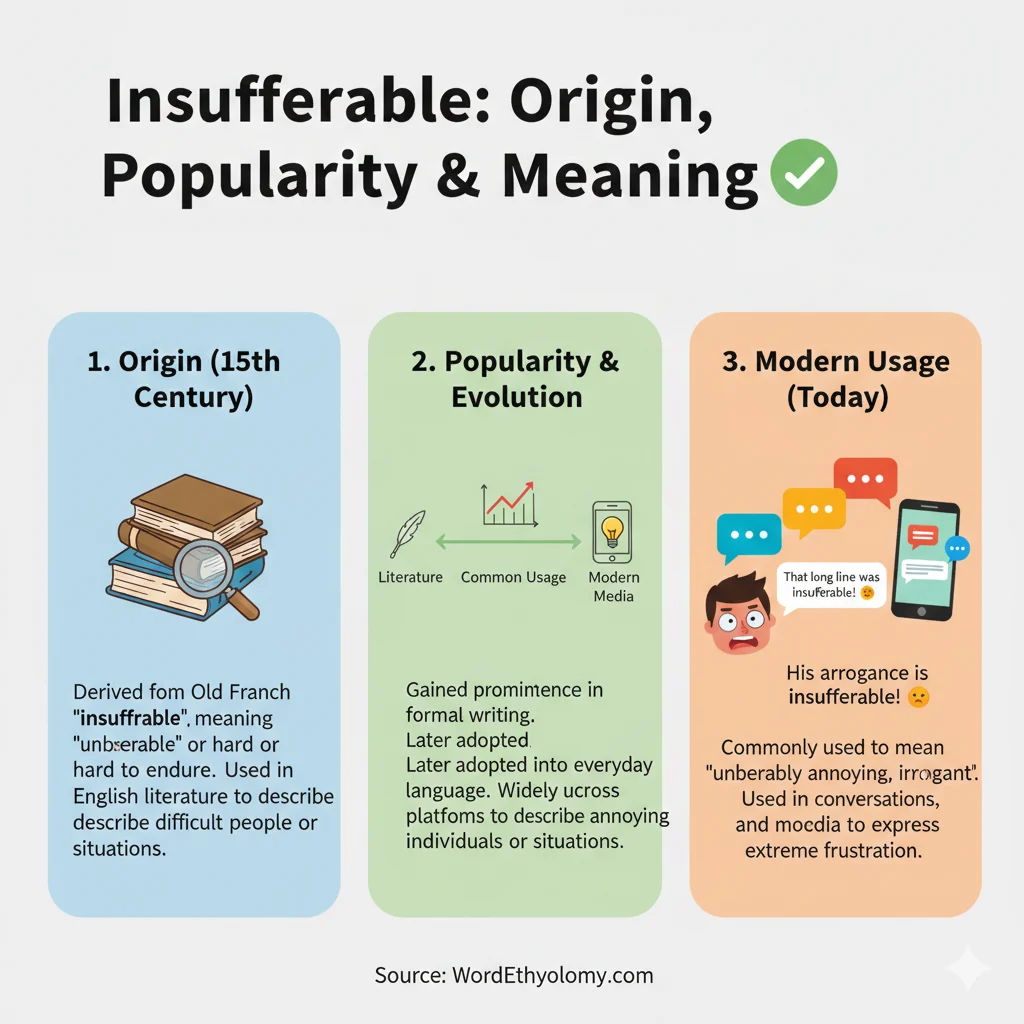
The word “insufferable” has been around since the 14th century, derived from the Latin word insufferabilis, meaning “that cannot be endured.”
It’s made up of:
- in- (not)
- sufferre (to bear or tolerate)
Originally used in older English literature, it became common in modern English to express irritation or frustration in a refined way.
Timeline highlight:
📖 1800s: Common in Victorian-era writing to describe unpleasant people.
📱 2000s–Present: Used in social media captions, tweets, and memes to describe irritating behaviors — e.g., “That influencer’s attitude is insufferable!”
🌐 “Insufferable” Meaning in Different Contexts
Let’s see how “insufferable” is used across various platforms and situations:
| Context | Meaning / Tone | Example |
| In Texting | A dramatic way to say someone is unbearable | “Ugh, he’s being insufferable again.” |
| On Instagram / TikTok | Used sarcastically or humorously | “Me before coffee ☕ = insufferable.” |
| In Business or Formal Writing | Describes intolerable conditions or behavior | “The meeting was insufferable due to endless delays.” |
| In Literature or Reviews | Describes characters or situations that test patience | “The hero’s arrogance made him insufferable.” |
💭 Examples of “Insufferable” in Conversations
Here are a few real-life style examples to help you use it naturally:
Example 1 (Casual Chat):
Friend 1: “Did you see his comment on every post again?”
Friend 2: “Yes, he’s insufferable! Always seeking attention.”
Example 2 (Workplace):
Colleague A: “The meeting lasted three hours!”
Colleague B: “That sounds insufferable.”
Example 3 (Online):
“Twitter after a celebrity breakup: insufferable chaos 😩.”
Example 4 (Formal Context):
“The noise from the construction site was insufferable during the presentation.”
🔄 Similar or Related Terms
To better understand “insufferable,” here are some related words and how they differ:
| Word | Meaning | Usage Example |
| Annoying | Mildly irritating | “That buzzing sound is annoying.” |
| Intolerable | Too bad to bear | “The heat was intolerable.” |
| Obnoxious | Extremely unpleasant or rude | “Her tone was obnoxious.” |
| Arrogant | Overly proud or self-important | “He’s too arrogant for his own good.” |
🪄 Tip: “Insufferable” often combines arrogance + irritation — making it slightly more dramatic and literary than “annoying.”
✅ How to Use “Insufferable” Correctly
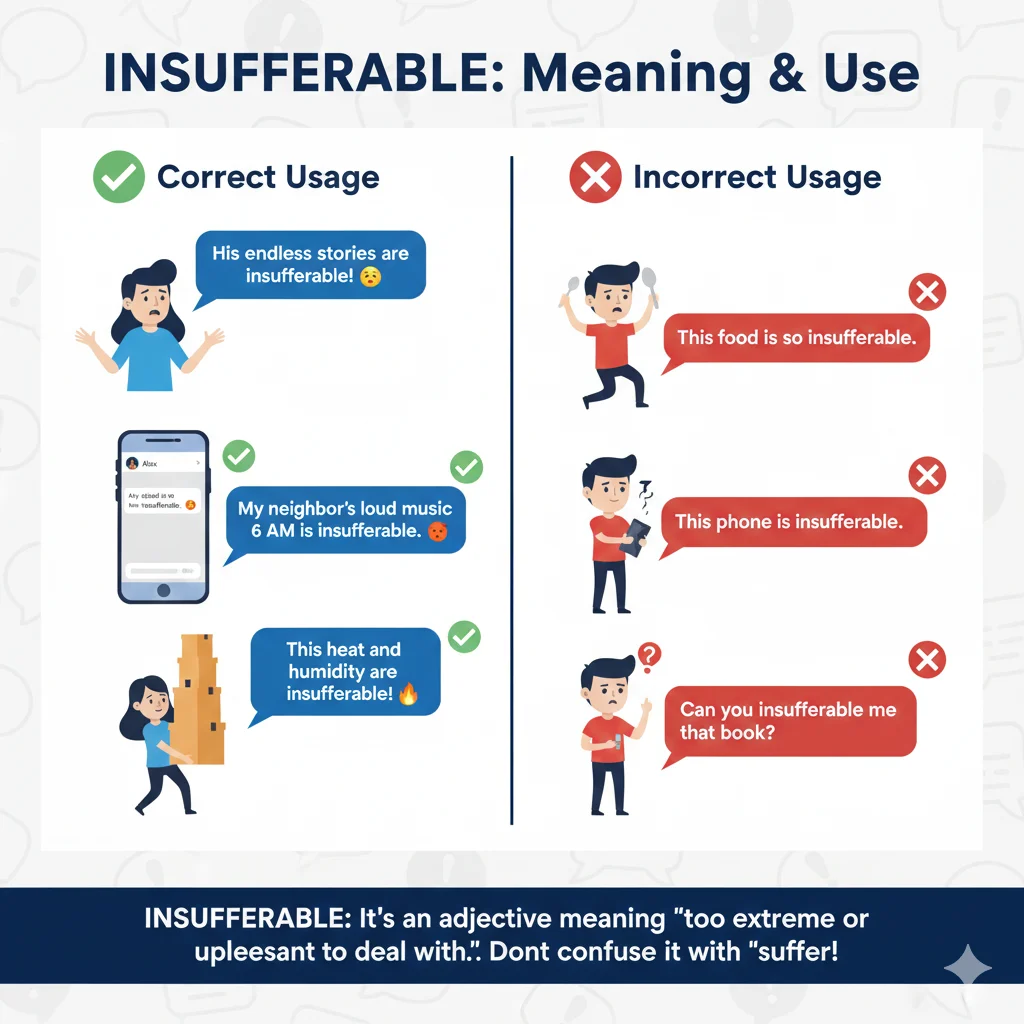
Here’s how to use this word naturally without sounding over-the-top:
Do’s:
✅ Use it when describing extreme annoyance or frustration.
✅ Apply it to people, habits, or situations.
✅ Use it for dramatic or humorous effect in casual conversation.
Don’ts:
❌ Don’t use it for minor inconveniences. (“The weather is insufferable” might sound exaggerated.)
❌ Avoid overusing it — it’s a strong word!
Correct Example:
“Her constant bragging is insufferable.”
Incorrect Example:
“This coffee is insufferable.” (Better: “This coffee tastes bad.”)
⚠️ Common Mistakes or Misinterpretations
Here are a few common misconceptions:
- ❌ “Insufferable” doesn’t mean “suffering.”
→ It describes someone who causes suffering or irritation, not someone in pain. - ❌ Not always negative humor: Some people use it jokingly.
→ “I’m insufferable before my morning latte ☕😂.” - ❌ Don’t confuse with “unbearable.”
→ Both mean difficult to tolerate, but “insufferable” is often used for people or attitudes.
❓ FAQ
1. What does “insufferable” mean in texting?
In texting, “insufferable” means someone is being too annoying or difficult to handle — usually said in a sarcastic or playful tone.
2. Is “insufferable” a bad word?
Not vulgar, but it’s negative. It implies strong disapproval or frustration, especially toward someone’s behavior.
3. What’s the difference between “insufferable” and “intolerable”?
“Insufferable” usually describes people or personalities, while “intolerable” describes situations (like heat or pain).
4. How do you reply if someone calls you insufferable?
If joking: laugh it off (“Haha, I know I’m dramatic 😅”).
If serious: reflect or respond politely (“Sorry, I didn’t mean to come off that way.”)
5. Can you use “insufferable” in a positive way?
Sometimes humorously — “I’m insufferable when I win arguments.” It adds personality to casual speech.
6. Where is “insufferable” most used?
It’s popular in English literature, social media sarcasm, and movie dialogue to express irritation dramatically.
🧩 Conclusion
So, what does “insufferable” mean?
It’s a strong adjective that describes something or someone so annoying or unbearable that you simply can’t stand it.
From old literature to modern memes, “insufferable” has kept its dramatic flair for centuries.
Now that you know how to use it correctly — in texts, captions, or conversations — you’ll never misuse this powerful word again.
✨ Keep exploring our site for more English meanings, slang breakdowns, and real-world language guides.

Jon McGregor is a language and word-meaning expert at Meanovia.com. He specializes in explaining complex words, phrases, and modern language trends in a clear, approachable style. His mission is to help readers quickly grasp the true meaning behind every term, making language learning and understanding effortless and engaging.