
Ever heard someone say, “That’s just an inference,” and wondered what they meant? 🤔
Whether you’re reading a novel, analyzing data, or just figuring out a friend’s tone in a text, you’re making inferences all the time — even if you don’t realize it.
In this guide, we’ll break down what “inference” means, where it comes from, how it’s used in school, science, and daily communication, plus real-life examples to help you understand it like a pro.
🔍 What Does “Inference” Mean?
Inference means drawing a conclusion based on evidence, facts, or reasoning rather than direct statements.
It’s not guessing — it’s reasoned understanding. You infer something when you take clues or data and figure out what they imply.
👉 In simple words: Inference means figuring out something that isn’t directly said or shown.
Type: Academic term / Common English word
Used in: Literature, logic, science, and everyday reasoning
🕰️ Origin and Popularity of the Term “Inference”
The word “inference” comes from the Latin “inferre,” which means to bring in or deduce.
It entered English in the 16th century and became a key concept in logic and philosophy, especially in reasoning and argumentation.
Over time, it became a common word in education, data analysis, linguistics, and communication, showing how humans naturally draw conclusions from information.
📅 Mini Timeline:
- 1500s: Introduced into English from Latin.
- 1800s: Widely used in logic and science.
- Today: Common in schools, research, and even daily conversations.
💬 Inference Meaning in Different Contexts
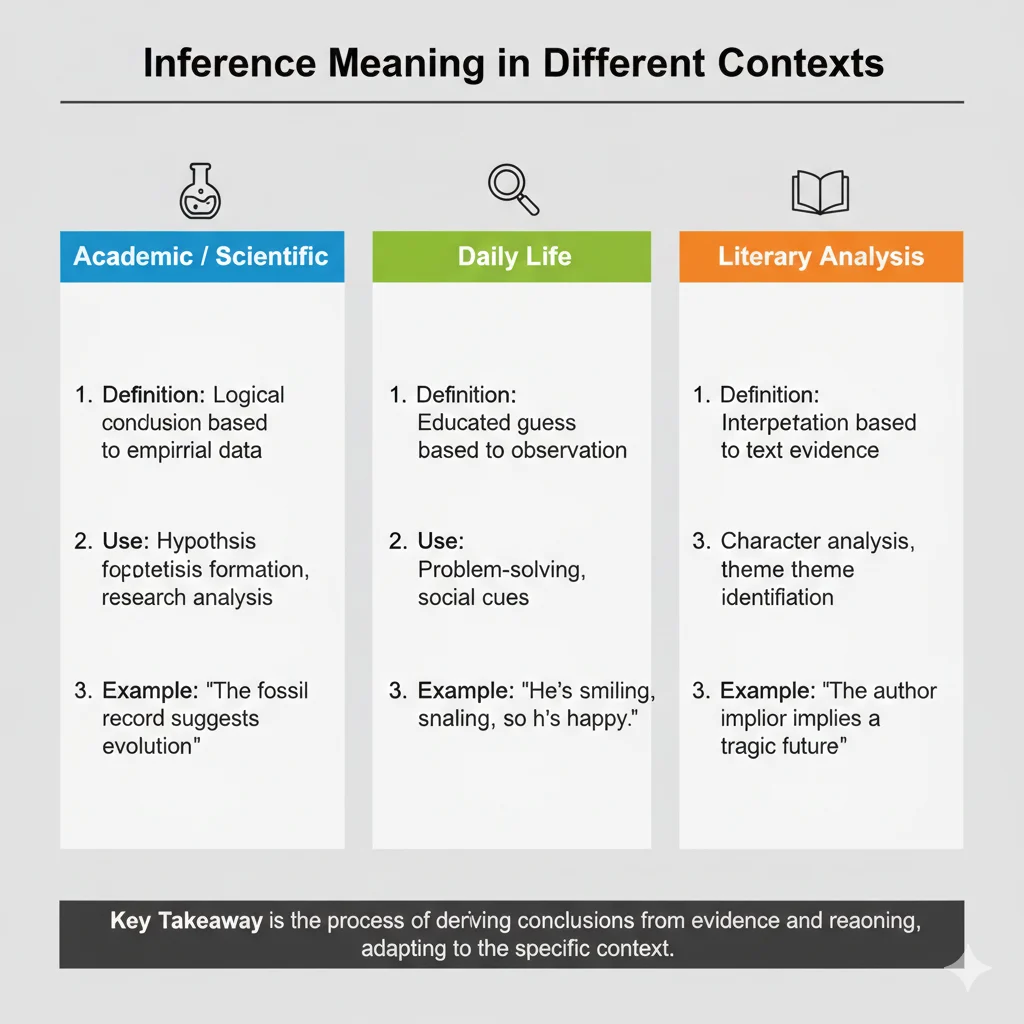
🧩 In Everyday Language
Inference means figuring out what someone means or feels without them saying it directly.
Example: If your friend says, “I’m fine” with a frown, you infer they’re not fine.
📚 In Reading & Literature
Teachers often say, “Make an inference” when you read between the lines.
It’s about understanding hidden meanings or emotions in text.
Example: From “He slammed the door and walked away,” you infer he’s angry — even though it’s not stated.
🔬 In Science & Research
Inferences are conclusions drawn from data or observations.
Scientists use them to explain why something happens based on evidence.
Example: If plants near sunlight grow faster, you infer that light affects plant growth.
💼 In Data & Business Analysis
In business or AI, inference means using data patterns to predict or conclude something — like inferring customer behavior from purchase trends.
| Context | Meaning of Inference | Example |
| Everyday talk | Reading between the lines | “She’s quiet today — I infer she’s upset.” |
| Literature | Understanding implied meaning in text | “The author implies sadness.” |
| Science | Drawing conclusions from experiments | “Light causes faster growth.” |
| Business/Data | Predicting outcomes using data | “AI infers buying habits.” |
💭 Examples of “Inference” in Conversations
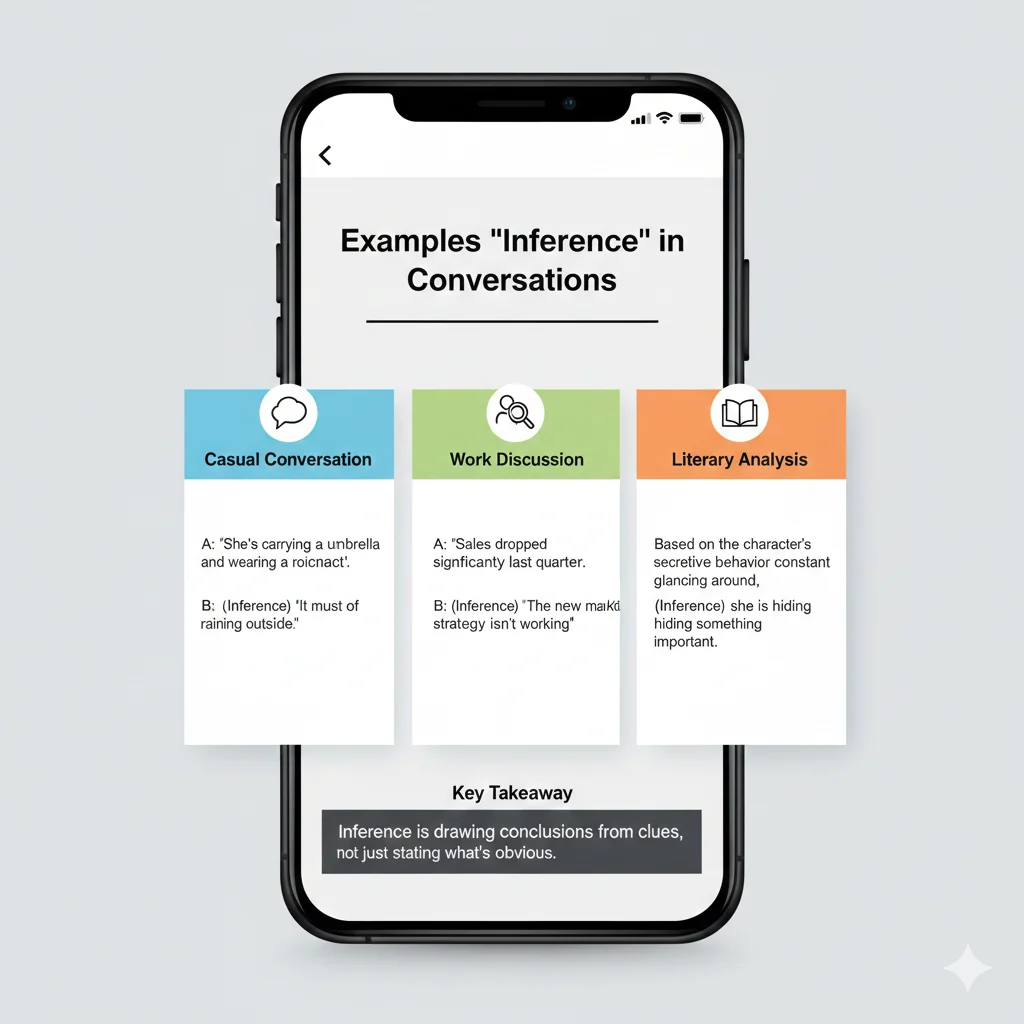
Example 1 – Everyday Life
👩🦰 Sarah: “John didn’t text me back all day.”
👩🧑 Emma: “You can infer he’s probably busy at work.”
Example 2 – In Class
📘 Teacher: “The author describes dark skies and thunder. What can you infer?”
👧 Student: “That something bad is about to happen.”
Example 3 – In Business
🧑💼 Analyst: “Based on last quarter’s data, we infer sales will rise in November.”
🔗 Similar or Related Terms
| Term | Meaning | Difference from Inference |
| Deduction | Logical reasoning from general to specific | All inferences can be deductions, but not all deductions are inferences |
| Assumption | Something taken for granted without proof | Inference uses evidence; assumption doesn’t |
| Prediction | Estimating future outcomes | Inference explains current or past situations |
| Conclusion | The final result of reasoning | Inference leads to a conclusion |
✅ How to Use “Inference” Correctly
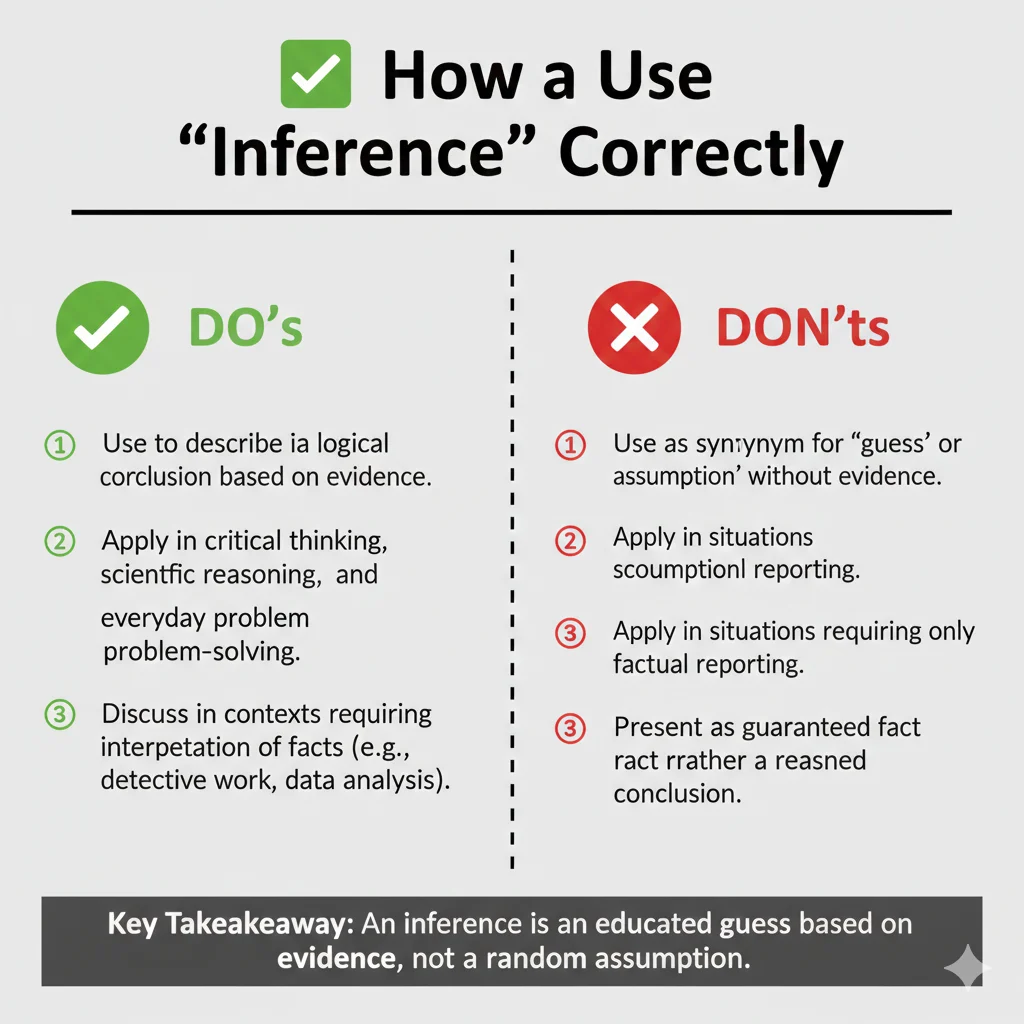
Do’s:
- ✅ Use it to describe conclusions based on facts or context.
- ✅ Say “make an inference” in essays or analyses.
- ✅ Use it when explaining reasoning or understanding hidden meaning.
Don’ts:
- ❌ Don’t confuse it with “assumption.”
- ❌ Don’t use it for pure guesses or speculation.
Correct: “We can infer the author was sad from the tone.”
Incorrect: “I infer aliens exist” (that’s speculation, not inference).
⚠️ Common Mistakes or Misinterpretations
- Confusing inference with assumption:
Inference relies on evidence, while assumption doesn’t. - Thinking inference = guessing:
Guessing lacks logic; inference uses reasoning. - Overlooking context:
The same evidence can lead to different inferences depending on the situation.
❓ FAQ: Inference Meaning Explained
1. What does inference mean in simple terms?
Inference means figuring out something from clues or evidence instead of being told directly.
2. Is inference the same as assumption?
No. An assumption is a belief without proof, while an inference is a conclusion based on evidence.
3. What is an example of inference in daily life?
If someone yawns during a meeting, you might infer they’re tired or bored.
4. How is inference used in reading comprehension?
It’s used to understand implied meanings — like emotions or intentions not stated outright.
5. What’s the difference between inference and conclusion?
An inference is the process of reasoning; a conclusion is the final decision or result of that reasoning.
6. Where is the word inference mostly used?
In academics, science, data analysis, and everyday communication.
🧾 Conclusion
Now you know that inference isn’t just an academic word — it’s something you use daily without noticing.
Whether you’re interpreting a message, analyzing data, or reading a story, making inferences helps you understand the deeper meaning behind information.
So next time someone says, “That’s just an inference,” you’ll know exactly what it means — and how to use it confidently!
✨ Keep exploring our site for more guides on everyday words, slang, and expressions explained clearly

Patrick Gale is a word-meaning expert at Meanovia.com. He explains complex terms, definitions, and language trends with clarity and precision. His goal is to help readers understand the exact meaning behind every word they search.