
Have you ever come across the word “enterprise” in business, tech, or even movies like Star Trek and wondered what it really means? 🚀 You’re not alone — this powerful word appears everywhere from company names to startup pitches.
In this article, we’ll break down:
✅ The definition of “enterprise”
📜 Its origin and history
💼 How it’s used in business, technology, and daily life
💬 Real-world examples
💡 Related terms and FAQs
By the end, you’ll clearly understand how to use “enterprise” correctly and confidently — whether you’re talking about business ventures or enterprise-level software.
📘 What Does Enterprise Mean?
“Enterprise” means a project, business, or organization that involves effort, initiative, and risk — usually for commercial or creative purposes.
It’s a noun, and most commonly used in business and technology contexts.
Example:
“The new enterprise focuses on developing sustainable energy solutions.”
In simpler terms, an enterprise is a company or venture that takes bold steps toward innovation or profit.
🕰️ Origin and Popularity
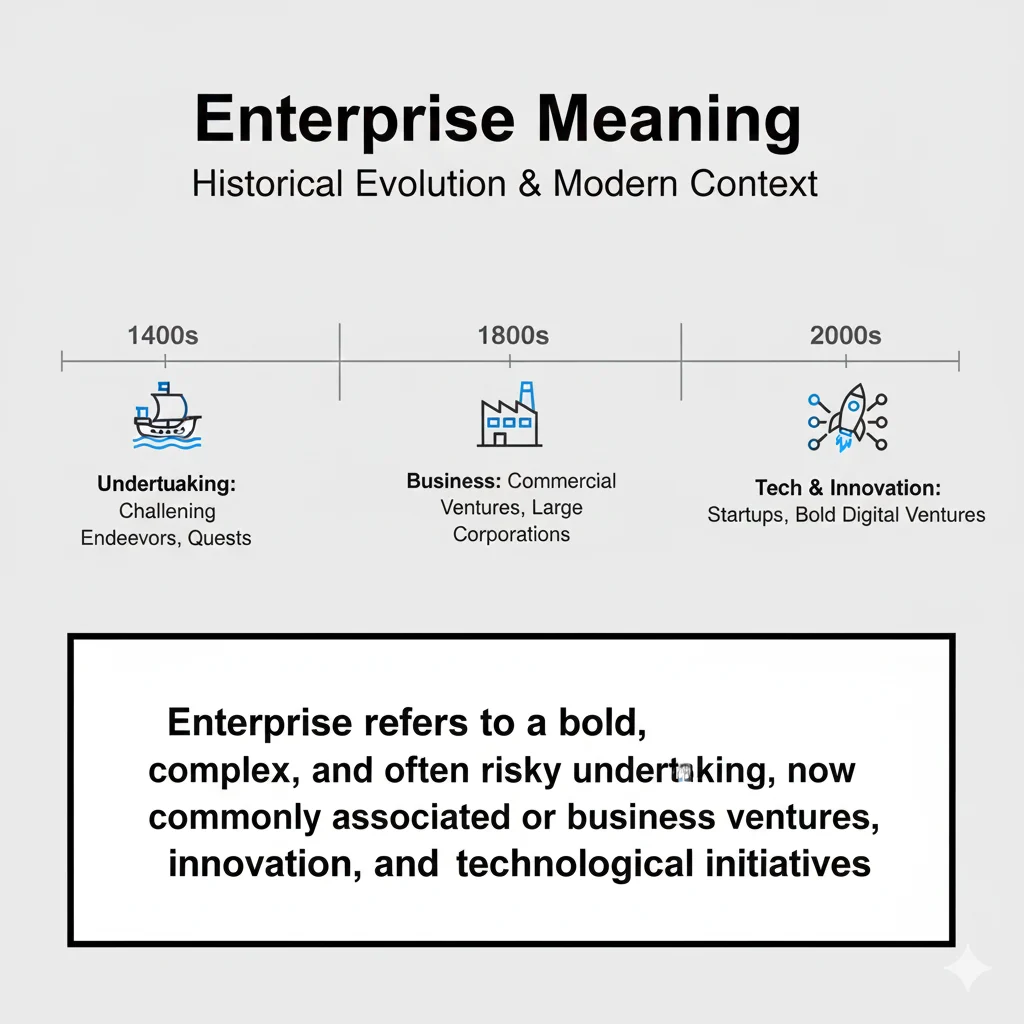
The word “enterprise” comes from the Old French word “entreprendre,” meaning “to undertake.” It entered English in the 15th century, originally referring to an undertaking or bold project.
Over time, “enterprise” became associated with:
- Business organizations taking on commercial ventures
- Technological systems built for large-scale operations
- Innovative projects driven by creativity and risk-taking
By the 20th century, “enterprise” evolved into a key term in corporate and tech culture, symbolizing ambition and large-scale achievement.
🌐 Enterprise Meaning in Different Contexts
💼 In Business
In business, enterprise refers to a company or organization, often highlighting entrepreneurship, scale, or ambition.
“Our enterprise is expanding into global markets.”
Types of Enterprises:
- Small Enterprise – small businesses or startups
- Medium Enterprise – growing businesses with structured teams
- Large Enterprise – corporations with national or global operations
💻 In Technology
In the tech world, enterprise describes large-scale software or IT systems designed for companies rather than individuals.
“Enterprise software helps organizations manage data, finance, and customers efficiently.”
Examples include enterprise applications, enterprise servers, and enterprise solutions used by major corporations.
🌍 In General Use
Outside of business, “enterprise” can mean any bold or challenging project.
“Climbing Mount Everest is a daring enterprise.”
| Context | Meaning of Enterprise | Example |
| Business | Company or organization | “The enterprise reported record profits.” |
| Technology | Large-scale systems for organizations | “Enterprise software is built for businesses.” |
| General | Bold or ambitious project | “Starting a charity is a noble enterprise.” |
💬 Examples of ‘Enterprise’ in Conversations
Example 1:
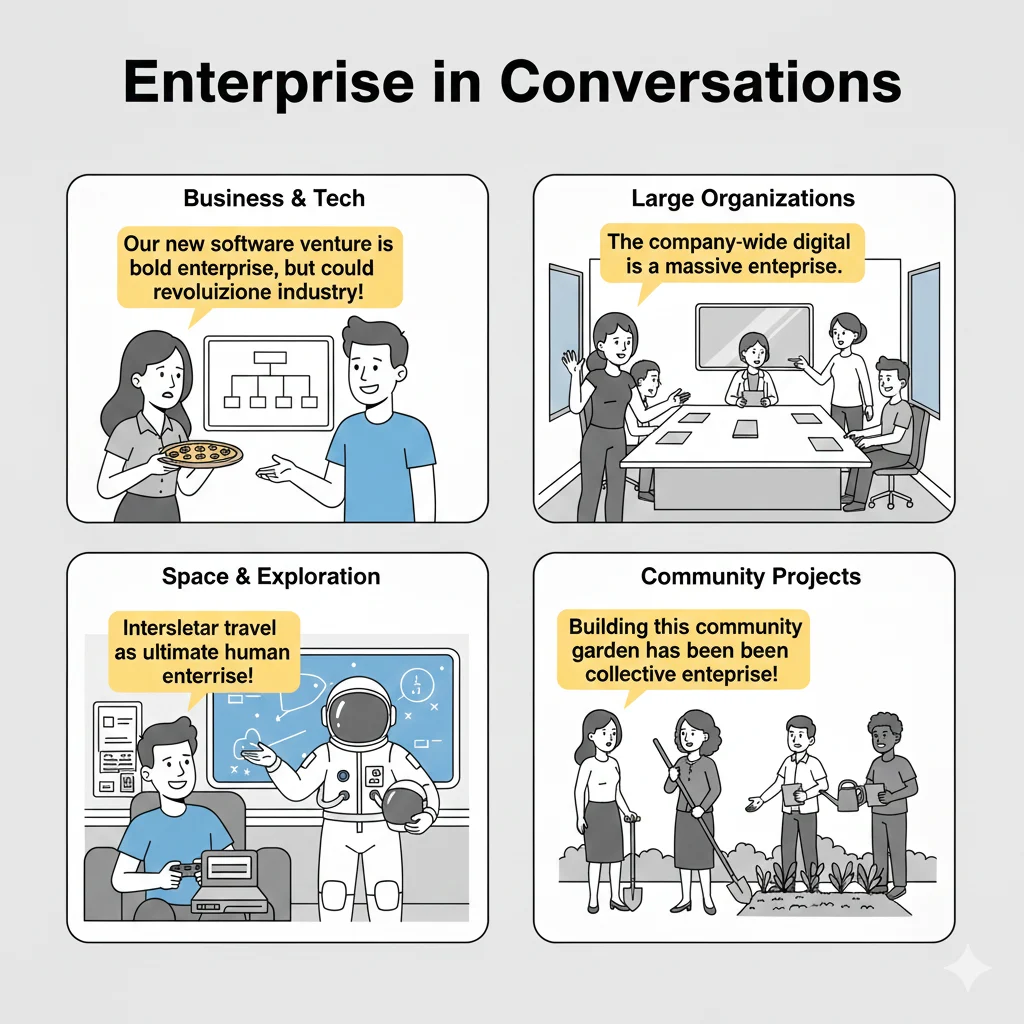
Manager: Our enterprise is investing in renewable energy.
Employee: That’s a great step toward sustainability! 🌱
Example 2:
Tech Lead: We’re deploying an enterprise-level CRM system next month.
Team: That’ll really help manage our clients better.
Example 3 (Formal):
“Enterprise development plays a key role in boosting a country’s economy.”
🧩 Similar or Related Terms
| Term | Meaning | How It Differs from ‘Enterprise’ |
| Business | A commercial organization or activity | Broader; can be small or local |
| Company | A specific registered organization | Legal entity within business category |
| Corporation | Large, structured business organization | More formal and regulated |
| Startup | Newly established business venture | Usually small and innovation-driven |
| Entrepreneurship | Process of starting and running ventures | The act behind creating an enterprise |
🧠 How to Use ‘Enterprise’ Correctly
✅ Do’s:
- Use enterprise to describe a company, organization, or project with ambition or scale.
- Apply it in formal, business, or professional writing.
❌ Don’ts:
- Don’t use enterprise casually for small personal projects.
- Avoid confusing it with entrepreneur — one refers to the business (enterprise), the other to the person running it (entrepreneur).
Example:
✅ “This enterprise has expanded across Asia.”
❌ “My weekend craft sale is an enterprise.” (Better: “small business”)
⚠️ Common Mistakes or Misinterpretations
- Mistake 1: Thinking enterprise only means “big company.”
→ It also refers to any bold or innovative venture, not just large corporations. - Mistake 2: Mixing up enterprise and entrepreneurship.
→ Enterprise = the business itself; entrepreneurship = the process or mindset. - Mistake 3: Using it in casual text conversations.
→ It’s a formal or professional term, not internet slang.
❓ FAQ Section
1. What does ‘enterprise’ mean in business?
In business, “enterprise” means a company or organization involved in commercial, industrial, or professional activities — often emphasizing innovation and growth.
2. Is ‘enterprise’ the same as ‘company’?
Not exactly. A company is a legal entity, while enterprise can refer to any organized venture or initiative, including startups or nonprofits.
3. What is enterprise software?
Enterprise software refers to large-scale digital systems designed to manage business processes, such as finance, HR, and customer relations.
4. Is ‘enterprise’ a formal word?
Yes, it’s a formal and professional term often used in business, government, and academic writing.
5. Can individuals be called an enterprise?
Not directly — individuals can start or own an enterprise, but the term itself refers to the venture, not the person.
6. What’s the difference between enterprise and entrepreneurship?
Enterprise is the organization or business, while entrepreneurship is the action or mindset of creating and managing that business.
🏁 Conclusion
To summarize, enterprise means a bold, organized venture or company built through initiative and risk-taking. Originating from French roots meaning “to undertake,” it now represents both business organizations and large-scale technological systems.
Whether it’s a startup striving for success or a multinational firm managing operations, enterprise captures the spirit of ambition, innovation, and growth.
Now that you know the enterprise meaning, you can use it confidently in any business or tech discussion! 🚀💼

Jon McGregor is a language and word-meaning expert at Meanovia.com. He specializes in explaining complex words, phrases, and modern language trends in a clear, approachable style. His mission is to help readers quickly grasp the true meaning behind every term, making language learning and understanding effortless and engaging.