Last year, I met two girls in a school event in Lahore. One girl had brown skin and straight black hair. The other girl looked the same. I thought they were from the same family.
Later I learned one was Punjabi and the other was Hazara. That day I learned the difference between race and ethnicity in real life. Many people mix these two words. The difference between race and ethnicity is about body look and family culture.
When we know the difference between race and ethnicity, we understand people better. This small lesson helped me respect others more. In this guide, you will learn the difference between race and ethnicity in easy words and clear examples.
Key Difference Between Both
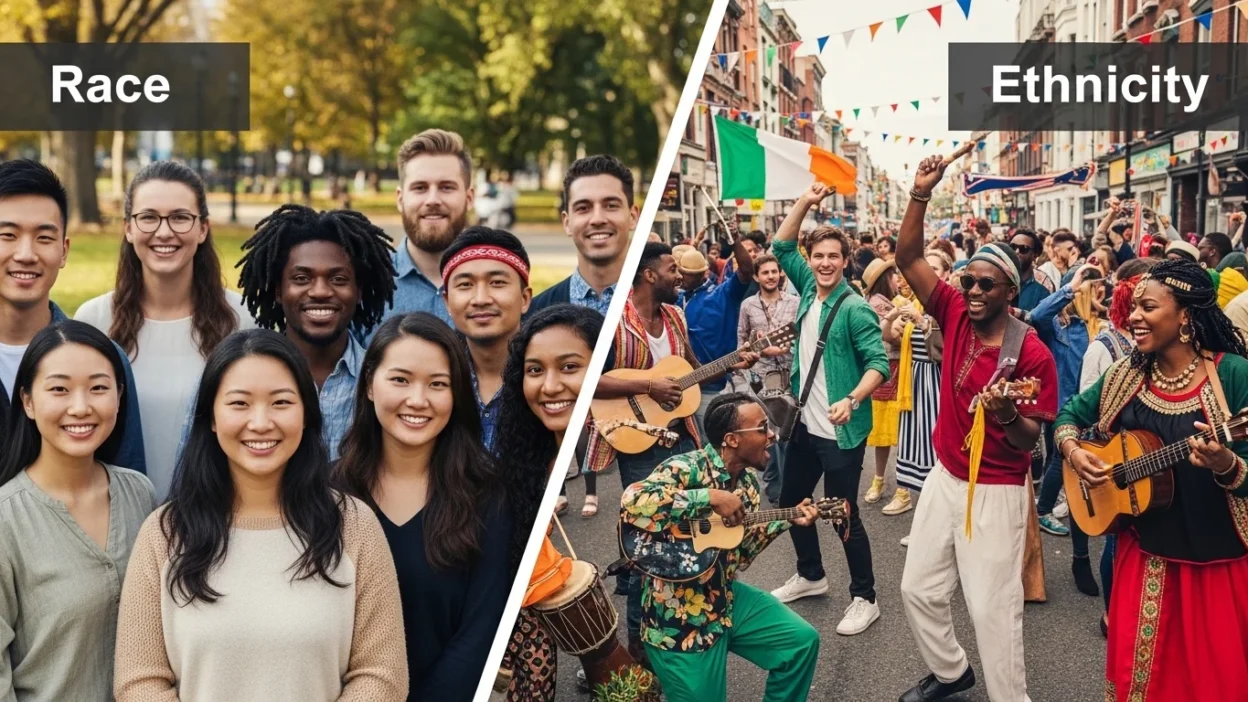
- Race is about body features like skin color, hair, and face shape.
- Ethnicity is about culture like language, food, clothes, and traditions.
Example:
- A person can be Asian race but Punjabi ethnicity.
- A person can be White race but Irish ethnicity.
Why Is Their Difference Important for Learners and Experts?
Knowing the difference helps us avoid wrong ideas. Students write better essays. Teachers explain history well. Doctors know health risks in some races. Experts in law and census collect correct data. In society, this knowledge builds respect and peace. When we know the difference between race and ethnicity, we do not judge people by looks. We learn to see their culture and story.
Pronunciation
- Race
- US: /reɪs/
- UK: /reɪs/
- Ethnicity
- US: /eθˈnɪsɪti/
- UK: /eθˈnɪsɪti/
Now let us go deeper and see the difference between race and ethnicity step by step.
Difference Between Race and Ethnicity
1. Based On Look vs Culture
Race → body look
Ethnicity → culture
Examples
- Black race, African-American ethnicity
- White race, German ethnicity
2. Fixed vs Changeable
Race stays mostly same.
Ethnicity can change by marriage or move.
Examples
- A baby born Asian stays Asian.
- A girl marries into Turkish family and learns Turkish culture.
3. Few Groups vs Many Groups
Race has few big groups.
Ethnicity has many small groups.
Examples
- Black, White, Asian races
- Punjabi, Pashtun, Sindhi ethnicities
4. Science vs Social Life
Race came from old science ideas.
Ethnicity comes from social life.
Examples
- Skin color study
- Language and dress study
5. Visible vs Invisible
Race is easy to see.
Ethnicity is not always seen.
Examples
- Dark skin
- Muslim or Christian culture
6. Global vs Local
Race is same in many countries.
Ethnicity changes by place.
Examples
- Asian race in China and Japan
- Punjabi ethnicity only in Punjab
7. Birth vs Choice
Race comes by birth.
Ethnicity can be learned.
Examples
- Baby born White
- Person learns Japanese culture
8. DNA vs Traditions
Race links to DNA look.
Ethnicity links to customs.
Examples
- Hair texture
- Wedding dance style
9. Used in Health vs Used in Culture
Doctors study race for disease risk.
Sociology studies ethnicity for culture.
Examples
- Sickle cell in some races
- Food habits in ethnic groups
10. Short Word vs Long Meaning
Race is one short idea.
Ethnicity is wide culture idea.
Examples
- Black race
- Arab ethnicity with language and history
Nature and Behaviour
Race Nature: Physical, fixed, simple idea.
Ethnicity Nature: Cultural, learned, rich idea.
Race shows body. Ethnicity shows heart and home life.
Why People Mix Race and Ethnicity
People look at skin and guess culture. Media also mixes words. Some forms use race and ethnicity together. History books also used wrong terms. So confusion grows.
Table – Difference and Similarity
| Point | Race | Ethnicity |
|---|---|---|
| Meaning | Body look | Culture |
| Change | Rarely | Possible |
| Groups | Few | Many |
| Seen | Yes | Not always |
| Example | Asian | Punjabi |
| Similarity | Both describe people’s identity |
Which Is Better in What Situation?
When we talk about health or body study, race helps more. Doctors use race to see disease risk. In this case, race gives useful facts.
When we talk about food, language, and festivals, ethnicity is better. Teachers and historians use ethnicity to show culture. In daily life, ethnicity helps us respect traditions.
Race and Ethnicity in Metaphors and Similes
People use them to talk about unity or difference.
Examples
- “Human race is one big family.”
- “Her culture was rich like a rainbow ethnicity.”
Connotative Meaning
Race
- Positive: unity of mankind
- Negative: racism idea
- Neutral: science study
Examples
- Positive: “We are one race.”
- Negative: “Race hate is wrong.”
Ethnicity
- Positive: proud culture
- Negative: ethnic fight
- Neutral: census form
Examples
- Positive: “She loves her ethnicity.”
- Negative: “War started by ethnic hate.”
Idioms or Proverbs
- Human race – all people
- Example: The human race needs peace.
- Run your own race – focus on yourself
- Example: Study hard and run your own race.
(No common idioms with ethnicity word)
Works in Literature
- “Race and Reunion” – History book, David Blight, 2001
- “Ethnicity and Nationalism” – Sociology book, Thomas Eriksen, 1993
Movies About Race or Ethnicity
- Crash – 2004, USA
- Green Book – 2018, USA
- Hotel Rwanda – 2004, UK/South Africa
- My Big Fat Greek Wedding – 2002, USA
FAQ
1. Can two people of same race have different ethnicity?
Yes. Example: White race, Irish and Italian ethnicity.
2. Can ethnicity change?
Yes, by marriage or living in new culture.
3. Is race scientific?
Partly, but modern science says race is social idea too.
4. Which is more important?
Both are important for identity.
5. Why should students learn this?
To avoid racism and respect culture.
How Both Help Our Surroundings
Race study helps doctors plan health care. Ethnicity study helps schools respect language and food needs. In offices, this knowledge builds teamwork. In cities, it stops hate and builds peace.
Final Words
Race shows our body story. Ethnicity shows our culture story. Both together show our full identity.
Conclusion
The difference between race and ethnicity is simple but very important. Race talks about body look. Ethnicity talks about culture and life style. When we learn this difference, we stop wrong thinking and respect people more.
Students, teachers, doctors, and leaders all need this knowledge. In our daily life, this idea builds peace and love. Remember, we may look different, but we all belong to one human family.

Claire Fuller is a word-meaning specialist at Meanovia.com. She explains complex words, phrases, and language trends in a clear, relatable way, helping readers quickly understand the exact meaning behind every term.