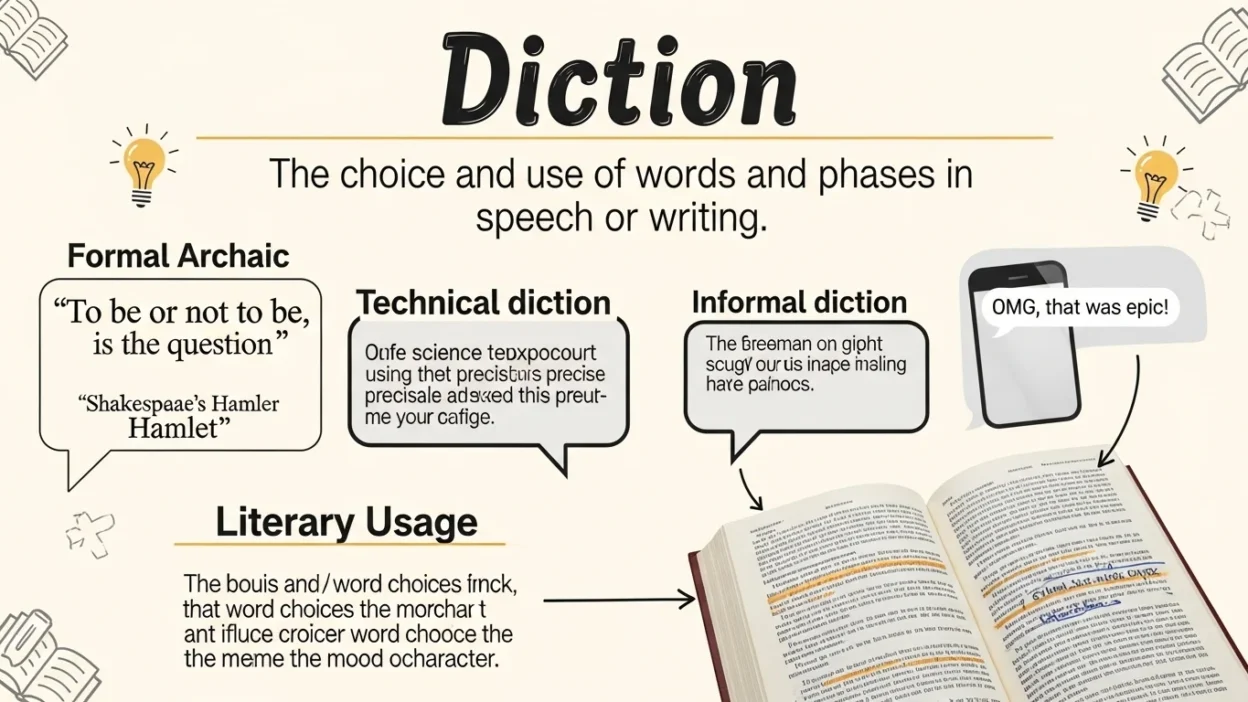
Diction means a person’s choice of words and the clarity with which they speak or write. It affects tone, style, and how effectively ideas are communicated in speech and literature.
Have you ever been told to “improve your diction” — but weren’t quite sure what that actually meant? Whether in school, public speaking, acting, or writing, diction plays a powerful role in how clearly and confidently you communicate.
In simple terms, diction refers to a person’s choice of words and the clarity with which they pronounce them. It influences tone, style, and how effectively your message is understood.
Diction means the choice of words and the clarity with which they are spoken or written. In simple terms, diction refers to how a person selects words and pronounces them to communicate ideas effectively.
The word comes from the Latin dictio, meaning “a saying” or “expression.” In everyday use, diction can refer to pronunciation clarity (how clearly you speak) or vocabulary choice (how carefully you select words in writing).
💬 What Does Diction Mean?
Diction refers to a person’s choice of words and style of speaking or writing that determines how clearly and effectively ideas are expressed.
It can describe both spoken and written language, and is often linked with tone, clarity, and expression.
In English, the meaning of diction includes both word choice and pronunciation clarity. If someone asks what does diction mean in English, it refers to how clearly and effectively a person expresses ideas through spoken or written language.
🔊 How to Pronounce “Diction”
“Diction” is pronounced:
DIK-shuhn
Phonetic spelling: /ˈdɪkʃən/
The first syllable sounds like “dik,” and the second is a soft “shun.” It is spoken clearly in two syllables.
🕰️ Origin and Popularity
The word “diction” comes from the Latin root “dicere,” meaning to say or speak. It entered the English language in the late 15th century to describe the art of verbal expression.
Over time, it became widely used in literary criticism, public speaking, and linguistics, representing the quality of language — whether formal, poetic, simple, or colloquial.
Timeline Snapshot:
- 1400s: First used in Old French and Latin contexts.
- 1600s: Popular in English literature and rhetoric.
- Today: Commonly used in education, speech coaching, and writing analysis.
🌍 Diction Meaning in Different Contexts
🗣️ In Speech or Communication
In everyday communication, diction refers to how clearly and correctly someone pronounces words.
Example: A public speaker with clear diction is easy to understand.
✍️ In Literature or Writing
In writing, diction defines the tone and voice of an author.
Example: Formal diction uses sophisticated vocabulary; informal diction uses casual or slang terms.
In writing, the use of diction determines how readers perceive tone and intent. Careful diction can make writing persuasive, emotional, technical, or conversational depending on the chosen vocabulary.
🎭 In Acting or Performance
Actors use diction to articulate dialogue clearly so the audience can grasp every word and emotion.
📚 Diction Meaning in Literature and Poetry
In literature, diction refers to an author’s specific choice of words used to create tone, mood, and style. When analyzing diction in poetry or prose, readers examine whether the language is formal, informal, abstract, concrete, or poetic. An author’s diction can reveal emotion, social context, and artistic intention, making it an important literary device.
| Context | Meaning of Diction | Example |
|---|---|---|
| Speech | Clarity and pronunciation | “His diction was flawless during the speech.” |
| Writing | Word choice and tone | “The author’s poetic diction adds beauty.” |
| Acting | Expression and articulation | “The actor’s diction made the monologue powerful.” |

💬 Examples of Diction in Conversations
Here are some real-life examples showing how diction changes tone and meaning:
📝 Diction Meaning and Examples
To better understand diction, consider this sentence:
“The exhausted traveler staggered home.”
The word “exhausted” reflects specific diction that creates a clearer emotional image than simply saying “tired.” This shows how diction shapes meaning and tone in a sentence.
Example 1 — Formal Diction:
“Good afternoon, how are you today?”
Example 2 — Informal Diction:
“Hey, what’s up?”
Example 3 — Poetic Diction:
“The golden rays of dawn kissed the silent sea.”
Example 4 — Colloquial Diction:
“Y’all ready for dinner?”
Example 5 — Neutral Diction:
“Please close the door.”
🗨️ Visual Suggestion: Use a quote-style graphic comparing “formal vs informal diction.”
🔤 Similar or Related Terms
Here are a few related linguistic terms often associated with diction:
| Term | Meaning |
|---|---|
| Syntax | Arrangement of words in a sentence |
| Tone | The author’s attitude toward the subject |
| Style | The unique way an author expresses ideas |
| Vocabulary | The set of words a person knows or uses |
| Pronunciation | The way words are spoken aloud |
These elements work together with diction to create clear and engaging communication.
✅ How to Use Diction Correctly
Here are a few do’s and don’ts to master diction in any setting:
✅ Do:
- Choose words that fit your audience.
- Speak clearly and at a comfortable pace.
- Match your tone to your purpose (formal, casual, persuasive).
❌ Don’t:
- Use overly complex words when simple ones work better.
- Mumble or speak too fast.
- Mix informal diction in formal writing.
Example:
✅ “Please submit the report by Friday.”
❌ “Hey dude, toss me that report when you can.”
⚠️ Common Mistakes or Misinterpretations
Many people confuse diction with accent or grammar, but they’re not the same:
- Diction = choice of words and clarity
- Accent = pronunciation style based on region
- Grammar = structure and rules of language
Tip: Good diction doesn’t require a “fancy” accent — it’s about clarity and word choice, not sounding elite.
❓ FAQ Section
1. What does diction mean in English?
Diction means the choice of words and clarity of speech used to express ideas effectively.
2. Is diction the same as pronunciation?
No. Pronunciation is how you say a word; diction includes what words you choose and how clearly you deliver them.
3. What are the 4 types of diction?
The main types are formal, informal, colloquial, and poetic diction — each suited to different tones and audiences.
Beyond the main categories, diction can also be classified more specifically:
- Formal diction: Professional, polished language used in academic or business settings.
- Informal diction: Casual language used in everyday conversation.
- Colloquial diction: Regional or conversational expressions.
- Abstract diction: Words that describe ideas or concepts rather than physical objects.
- Concrete diction: Words that refer to tangible, specific things.
- Technical diction: Specialized vocabulary used in specific professions or fields.
4. Why is diction important in writing?
It shapes the tone, mood, and style of your writing, helping readers understand your intent and emotions.
5. How can I improve my diction in speaking?
Practice enunciation exercises, read aloud, and listen to skilled speakers. Focus on clarity over speed.
6. What’s the difference between diction and tone?
Diction is the choice of words; tone is the emotional attitude behind them.
🏁 Conclusion
Now you know that “diction” isn’t just about fancy words — it’s about choosing the right words and expressing them clearly to fit your purpose and audience.
Whether you’re writing an essay, giving a speech, or acting on stage, good diction makes your message powerful and easy to understand.
✨ So next time someone compliments your diction — take it as a sign of excellent communication skills!

Patrick Gale is a word-meaning expert at Meanovia.com. He explains complex terms, definitions, and language trends with clarity and precision. His goal is to help readers understand the exact meaning behind every word they search.