
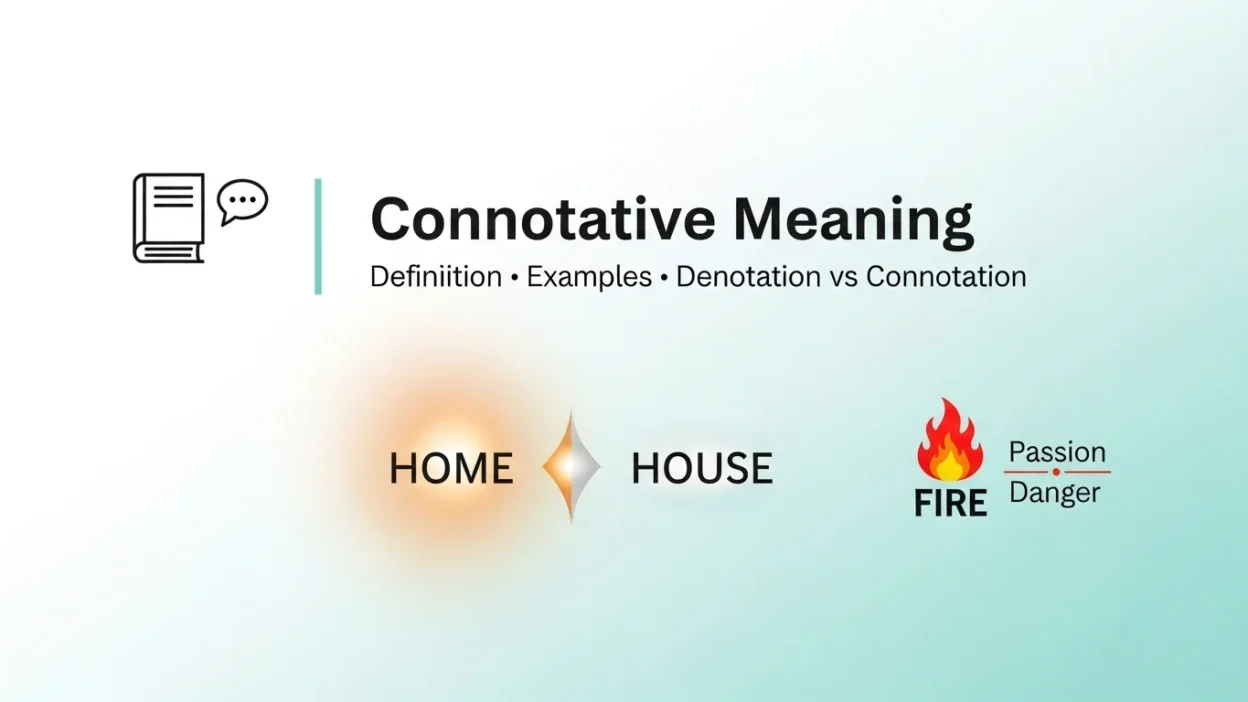
Connotative meaning is the extra meaning a word carries beyond its literal dictionary definition. It includes the feelings, emotions, and associations people connect with a word. For example, “home” and “house” can point to a place to live, but home often feels warm and safe, while house feels more neutral and factual.
Entity of the Word
- Entity Type: Linguistics / English Grammar / Semantics (Meaning in Language)
- Part of Speech: Connotative (adjective) — related noun: connotation
- Core Concept: Implied meaning (emotional + cultural + personal associations)
- Related Entities: denotation, connotation, tone, emotion, imagery, diction, context, audience, communication
- Where It’s Used: school English, literature, poetry, ads/marketing, social media, speeches, everyday conversation
Connotative meaning is the emotional and associative meaning a word suggests beyond its literal (denotative) meaning.
Have you noticed how two words can “mean” the same thing but still feel very different? If someone says, “That’s your house,” it sounds normal and factual. But if they say, “That’s your home,” it often feels warmer and more personal.
This difference happens because words carry more than just dictionary meanings. They also carry feelings, images, and memories. That hidden layer is called connotative meaning. People search “connotative meaning” because they want to understand what a word suggests, not only what it defines.
In this guide, you’ll learn the connotative meaning definition, how it differs from denotative meaning, and how to spot connotations using simple steps and many examples (including the connotative meaning of home and fire). You’ll also learn why connotative meaning matters in communication, writing, and everyday speech.
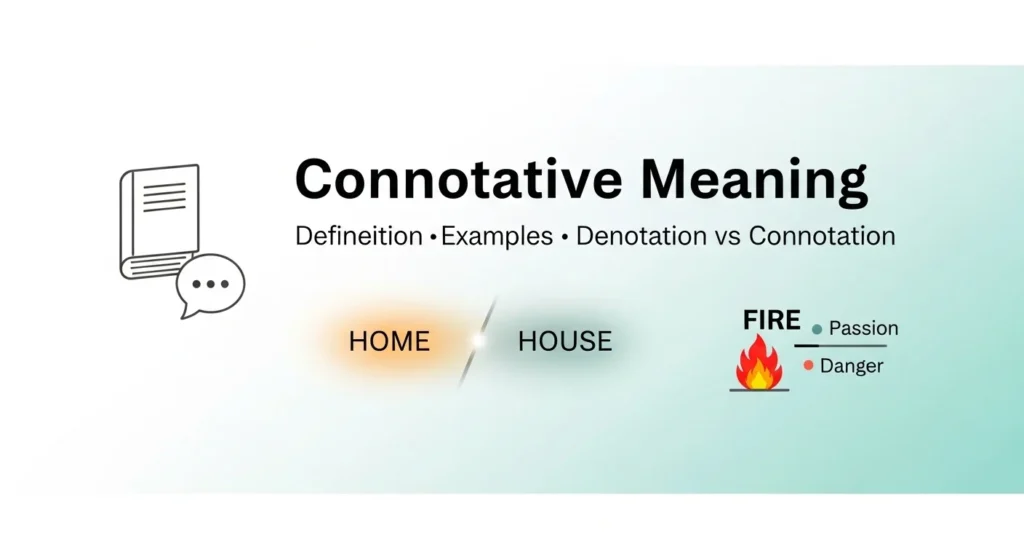
1) What Is Connotative Meaning?
Connotative Meaning (Simple Definition)
Connotative meaning is the emotional and associative meaning of a word. It is what a word makes you feel or makes you imagine, based on experiences, culture, and context.
What Does “Connotative” Mean?
The word connotative describes language that carries connotation—meaning beyond the literal definition.
- Denotation = dictionary meaning (literal)
- Connotation = feelings and associations (implied)
So when someone asks:
- “What is connotative meaning?”
- “What is a connotative meaning?”
- “What does connotative meaning mean?”
They are asking:
What feelings, ideas, or associations does the word carry in real life?
2) Connotative Meaning Definition (Clear + School-Friendly)
Definition of Connotative Meaning
The connotative meaning of a word is the set of feelings, associations, and emotional ideas that the word suggests to people.
These associations can be:
- positive (good feelings)
- negative (bad feelings)
- neutral (no strong emotion)
Simple Example
- Childlike often sounds positive (sweet, innocent)
- Childish often sounds negative (immature, annoying)
Both words relate to “child,” but their connotative meanings are different.
3) Denotative and Connotative Meaning (The Big Difference)
Many learners search:
- denotative and connotative meaning
- denotative vs connotative meaning
- denotation vs connotation
Let’s make it simple.
Denotative Meaning (Literal)
Denotative meaning is the literal, dictionary definition of a word.
Example:
- Snake (denotation) = a long reptile with no legs
Connotative Meaning (Implied)
Connotative meaning is the feeling or idea connected to the word.
Example:
- Snake (connotation) = a “dangerous” or “untrustworthy” person (in many cultures)
Why This Matters
In real communication, people react to connotation even when you only meant the literal meaning.
Denotative vs Connotative Meaning Table
| Feature | Denotative Meaning | Connotative Meaning |
|---|---|---|
| What it is | Literal definition | Emotional/associative meaning |
| Where it comes from | Dictionary | Culture, experience, context |
| Is it stable? | Mostly stable | Can change by audience and time |
| Example: “home” | a place to live | warmth, family, safety |
| Example: “cheap” | low price | low quality, not classy (often) |
4) What Is the Connotative Meaning of a Word?
People search:
- “what is the connotative meaning of a word”
- “connotative meaning of a word”
- “the connotative meaning of a word is”
Answer
The connotative meaning of a word is:
- what the word suggests
- what emotions it triggers
- what images it creates
- what social/cultural ideas it carries
A word can have:
- the same denotation as another word
- but a very different connotation
Example:
- slim vs skinny
- denotation: thin
- connotation: slim = positive, skinny = often negative
5) Types of Connotation: Positive, Negative, Neutral
A) Positive Connotation
Words that feel pleasant, respectful, or admiring.
Examples:
- confident (positive)
- frugal (positive way to say careful with money)
- youthful (positive)
B) Negative Connotation
Words that feel harsh, rude, judgmental, or insulting.
Examples:
- arrogant (negative)
- cheap (often negative)
- nosy (negative)
C) Neutral Connotation
Words that feel factual and do not carry strong emotion.
Examples:
- building
- vehicle
- chair
6) Why Connotative Meaning Matters
Connotative meaning matters because words are not only information—they are also tone.
1) It Changes How People Feel
If you say:
- “She is slim.” (often positive)
- “She is skinny.” (often negative)
The listener may react differently even if you meant the same thing.
2) It Affects Relationships
Connotation can:
- show respect or disrespect
- create trust or offense
- sound friendly or rude
3) It Improves Writing
Writers use connotation to:
- build mood
- create strong imagery
- show a character’s personality
- make sentences more powerful
4) It Matters in Marketing and Advertising
Brands choose words with positive connotations:
- “affordable” (better connotation than “cheap”)
- “premium” (signals quality)
5) It’s Key in Communication
In communication, connotation helps explain why:
- the same message can be understood differently by different people
- misunderstandings happen even without bad intention
7) Connotative Meaning in Communication
People search: connotative meaning in communication.
What it means
In communication, connotative meaning is the emotional message behind the words.
Even simple words can feel different depending on:
- speaker’s tone
- listener’s culture
- situation
- relationship between people
Example
You say: “Interesting.”
- In one context, it can mean “I like it.”
- In another, it can mean “I don’t like it.”
Same denotation. Different connotation.
Culture and Audience
A word may be positive in one group and negative in another. That is why good communicators:
- think about their audience
- choose words carefully
8) Connotative Language Meaning (and Connotative Diction)
People also search:
- “connotative language meaning”
- “connotative diction meaning”
- “define connotative diction”
Connotative Language
Connotative language is language chosen to create feelings, imagery, and emotional impact.
It is common in:
- poetry
- stories
- speeches
- persuasive writing
- ads
Connotative Diction
Diction means word choice.
So connotative diction means choosing words for their emotional effect, not only their literal meaning.
Example:
- Neutral: “He walked into the room.”
- Connotative: “He stomped into the room.” (suggests anger)
- Connotative: “He glided into the room.” (suggests calm, elegance)
9) How to Find Connotative Meaning (Step-by-Step Method)
Use this simple method anytime:
Step 1: Find the Denotation
Ask: “What does this word literally mean?”
Step 2: Ask: How does it feel?
Is it positive, negative, or neutral?
Step 3: Imagine a picture
What image comes to mind?
Step 4: Think about who is speaking and who is listening
Same word can change based on audience.
Step 5: Compare with a similar word
Word swaps are the fastest way to spot connotation.
Example:
- thrifty vs stingy
- both mean careful with money
- thrifty = positive
- stingy = negative
10) Connotative Meaning Examples
Below are connotative meaning examples with clear comparisons.
(These are perfect for students and ready to use in articles.)
A) Appearance / Body
- Slim (positive) vs Skinny (negative)
- Curvy (positive) vs Chubby (often negative)
- Youthful (positive) vs Childish (negative)
B) Personality
- Confident (positive) vs Arrogant (negative)
- Careful (neutral/positive) vs Paranoid (negative)
- Curious (positive) vs Nosy (negative)
C) Money / Spending
- Affordable (positive) vs Cheap (often negative)
- Thrifty (positive) vs Stingy (negative)
- Luxurious (positive) vs Expensive (neutral/negative depending)
D) Work / Behavior
- Determined (positive) vs Stubborn (negative)
- Assertive (positive) vs Aggressive (negative)
- Focused (positive) vs Obsessed (negative)
E) Communication
- Direct (neutral/positive) vs Rude (negative)
- Honest (positive) vs Harsh (negative)
- Persuasive (neutral/positive) vs Manipulative (negative)
F) Emotions
- Relaxed (positive) vs Lazy (negative)
- Proud (can be positive) vs Proud (can be negative if arrogant)
- Sensitive (neutral) vs Overly sensitive (negative)
“Example of Connotative Meaning” in Sentences (20 Quick Sentences)
- Calling him frugal sounds respectful, but calling him stingy sounds insulting.
- The word slim feels like a compliment; skinny can sound rude.
- She gave a smirk, not a smile, which made her look unfriendly.
- He stomped into the room, showing anger without saying a word.
- The coach said she was determined, not stubborn.
- “That’s interesting” sounded like polite disagreement.
- “He’s confident” felt positive; “he’s arrogant” felt negative.
- The ad used “affordable” instead of “cheap” to sound high quality.
- “She’s curious” sounds good; “she’s nosy” sounds bad.
- The manager praised her for being assertive, not aggressive.
- The word home made the speech feel warm and personal.
- The word house sounded neutral and practical.
- The hero’s glow felt positive, while the villain’s shadow felt negative.
- The author used “slender” to create a graceful image.
- “He’s persistent” sounds better than “he’s pushy.”
- “She asked” sounds neutral; “she demanded” sounds harsh.
- “He explained” sounds calm; “he lectured” sounds annoying.
- “She noticed” sounds neutral; “she stared” sounds uncomfortable.
- “They discussed” sounds normal; “they argued” sounds tense.
- “He guided me” feels helpful; “he controlled me” feels negative.
11) The Connotative Meaning of “Home”
People search: connotative meaning of home.
Denotation of Home
A place where someone lives.
Connotative Meaning of Home
Home often suggests:
- warmth
- love
- family
- safety
- comfort
- belonging
Why “Home” Feels Strong
Because many people connect “home” with emotional memories and relationships.
Example sentences
- “After months away, she finally came home.” (warm, emotional)
- “This team feels like home.” (belonging, support)
12) What Is the Connotative Meaning of “Fire”?
People search: what is the connotative meaning of fire?
Denotation of Fire
Flames and heat created by burning.
Connotative Meaning of Fire
“Fire” can suggest different things depending on context:
Positive connotations
- passion
- energy
- motivation
- inspiration
- power
Example:
- “He has fire in his heart.” (passion)
Negative connotations
- danger
- destruction
- anger
- violence
- fear
Example:
- “The argument ended in fire.” (anger, chaos)
Neutral/technical
- “Fire safety rules” (more literal, practical)
Key point: the connotation changes with context.
13) Connotative Meanings in Literature, Poetry, and Speeches
Writers use connotation to create:
- mood (happy, scary, romantic)
- character (kind, cruel, funny)
- imagery (pictures in the reader’s mind)
- symbolism (deeper meaning)
Example: “Night”
- Denotation: time after sunset
- Connotation: fear, mystery, loneliness (in many stories)
Example: “Light”
- Denotation: brightness
- Connotation: hope, truth, safety
14) Connotative Interpretation: Why People Understand Words Differently
People may interpret connotation differently because of:
- personal experiences
- cultural background
- age and generation
- social environment
- media influence
Example:
The word “old”:
- can feel neutral (age)
- can feel negative (weak, outdated)
- can feel positive (wise, experienced)
So connotative meaning is not always “one answer.” It can depend on the person and context.
15) Connotation vs Denotation (More Practice)
Here are more strong word pairs for students:
Positive vs Negative pairs
- childlike (sweet) vs childish (immature)
- economical (smart) vs cheap (low quality)
- resolute (strong) vs stubborn (unreasonable)
- interested (curious) vs nosy (too curious)
- confident (strong) vs cocky (annoying)
16) Mini Quiz: Denotation vs Connotation (5 Questions)
Try this quick test:
- “She strolled into the park.”
Is strolled connotative or denotative?
Answer: Connotative (suggests relaxed, calm walking) - “He shouted at the waiter.”
What connotation does “shouted” carry?
Answer: Anger, rudeness, intensity - “That’s an affordable phone.”
Why choose “affordable” instead of “cheap”?
Answer: Affordable has a more positive connotation. - “He is thin.”
Is “thin” positive, negative, or neutral?
Answer: Often neutral, but context can change it. - “The room was cozy.”
What does cozy suggest?
Answer: Warm, comfortable, safe (positive connotation)
17) Common Mistakes and Confusions
This section covers spelling mistakes and wrong terms people type.
A) Connotative vs Connotation
- Connotative = adjective (describes meaning)
- Connotation = noun (the association itself)
Example:
- “This word has a strong connotation.”
- “This word has a strong connotative meaning.”
B) Misspellings People Search
People often type:
- conotative meaning
- connotive meaning
- connotative meanig / meanin
- connatative / connontation / conntation
Fix tip: The correct spelling is connotative (with double “n”).
C) Confusing “Connative” with “Connotative”
Some people type connative meaning.
But connative is a different word in some contexts and is not the same as connotative in everyday English lessons. If your goal is implied meaning and emotion in words, the correct term is connotative.
D) “Confutative meaning” (Wrong word)
Some users type confutative meaning by mistake.
That is not the word you want here.
If your topic is implied emotional meaning, it is connotative meaning.
18) Connotative Words Definition (Simple)
People search:
- “define connotative words”
- “connotative words definition”
Connotative words
Connotative words are words chosen because they carry strong feelings or extra meaning.
Examples:
- stingy (negative feeling)
- glorious (positive feeling)
- heartbroken (strong emotional meaning)
- heroic (admiring tone)
19) How to Teach Connotative Meaning (For Students / Kids)
Even if your audience is not kids, this makes the concept easier.
Connotative meaning for kids (easy)
- Denotation = what it means
- Connotation = what it feels like
Example:
- “Dog” = animal (denotation)
- “Dog” = loyal friend (connotation)
Simple classroom activity
Write these words and ask:
- Is it positive, negative, or neutral?
- What feelings come to mind?
Words:
- home, fire, snake, sunshine, storm, whisper, shout, grin, glare
20) FAQs
1) What is connotative meaning?
Connotative meaning is the emotional and associative meaning a word suggests beyond its literal definition.
2) What is a connotative meaning?
A connotative meaning is the “extra message” in a word—its feelings, tone, and associations.
3) What does connotative meaning mean?
It means the implied meaning of a word, shaped by emotion, culture, and context.
4) What is the connotative meaning of a word?
It is what the word makes people feel or imagine, not just what the dictionary says.
5) Define connotative meaning.
Connotative meaning is the emotional and cultural meaning linked to a word beyond its denotation.
6) What is the difference between denotative and connotative meaning?
Denotative meaning is literal; connotative meaning is implied and emotional.
7) What is the connotative meaning of “home”?
Home often suggests warmth, comfort, love, safety, and belonging.
8) What is the connotative meaning of “fire”?
Fire can suggest passion and energy (positive) or danger and destruction (negative), depending on context.
9) Why is connotative meaning important in communication?
Because people respond to tone and emotion, and connotations can change how a message is understood.
10) What are examples of connotative meaning?
Slim vs skinny, affordable vs cheap, curious vs nosy—same basic idea, different emotional impact.
11) What is connotative language?
Connotative language uses words chosen to create emotion, imagery, and tone, often in literature and persuasion.
12) What is connotative diction?
Connotative diction is word choice that focuses on the emotional effect of language.
21) Conclusion
Connotative meaning is the emotional and associative layer of language. It is what words suggest beyond what they define. That is why words like home, fire, slim, and cheap can shape feelings instantly—even when the dictionary meaning seems simple. If you remember one rule, remember this: Denotation is the literal meaning; connotation is the feeling. Once you learn to notice connotation, you will communicate better, write better, and understand books, speeches, and ads more clearly.

Jon McGregor is a language and word-meaning expert at Meanovia.com. He specializes in explaining complex words, phrases, and modern language trends in a clear, approachable style. His mission is to help readers quickly grasp the true meaning behind every term, making language learning and understanding effortless and engaging.