
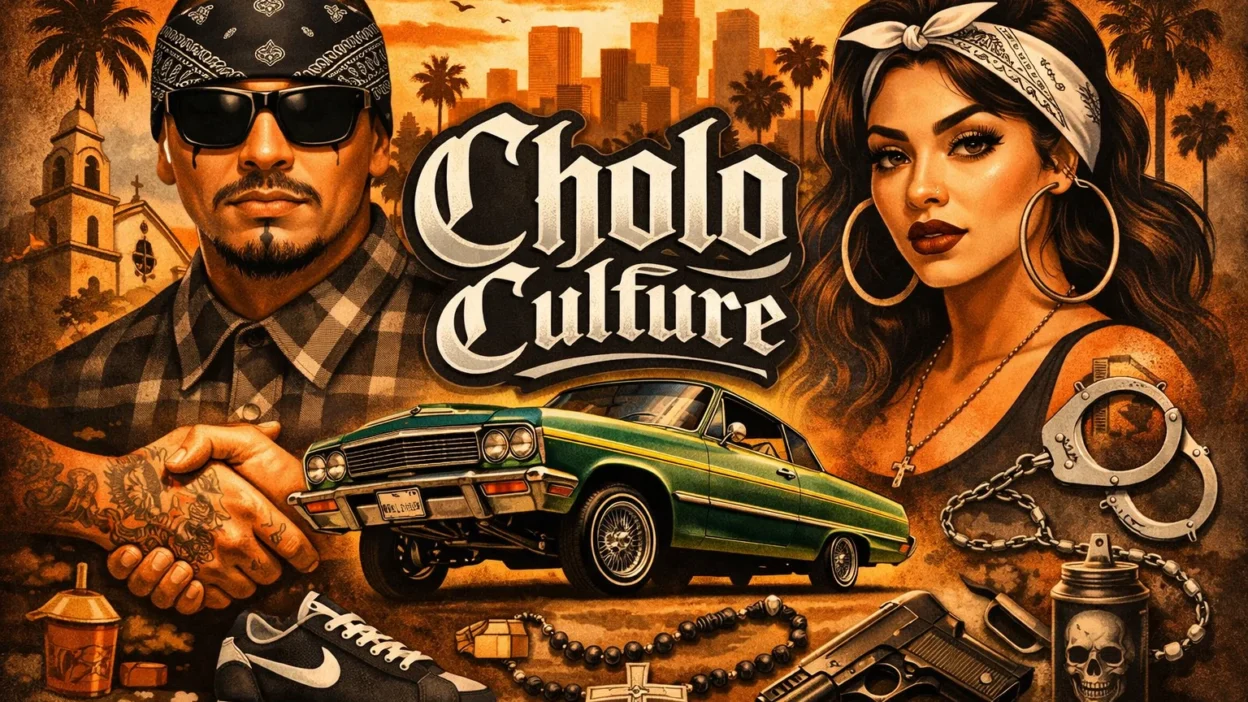
You may have seen the word “Cholo” online, in chats, comments, or on social media—and wondered, “What does this really mean?” Some people laugh it off. Others feel confused. And a few say, “No one explains the real meaning.”
what is a cholo?
Quick answer: Cholo does not have just one meaning. Its meaning changes by language, culture, and context.
In Spanish, cholo can mean a person of mixed heritage. In South Asian or internet slang, people sometimes use it casually, jokingly, or incorrectly—often without knowing the original meaning. This is where confusion starts.
In 2026, words like cholo spread fast online, but their meanings get twisted. That’s why understanding the real meaning, hidden context, and how people use it today matters—especially for students, bloggers, content writers, and social media users.
Let’s uncover the truth behind “Cholo”, where it comes from, and how to use (or avoid) it correctly.
🔍 What Does Cholo Mean?
“Cholo” refers to a person of Mexican or Latin American descent, often associated with a distinctive street culture, style, and attitude.
What does cholos mean?
Cholos is simply the plural form of cholo. It refers to a group of people who identify with or are associated with cholo culture, which is strongly linked to Mexican-American communities.
When someone says cholos, they usually mean multiple individuals who share the same street style, cultural identity, or neighborhood roots. The meaning stays the same as cholo — only the number changes.
Originally, it was used as a slang term to describe Mexican-American urban youth or gang members, but over time it’s also become a proud cultural identity symbolizing resilience and heritage.
🕰️ Origin and Popularity of “Cholo”
The word “cholo” traces its roots back to 16th-century colonial Latin America, where Spanish colonizers used it as a racial classification for people of mixed Indigenous and European descent.
By the 20th century, the term resurfaced in the United States, particularly in California, Texas, and the Southwest, as part of Mexican-American barrio culture.
In the 1970s and 1980s, “cholo culture” became synonymous with:
- Lowrider cars
- Baggy khaki pants and plaid shirts
- Tattoos and slicked-back hair
- Neighborhood pride and identity
Today, the term is both cultural and stylistic, appearing in music, TikTok trends, and fashion — often celebrated as a proud symbol of Mexican-American roots rather than just street slang.
📅 Timeline
- 1500s: Colonial origin (mixed ancestry term)
- 1940s–70s: Emerges in U.S. barrios
- 2000s–2020s: Gains mainstream pop-culture attention
Cholo Meaning in Spanish and English
Cholo meaning in Spanish and English can change based on region and tone.
In Spanish, cholo traditionally refers to a person of mixed Indigenous and European ancestry, especially in Latin America. In some countries, it can be neutral or cultural, while in others it may sound informal or sensitive depending on how it’s used.
In English, cholo is commonly used to describe Mexican-American street culture, including fashion, identity, and lifestyle. The meaning in English is more cultural and stylistic than racial.
Pronunciation (English): CHO-lo (choh-loh)
Cholo Meaning in Different Countries
In Mexico, cholo usually refers to street style or urban culture, especially influenced by Mexican-American communities.
In Peru, cholo often refers to Indigenous or mixed-heritage identity. It can be neutral, cultural, or offensive, depending on tone and context.
💬 “Cholo” Meaning in Different Contexts
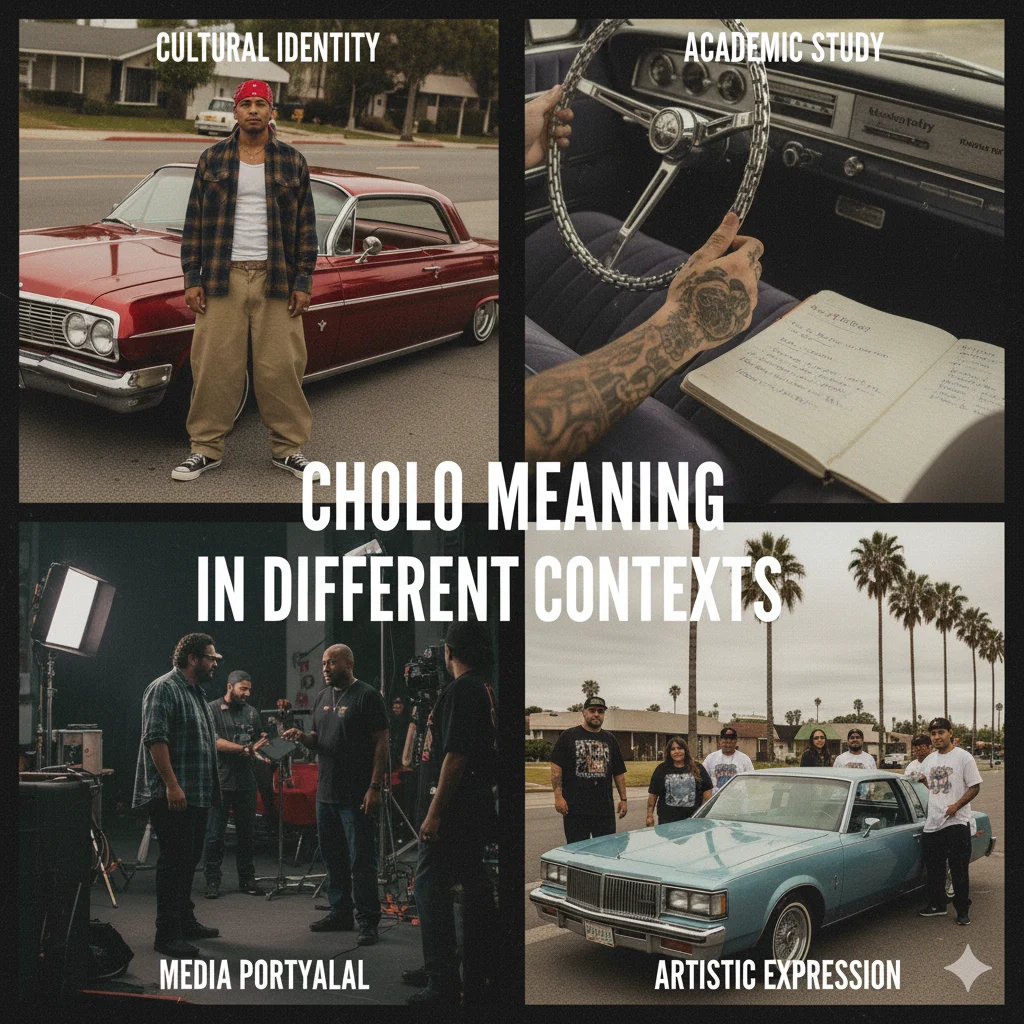
In Culture and Identity
“Cholo” often represents Mexican-American pride and urban heritage. Many people embrace it as an empowering identity, celebrating community, family, and loyalty.
Common Spanish Phrases Using “Cholo”
El cholo – Means “the cholo”, referring to a person identified with cholo culture.
Mi cholo – Means “my cholo”, often used affectionately or casually.
Soy cholo – Means “I am cholo”, expressing identity or pride.
Qué cholo – In some regions, it can mean “how cool” or “how nice”, depending on tone.
Está cholo – Can mean “he looks cool/stylish” in informal speech.
Cholo Mexican Meaning
Cholo Mexican refers to the connection between the word cholo and Mexican or Mexican-American culture.
A cholo is not simply any Mexican person. Instead, the term is mainly used for Mexican-Americans or people influenced by Mexican barrio (neighborhood) culture, especially in the United States.
Historically, the word became popular among Mexican communities in the U.S., where it described a specific street style, attitude, and cultural identity, not nationality alone.
So, while cholo has strong Mexican roots, not every Mexican is a cholo, and being a cholo is more about culture and lifestyle than being Mexican by birth.
Cholo meaning in English (Oxford-style definition):
In formal English dictionaries, cholo is listed as an informal or regional term, mainly referring to Mexican-American street culture or identity. It is not considered a standard or formal English word.
Vato Cholo Meaning
Vato cholo is a slang phrase combining two words from Mexican-American street language.
Vato means “guy” or “dude”.
Cholo refers to a person connected to cholo culture.
Together, vato cholo informally means “a cholo guy” or “a dude from cholo culture”. According to Urban Dictionary, it’s casual slang and not a formal term.
The phrase originated in Mexican-American barrios and is mostly used in spoken slang, not formal writing.
Cholo Church Meaning
Cholo church meaning does not refer to any official religious term or church concept.
There is no recognized meaning of “cholo church” in Christianity or any other religion. In most cases, the phrase is either misheard, misused, or informally created online.
Sometimes, people use cholo next to church to describe members of cholo culture attending church, or a church serving Mexican-American or barrio communities. However, this is descriptive, not religious terminology.
In short, cholo church has no fixed or official meaning and depends entirely on context.
In Fashion
The “cholo style” includes oversized shirts, bandanas, Nike Cortez shoes, and tattoos — a look that’s now iconic worldwide.
Cholo boy meaning: Cholo boy simply means a young male associated with cholo culture, either by style, attitude, or background. It does not mean a criminal or gang member—it mainly describes appearance or cultural identity.
Chola Culture
Chola culture refers to the female expression of cholo culture, rooted in Mexican-American communities. It represents a mix of cultural pride, identity, fashion, and attitude, rather than gangs or crime.
Women who identify with chola culture often express it through distinctive fashion and makeup, such as bold eyeliner, dark lipstick, styled eyebrows, oversized clothing, and hoop earrings. Beyond appearance, chola culture emphasizes strength, independence, loyalty, and community pride.
Today, chola culture is widely seen in music, art, fashion, and social media, where it is celebrated as a symbol of empowerment and cultural heritage rather than a stereotype.
In Slang or Street Contexts
Sometimes, “cholo” is used to describe a tough or gangster-like person, depending on the tone or region.
However, this meaning is context-sensitive — outsiders using it casually can come across as offensive or stereotyping.
What does the cholo whistle mean?
The cholo whistle is a sharp, loud whistle sound often associated with cholo or barrio street culture, especially in Mexican-American communities.
Its meaning depends on context. In many cases, it is used to get someone’s attention, signal presence, or call out to friends from a distance. Sometimes, it can also be used playfully or as a form of street-style expression.
While movies and media sometimes portray the cholo whistle as a gang warning or threat, this is not always true. Most of the time, it is simply a casual sound or cultural habit, not a secret code or violent signal.
In Pop Culture and Media
Movies like “Blood In Blood Out” and “American Me” brought cholo culture into the spotlight. More recently, social media platforms like TikTok and Instagram have revived it through fashion aesthetics and dance trends.
| Context | Meaning / Tone | Example |
| Cultural Identity | Pride in heritage and community | “He embraces his cholo roots with pride.” |
| Slang / Street | Gang-related or tough image | “That guy looks like a real cholo.” |
| Fashion | Distinct urban aesthetic | “She recreated a chola makeup look on TikTok.” |
Chol9 does not have an official meaning.
In most cases, chol9 is a mistyped or stylized version of the word “cholo”, often used in casual chats, usernames, or social media posts. The number 9 is sometimes used by mistake or as a design choice, but it does not change the meaning.
If someone writes chol9, they are usually referring to cholo culture or style, not a new or separate word.
💭 Examples of “Cholo” in Conversations
Example 1:
👦 Friend 1: “Bro, your outfit looks so cholo today!”
👦 Friend 2: “Yeah, I’m going for that lowrider vibe.”
Example 2:
👩 A: “Is he a cholo?”
👨 B: “Not really, he just likes the style.”
Example 3 (Cultural pride):
🧑 “Being cholo isn’t about gangs — it’s about family, loyalty, and roots.”
🔗 Similar or Related Terms
| Term | Meaning |
| Chola | The feminine form of cholo, referring to women embracing the same style or culture. |
| Vato | Mexican slang for “dude” or “guy,” often used in the same circles. |
| Barrio | Refers to a neighborhood, especially in Latino communities. |
| Pachuco | 1940s subculture that influenced early cholo fashion and slang. |
✅ How to Use “Cholo” Correctly
Do’s:
- ✅ Use “cholo” respectfully when referring to cultural style or identity.
- ✅ Appreciate the art, music, and community associated with it.
- ✅ Understand regional and historical sensitivity before using it casually.
Don’ts:
- ❌ Don’t use “cholo” as an insult or stereotype.
- ❌ Avoid assuming all Latinos or Mexican-Americans identify as cholos.
- ❌ Never use it jokingly if you’re not part of the culture — it can be offensive.
⚠️ Common Mistakes or Misinterpretations
Many people mistakenly use “cholo” to mean “gangster” or “criminal.”
While the term has been linked to street culture, that’s not its full meaning. For many, it’s a symbol of heritage, unity, and survival.
In short: “cholo” ≠ “criminal” — it’s cultural, not derogatory.
Cholo Meaning in Medical Terms
cholo has no medical meaning. It is not a medical term, disease, condition, or diagnosis.
If someone uses cholo in a medical context, it is incorrect or unrelated. The word is strictly cultural and slang-based, not scientific or medical.
Cholo Stereotype
Cholo stereotype refers to the oversimplified and negative image often associated with cholo culture. Many people wrongly assume that all cholos are gang members, criminals, or violent, which is not accurate.
This stereotype largely comes from movies, media portrayals, and headlines, not real-life experiences. In reality, cholo culture is deeply connected to family, neighborhood pride, cultural identity, and self-expression.
While some individuals involved in street culture may identify as cholos, most people who embrace cholo identity are not criminals. The stereotype ignores the cultural, historical, and social roots of the community.
Is chola an insult?
Chola is not automatically an insult, but it depends on context and who is using the word. Within Mexican-American communities, chola is often used with pride to describe cultural identity, fashion, and strength.
However, when used by outsiders in a mocking or stereotyping way, it can sound offensive or disrespectful. Because of its historical and cultural background, it’s best to use the word carefully and respectfully, especially if you are not part of the culture.
❓ FAQ Section
1. What does “cholo” mean in slang?
In slang, “cholo” refers to a Mexican-American person who embraces a specific street style — baggy clothes, tattoos, and neighborhood pride. It can mean “tough guy,” but context matters.
2. Is cholo an insult?
It depends on who says it and how. Within the community, it can be a term of endearment or pride. Used by outsiders, it can sound disrespectful if not understood properly.
3. What’s the difference between “cholo” and “chola”?
“Cholo” refers to males; “chola” is the female counterpart. Both share similar cultural and stylistic roots.
4. Where is “cholo” most commonly used?
It’s popular in the United States (especially the Southwest), Mexico, and Latin America, often within Mexican-American or Latino communities.
5. How should I use “cholo” in conversation?
Use it only when discussing style, music, or culture — not to label someone. Respectful curiosity is always better than casual assumption.
6. What does “cholo culture” represent today?
It represents a blend of Latino pride, family values, urban art, and fashion, celebrated globally as part of street and hip-hop culture.
🏁 Conclusion
The word “cholo” carries a rich history — from its colonial origins to its evolution into a vibrant symbol of Mexican-American identity and pride.
While it can describe a style or subculture, its deeper meaning lies in community, resilience, and cultural expression.
Now that you know what “cholo” really means, you’ll never misuse it again. Keep exploring our site for more insights into slang, culture, and trending expressions!

Jon McGregor is a language and word-meaning expert at Meanovia.com. He specializes in explaining complex words, phrases, and modern language trends in a clear, approachable style. His mission is to help readers quickly grasp the true meaning behind every term, making language learning and understanding effortless and engaging.