Slut meaning refers to a slang term used to describe a person—most often a woman—who is perceived as having many sexual partners or behaving in a sexually open way. In most contexts, the word is considered insulting and is commonly used to shame or judge someone rather than describe them objectively. However, its meaning can change depending on tone, intent, and situation.
Today, the word appears frequently in everyday speech, social media, movies, and music, which often causes confusion about whether it is offensive or casual slang. Some people strongly reject the term because of its harmful social impact, while others attempt to reclaim it as a form of self-expression. Understanding the meaning of “slut” isn’t just about the definition—it’s about how, when, and why the word is used. Keep reading to learn its exact meaning, origins, modern usage, and why it remains so controversial worldwide
💡 What Does “Slut” Mean?
The word “slut” traditionally refers to a woman perceived as having many sexual partners or behaving in a sexually open way.
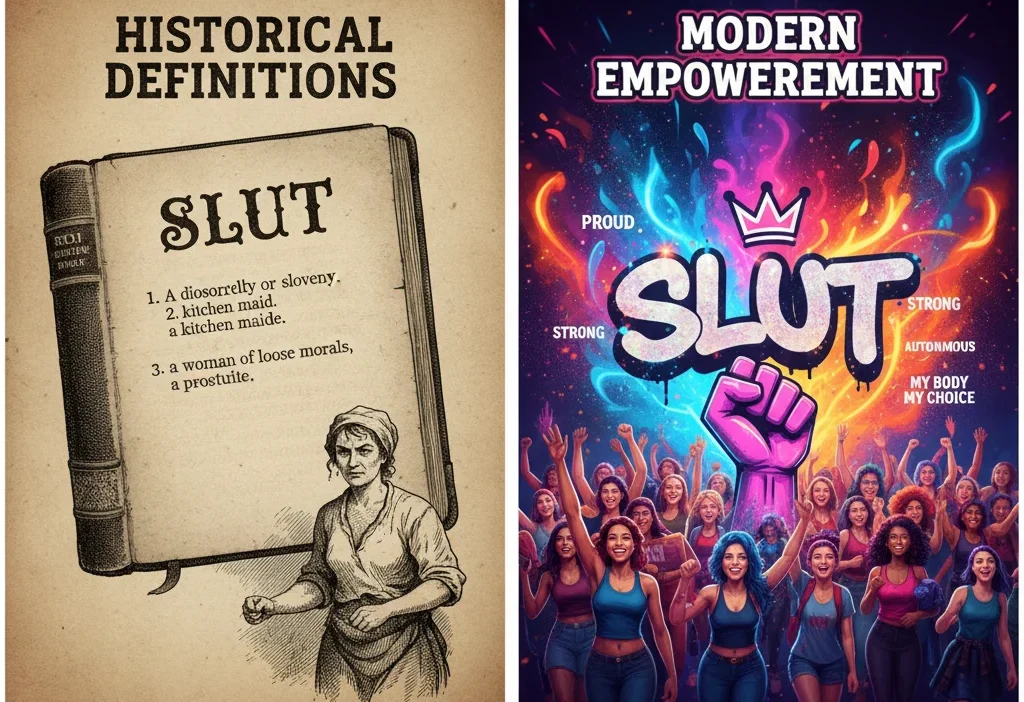
However, in modern culture, especially among younger generations and feminists, the term has been reclaimed to represent sexual freedom and body autonomy rather than shame.
👉 It’s both a slang term and a socially loaded word, used mostly in informal or online contexts.
🕰️ Origin and Popularity
The term “slut” dates back to the 15th century in English. Originally, it didn’t even have sexual connotations — it meant a messy or untidy woman.
Over time, especially by the 17th and 18th centuries, it evolved to describe a woman seen as morally loose or sexually active.
In the 2010s, the “SlutWalk” movement — started in Toronto — helped reclaim the word, turning it into a symbol of empowerment and protest against slut-shaming and victim-blaming.
Today, the term appears frequently across social media platforms like TikTok, Instagram, and Twitter (X), often used ironically or proudly.

🌐 “Slut” Meaning in Different Contexts
The meaning of “slut” depends heavily on context, tone, and intent. Here’s how it’s used across different scenarios:
📱 In Texting or Chats
Used jokingly or affectionately among friends:
“You went on three dates this week? You slut 😜”
It’s casual here — not meant as an insult but as friendly teasing.
📸 On Instagram or TikTok
Used in captions or hashtags to express confidence or sexual liberation:
“Feeling cute, wearing what I want. #slutenergy 💅”
It’s part of a body-positive or self-empowered narrative.
💼 In Professional or Formal Contexts
❌ Avoid using “slut” — it’s considered offensive or inappropriate in workplace or academic settings.
| Platform | Meaning / Tone | Example Use |
| Texting | Teasing or playful | “Okay, you flirt, you slut 😂” |
| TikTok | Empowerment or irony | “#SlutEra” trend |
| Everyday speech | Depends on tone | “Don’t call someone that unless they’re okay with it.” |
| Workplace | Offensive | Should never be used |
💬 Examples of “Slut” in Conversations
Here are a few examples to help you understand tone and context:
Example 1 — Friendly (Playful):
Friend 1: You’ve got another date tonight?
Friend 2: Haha, yeah, don’t judge me!
Friend 1: You little slut 😆
Example 2 — Empowering (Self-expression):
Caption: “It’s my body, my rules. Slut and proud 💋 #SlutWalk”
Example 3 — Negative (Insulting):
Person A: “She’s such a slut.”
Person B: “That’s not cool. Don’t judge people for their choices.”
🔄 Similar or Related Terms
| Term | Meaning | Usage |
| Thot | “That hoe over there” – a slang insult | Online, often derogatory |
| Player | Someone who dates multiple people | Neutral / playful |
| Baddie | Confident, stylish, attractive woman | Empowering |
| Slut-shaming | Criticizing someone for their sexuality | Negative behavior |
✅ How to Use “Slut” Correctly
Because it’s a loaded term, be mindful when and how you use it:
Do’s:
- ✅ Use it with close friends who are comfortable with the term.
- ✅ Use it ironically or playfully in empowering contexts.
- ✅ Support reclamation movements like SlutWalk.
Don’ts:
- ❌ Never use it to insult or demean someone.
- ❌ Avoid it in professional or public discussions.
- ❌ Don’t assume everyone is okay being called that.
🚫 Common Misinterpretations
Many people still associate “slut” only with insult, forgetting its evolving, empowering meaning in modern feminism.
👉 Context and consent matter — what’s empowering to one person may be offensive to another.
It’s also different from terms like “thot” or “hoe,” which are more explicitly derogatory.
❓FAQ Section
What does “slut” mean in modern slang?
In modern slang, “slut” can describe a person — usually a woman — who embraces her sexuality confidently. It can be empowering or insulting, depending on tone and intent.
Is “slut” a bad word?
Traditionally yes, but it’s increasingly being reclaimed as a positive expression of sexual freedom. Still, context determines whether it’s offensive.
What’s the difference between “slut” and “thot”?
“Slut” can be used positively in feminist or joking contexts, while “thot” is almost always derogatory and objectifying.
How do you reply if someone calls you a slut?
If said jokingly by a friend, you might laugh it off. But if used as an insult, you can respond confidently: “That word doesn’t define me.”
Where is the word “slut” most used?
It’s common in social media, pop culture, and casual chats, especially in Western contexts tied to body positivity and feminist movements.
When should you not use “slut”?
Avoid using it in formal, work, or public discussions — or toward someone who might find it offensive.
🏁 Conclusion
The word “slut” has come a long way — from an old insult to a modern badge of confidence and empowerment. 💪
While it still carries negative history, many people are redefining it to celebrate freedom, choice, and body positivity.
Now that you know what “slut” really means, you’ll recognize how context changes everything. Use it wisely — and always with respect. 💖
✨ Keep exploring our site for more meanings behind trending slang and cultural terms!

Jon McGregor is a language and word-meaning expert at Meanovia.com. He specializes in explaining complex words, phrases, and modern language trends in a clear, approachable style. His mission is to help readers quickly grasp the true meaning behind every term, making language learning and understanding effortless and engaging.