Ever heard someone described as “senile” and wondered what it truly means? You’re not alone. The term senile is often used in everyday conversations — sometimes accurately, sometimes not. But what does it really mean, where did it come from, and how should it be used correctly?
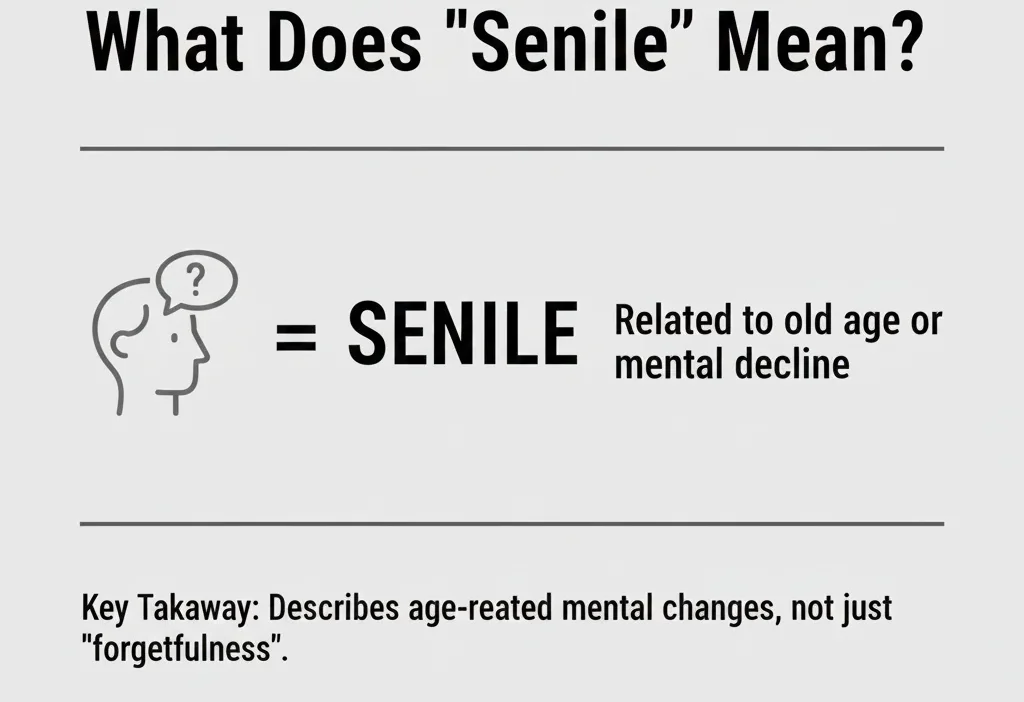
Senile describes someone who is showing signs of old age, especially mental decline, such as memory loss, confusion, or reduced cognitive abilities.
The word senile is often used when discussing aging, health, or behavior, and people search for its meaning to understand its implications. It typically refers to age-related cognitive decline, which can include forgetfulness, difficulty concentrating, or changes in personality. While the term is medical in origin, it is sometimes used informally to describe someone acting confused or forgetful.
Understanding the meaning of senile helps in interpreting conversations, medical contexts, and literature correctly.
🧩 What Does “Senile” Mean?
“Senile” means showing a decline in mental or physical abilities due to old age.
The term often refers to memory loss, confusion, or slower thinking in elderly individuals. It’s derived from medical and everyday English and is not slang or an abbreviation.
📍 Used in: medical discussions, everyday speech, and literature.
⚠️ Note: The word can sound disrespectful if used casually, so tone matters.
📜 Origin and Popularity of “Senile”
The word senile comes from the Latin term “senilis,” meaning “of old age.” It dates back to the 17th century and originally described anything associated with aging — not just mental decline.
By the 1800s, the phrase “senile dementia” became common in medical writing to describe age-related cognitive decline. Today, the term is still understood but has largely been replaced in clinical settings by “dementia” or “cognitive impairment.”
🕰️ Timeline Snapshot:
- 1600s: “Senile” used to describe old age in general.
- 1800s: Adopted in medical terms like “senile dementia.”
- Modern Day: Commonly used in informal speech, sometimes inaccurately.
💬 “Senile” Meaning in Different Contexts
🏥 In Medical or Scientific Use
“Senile” refers to age-related cognitive decline or symptoms such as memory loss and confusion.
Example: “The doctor mentioned signs of senile dementia in older patients.”
🗣️ In Everyday Language
People often use “senile” loosely to mean forgetful or confused — even for younger individuals.
Example: “I forgot my keys again — I’m getting senile!”
⚠️ This use is informal and can be considered insensitive when referring to others.
📚 In Literature and Media
Writers may use “senile” symbolically to portray wisdom mixed with decline or nostalgia.
Example: “The senile king clung to his fading glory.”
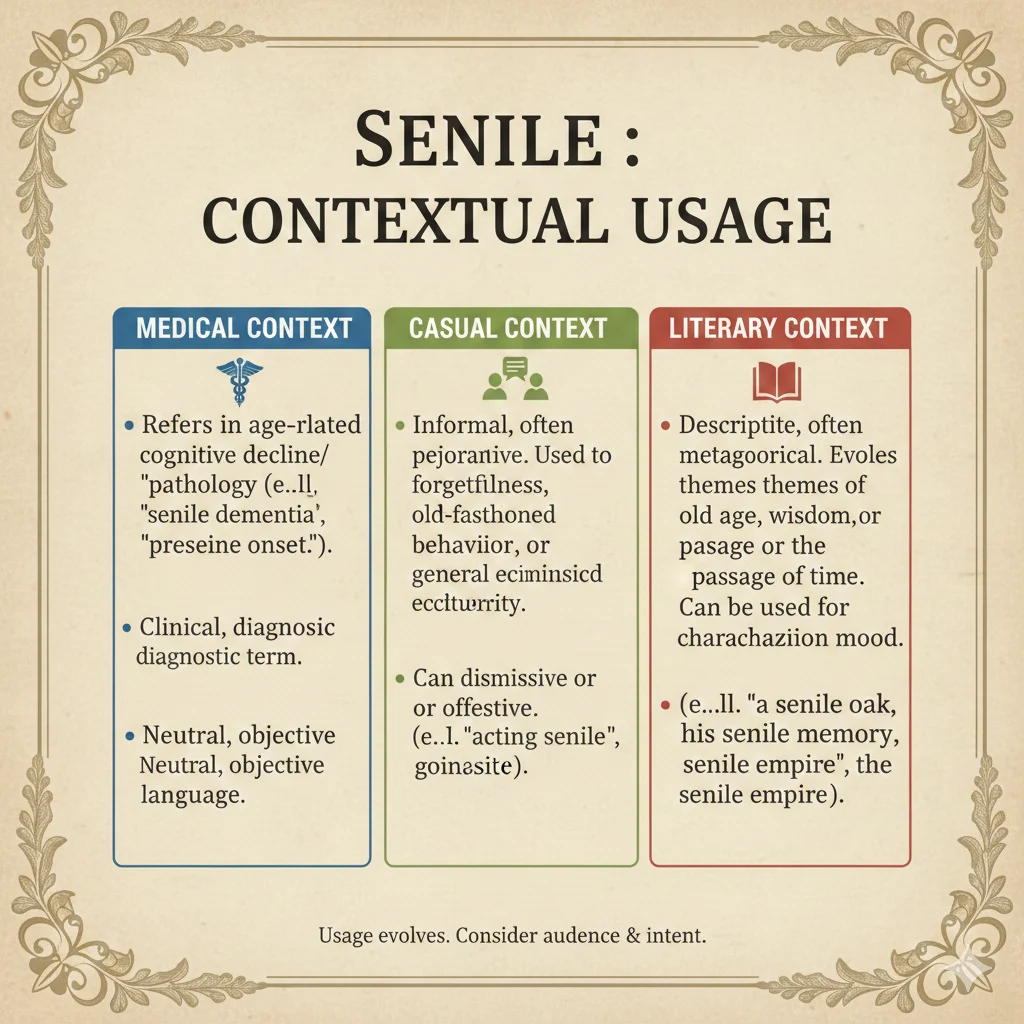
| Context | Meaning | Tone |
| Medical | Age-related mental decline | Clinical |
| Everyday | Forgetfulness, confusion | Informal |
| Literature | Symbol of old age or decay | Figurative |
🗨️ Examples of “Senile” in Conversations
Example 1 (Casual):
👤 Friend 1: “I can’t remember where I parked!”
👤 Friend 2: “You’re going senile already?”
Example 2 (Medical):
🧑⚕️ Doctor: “Your father is showing early signs of senile dementia.”
👩 Patient: “Is there any treatment available?”
Example 3 (Literary):
📖 Quote: “The senile ruler wandered through his palace, lost in time.”
🔍 Similar or Related Terms
| Term | Meaning | Usage |
| Dementia | General term for cognitive decline | Medical |
| Forgetful | Temporary memory lapse | Everyday |
| Elderly | Advanced in age | Neutral |
| Cognitive decline | Scientific term for aging-related changes | Academic |
| Geriatric | Relating to old age or elderly care | Clinical |
✅ How to Use “Senile” Correctly
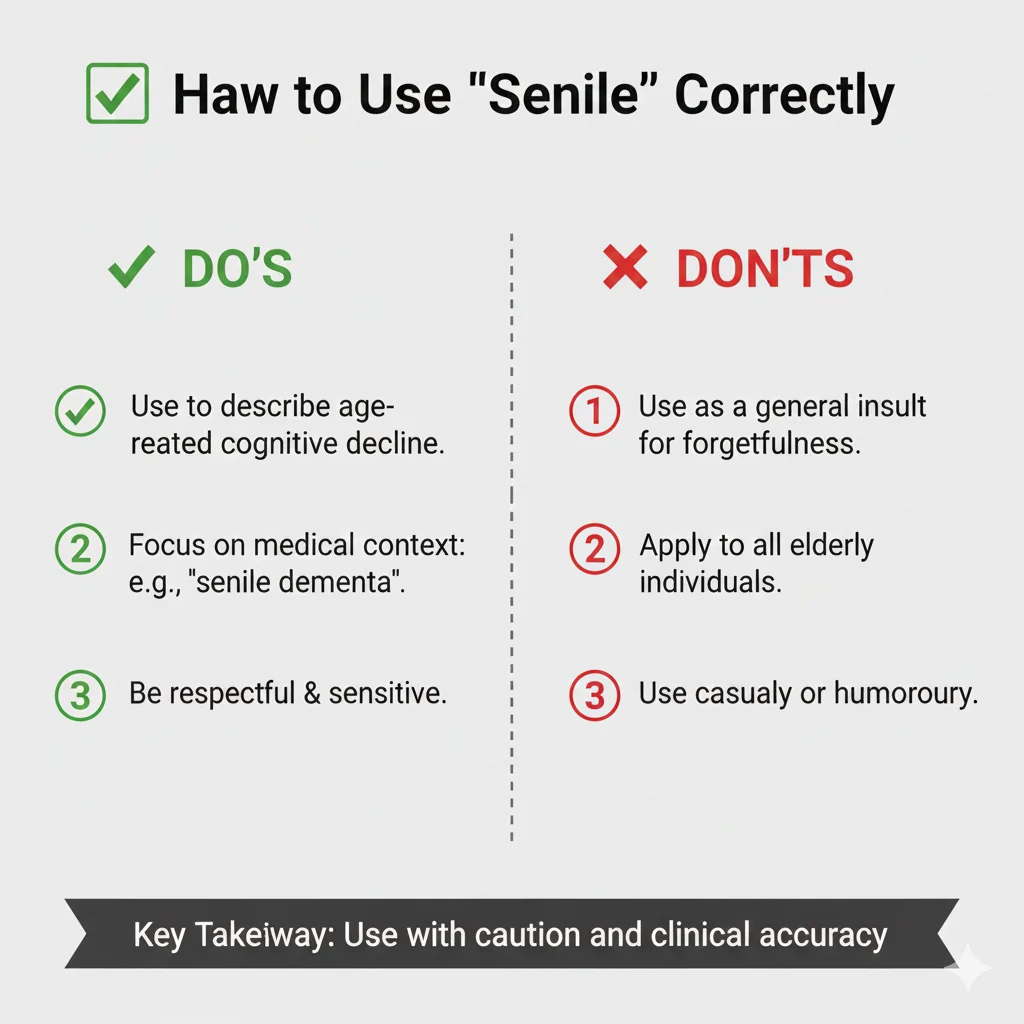
Here are some do’s and don’ts for using the word “senile”:
✅ Do:
- Use it when discussing age-related mental decline.
- Use it carefully in medical or descriptive writing.
❌ Don’t:
- Use it jokingly or insultingly toward others.
- Confuse it with normal forgetfulness or stress-related memory issues.
Example of proper use:
“The patient’s senile condition requires careful monitoring.”
Example of incorrect use:
“You forgot your password again? You’re so senile!” (Rude or inappropriate)
⚠️ Common Mistakes or Misinterpretations
- Confusing “senile” with “dementia.”
→ Dementia is a medical condition; senile is a descriptive adjective. - Using it for younger people.
→ It’s incorrect — the word specifically relates to old age. - Assuming it always means crazy or foolish.
→ It refers to mental decline, not behavior or intelligence.
❓ FAQ
1. What does “senile” mean in simple words?
“Senile” means showing signs of aging, especially mental decline like forgetfulness or confusion.
2. Is “senile” a bad word to use?
It can be — especially if used to mock or insult someone. In professional or polite settings, use “elderly” or “cognitive decline” instead.
3. What’s the difference between “senile” and “dementia”?
“Dementia” is a medical diagnosis, while “senile” is an adjective describing age-related decline.
4. Can a young person be called “senile”?
No. The word applies to older adults, not to temporary forgetfulness in younger people.
5. Is “senile” still used in medicine?
It’s becoming less common in medical language, replaced by terms like “neurocognitive disorder” or “age-related dementia.”
6. How do you respectfully talk about aging and memory loss?
Use phrases like “memory impairment,” “cognitive decline,” or “age-related changes” instead of “senile.”
🧾 Conclusion
To sum up, “senile” means showing signs of aging, especially mental or physical decline. Originating from Latin, the term once had a neutral tone but now carries a sensitive connotation. It’s best used carefully — ideally in medical or descriptive contexts, not casually.
Now that you know what “senile” really means, you’ll never misuse it again! Keep exploring our site for more word meanings, slang guides, and language insights that help you speak smarter and clearer every day.

Deborah Levy is a word-meaning expert at Meanovia.com. She explains complex terms, phrases, and language trends in a clear, relatable way, helping readers quickly understand the exact meaning behind every word.