
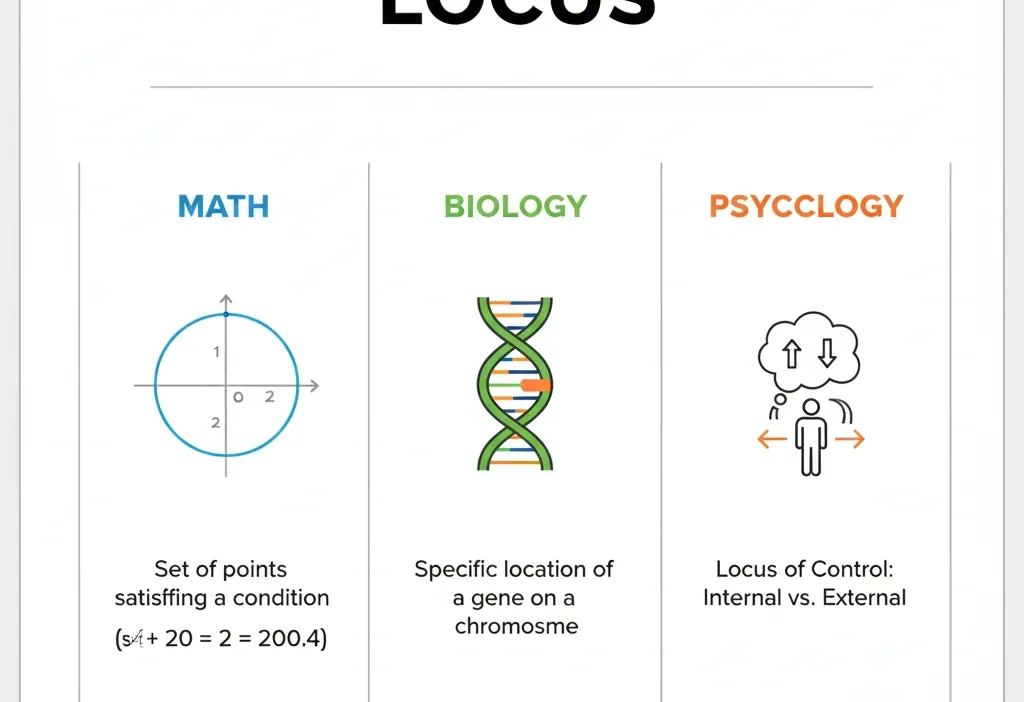
Ever heard the word “locus” in a conversation or textbook and wondered what it actually means? You’re not alone! “Locus” is one of those versatile terms that appear in different contexts — from mathematics and genetics to psychology and philosophy — but its core idea remains the same: a specific place or position.
In this article, we’ll cover:
- The definition of “locus”
- Its origin and popularity
- Different meanings across contexts
- Real-world examples
- Related terms and FAQs
📘 What Does Locus Mean?
“Locus” means a specific place, position, or point where something occurs or exists.
It’s a Latin-origin noun often used in academic and scientific contexts such as mathematics, biology, and psychology.
For example:
- In math, it means a set of points satisfying a particular condition.
- In genetics, it refers to the position of a gene on a chromosome.
- In psychology, it refers to one’s sense of control over life events — known as “locus of control.”
🏛️ Origin and Popularity
The word “locus” comes directly from Latin, meaning “place” or “location.” It was first recorded in English use during the 17th century, primarily in geometry and logic.
📜 Quick Timeline:
- 1600s: Introduced in mathematics to describe positions of points.
- 1900s: Adopted in biology for genetic mapping.
- 1950s onward: Used in psychology with “locus of control,” popularized by Julian B. Rotter, an American psychologist.
Today, “locus” remains widely used in academic fields, showing how a single term can connect multiple disciplines through the idea of “place” or “position.”
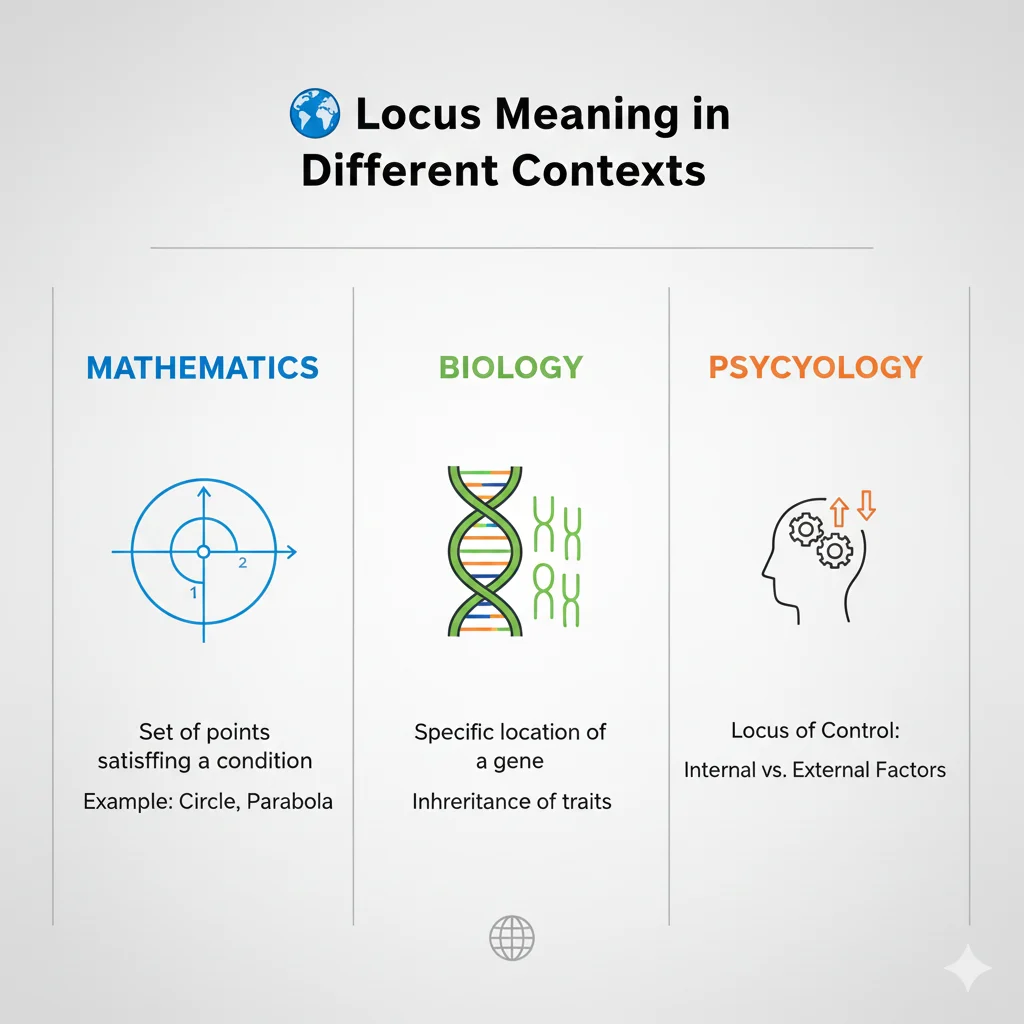
🌍 Locus Meaning in Different Contexts
Let’s break down what “locus” means in various fields:
🧮 In Mathematics
Locus refers to a set of points that satisfy a given condition or rule.
Example: “The locus of points equidistant from a fixed point is a circle.”
It’s fundamental in geometry for defining shapes and curves.
🧬 In Genetics
A locus is the specific physical location of a gene or genetic marker on a chromosome.
Example: “The BRCA1 gene is located at locus 17q21 on chromosome 17.”
Scientists use loci (plural of locus) to map genes and study inheritance patterns.
🧠 In Psychology
In psychology, “locus” appears in the concept of locus of control, which describes how strongly individuals believe they have control over life events.
- Internal locus: Belief that one controls their destiny.
- External locus: Belief that external forces control life outcomes.
Example: “People with an internal locus of control tend to take more responsibility for their actions.”
📖 In General Usage
Outside academic settings, “locus” simply means a central point or hub where something happens.
Example: “The city became the locus of cultural exchange.”
🗂️ Summary Table: Locus Across Fields
| Context | Meaning | Example Usage |
| Mathematics | Set of points satisfying a condition | Locus of points equidistant from a line |
| Genetics | Position of a gene on a chromosome | Locus of BRCA1 gene on chromosome 17 |
| Psychology | Perceived control source (internal/external) | Locus of control |
| General Use | Central or focal place | The campus is the locus of innovation |
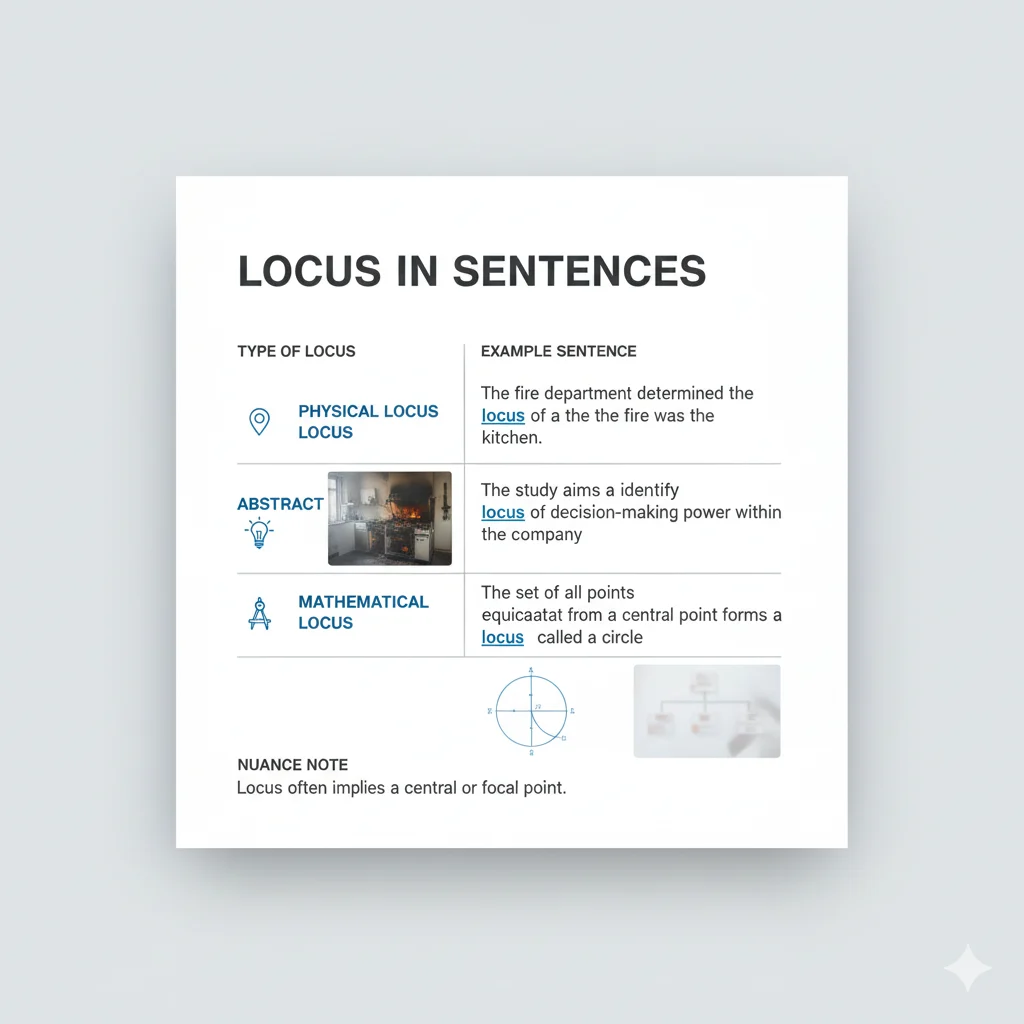
💬 Examples of Locus in Sentences
Here are some real-world examples to make it clearer:
🧮 “In geometry, the locus of all points equidistant from two lines forms an angle bisector.”
🧬 “Each gene occupies a unique locus on a chromosome.”
🧠 “Her internal locus of control helps her stay motivated even under pressure.”
🏙️ “The library became the locus of student activity during finals week.”
🔗 Similar or Related Terms
Here are some related or semantically linked terms that help expand your vocabulary:
| Term | Meaning | Relation to “Locus” |
| Location | A specific place | Common synonym |
| Position | Place where something is situated | Conceptually similar |
| Site | Particular spot where something occurs | Often used in science |
| Focus | Center of attention or activity | Figuratively linked |
| Loci | Plural of “locus” | Used in scientific writing |
✍️ How to Use “Locus” Correctly
✅ Do’s
- Use it in academic or formal contexts.
- Clarify the field (math, genetics, psychology) when relevant.
- Remember that “loci” is the plural form.
❌ Don’ts
- Don’t use it casually in everyday text messages.
- Don’t confuse it with “location” unless discussing a conceptual position.
Example:
✅ “The locus of control theory explains personality differences.”
❌ “Let’s meet at the locus” (use “location” instead).
⚠️ Common Mistakes or Misinterpretations
- Confusing Locus with Focus:
While both relate to a “center,” focus refers to attention or emphasis, whereas locus refers to a position or place. - Using Wrong Plural Form:
The plural is “loci”, not “locuses.” - Overgeneralizing:
Avoid using “locus” to mean any random place — it’s more precise and context-bound.
❓ FAQ Section
1. What does “locus” mean in simple terms?
“Locus” means a specific place or position where something occurs — physical, conceptual, or symbolic.
2. What does “locus” mean in genetics?
In genetics, it’s the exact spot on a chromosome where a particular gene is found.
3. What is the plural of “locus”?
The plural form is “loci”, pronounced low-sigh.
4. What is the “locus of control” in psychology?
It’s a theory describing whether a person believes they control their life (internal) or external forces control it (external).
5. Is “locus” used in daily English?
Rarely. It’s mostly found in academic, scientific, or formal contexts.
6. What’s the difference between “locus” and “location”?
“Location” refers to a general physical place, while “locus” often has a specific or conceptual meaning, especially in science.
🏁 Conclusion
To sum it up, “locus” means a specific place or position where something occurs, whether it’s a point in geometry, a gene’s position in genetics, or a psychological concept of control. Its Latin roots and cross-disciplinary use make it a powerful, precise word across science and academia.
Now that you know what “locus” means, you’ll recognize it everywhere — from textbooks to scientific papers. Keep exploring our site to learn more about fascinating terms that connect language, science, and culture! 🌍✨

Jon McGregor is a language and word-meaning expert at Meanovia.com. He specializes in explaining complex words, phrases, and modern language trends in a clear, approachable style. His mission is to help readers quickly grasp the true meaning behind every term, making language learning and understanding effortless and engaging.