
Ever come across the phrase “in situ” in a science article, construction report, or even a museum description and wondered what it really means? You’re not alone!
The term “in situ” is a Latin phrase that pops up across multiple fields — from medicine and archaeology to everyday English. In this guide, we’ll break down:
In situ is a Latin phrase that means “in its original place” or “on site,” referring to something that remains where it naturally occurs.
The term in situ is commonly used in science, medicine, archaeology, and everyday language to describe something observed, studied, or left in its original position. For example, in archaeology, artifacts found in situ have not been moved from where they were discovered. In medicine, it can describe a condition that has not spread beyond its original location.
Understanding the meaning of in situ helps you interpret academic texts, reports, and professional discussions accurately. The phrase emphasizes context and authenticity, showing that location matters when analyzing or evaluating something.
💬 What Does In Situ Mean?
“In situ” means “in its original place” or “in position.”
It’s a Latin phrase used to describe something that remains or occurs in its natural, original, or proper location — whether it’s a fossil, a tumor, a building artifact, or an environmental process.
For example:
- In archaeology: an artifact found in situ means it was discovered exactly where it was originally placed or used.
- In medicine: a tumor in situ means it hasn’t spread from its original location.
🏛️ Origin and Popularity
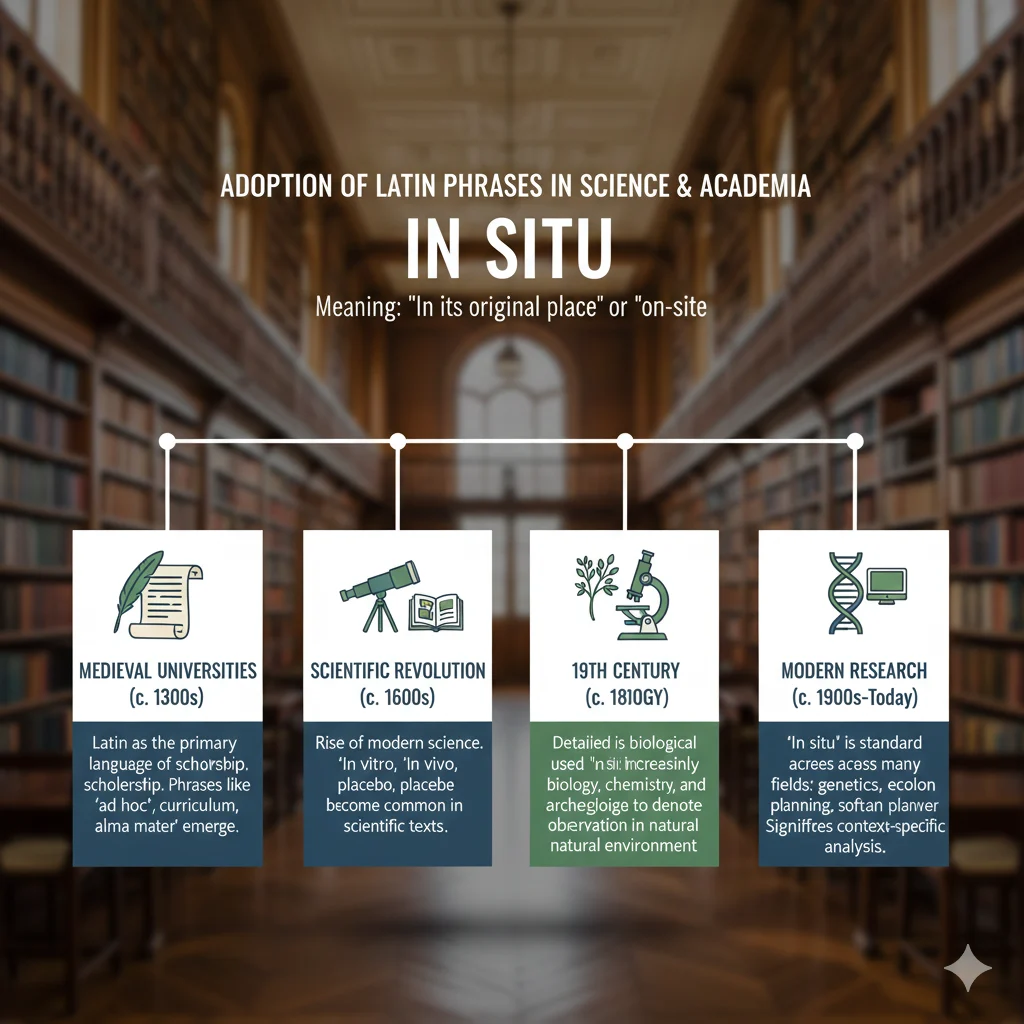
The phrase “in situ” comes from Latin, where in means “in” and situ means “place” or “position.”
It dates back to ancient Rome but gained modern relevance through scientific and academic writing in the 17th–19th centuries. Scholars, geologists, and medical professionals used Latin to describe precise conditions, and in situ became a go-to term for accuracy.
Today, the phrase remains popular across disciplines — from engineering and environmental science to museums and social media captions referencing “original context” or “authentic location.”
🌐 In Situ Meaning in Different Contexts
Because of its versatility, in situ is used in several professional and academic settings. Here’s how the meaning shifts slightly by context:
🧬 In Science and Medicine
- Refers to something that exists in its original or natural position.
- Example: “Carcinoma in situ” describes cancer cells that have not invaded surrounding tissues.
🏗️ In Engineering or Construction
- Describes materials, structures, or experiments performed on-site rather than in a lab or factory.
- Example: “In situ concrete” means concrete poured and hardened directly at the construction site.
🏺 In Archaeology and Art
- Used when artifacts, fossils, or artworks are found or displayed in their original context or location.
- Example: “The pottery was found in situ within the burial site.”
🌱 In Environmental Science
- Refers to processes or conservation efforts occurring within natural ecosystems.
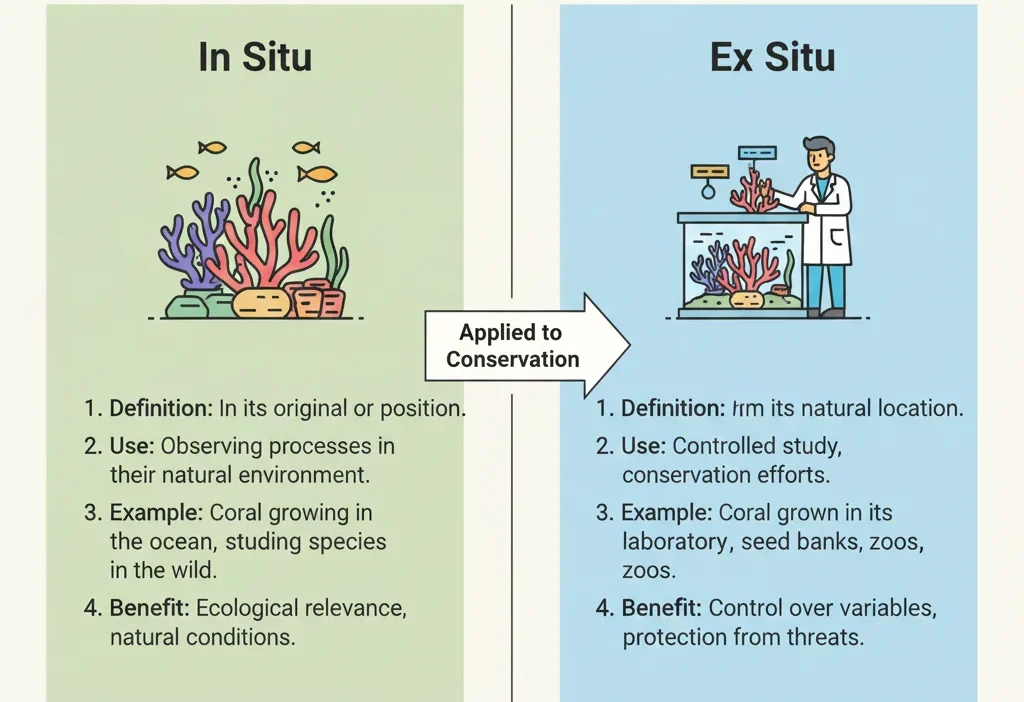
- Example: “In situ conservation” means protecting species in their natural habitats.
| Field | Meaning of “In Situ” | Example |
| Medicine | Still in original place | Carcinoma in situ |
| Engineering | Built or tested on site | In situ concrete |
| Archaeology | Found in original location | Fossil found in situ |
| Environmental Science | In natural habitat | In situ conservation |
💬 Examples of In Situ in Real Conversations
Here are a few ways you might see or hear in situ used:
In Academic or Professional Contexts:
“The research was conducted in situ to observe natural behavior.”
“They discovered an in situ fossil near the ancient riverbed.”
In Casual or Cultural Use:
“The artist preferred to paint in situ, capturing the light as it naturally fell on the scene.”
Medical Example:
“The biopsy confirmed a carcinoma in situ, meaning it hasn’t spread yet.”
🔍 Similar or Related Terms
Here are a few related Latin and English expressions often seen alongside in situ:
| Term | Meaning | Example |
| Ex situ | Outside the original place | Ex situ conservation in zoos |
| In vivo | Within a living organism | In vivo testing on animals |
| In vitro | In glass (lab conditions) | In vitro fertilization |
| On-site | At the physical location | On-site concrete work |
🧠 How to Use In Situ Correctly
✅ Do’s:
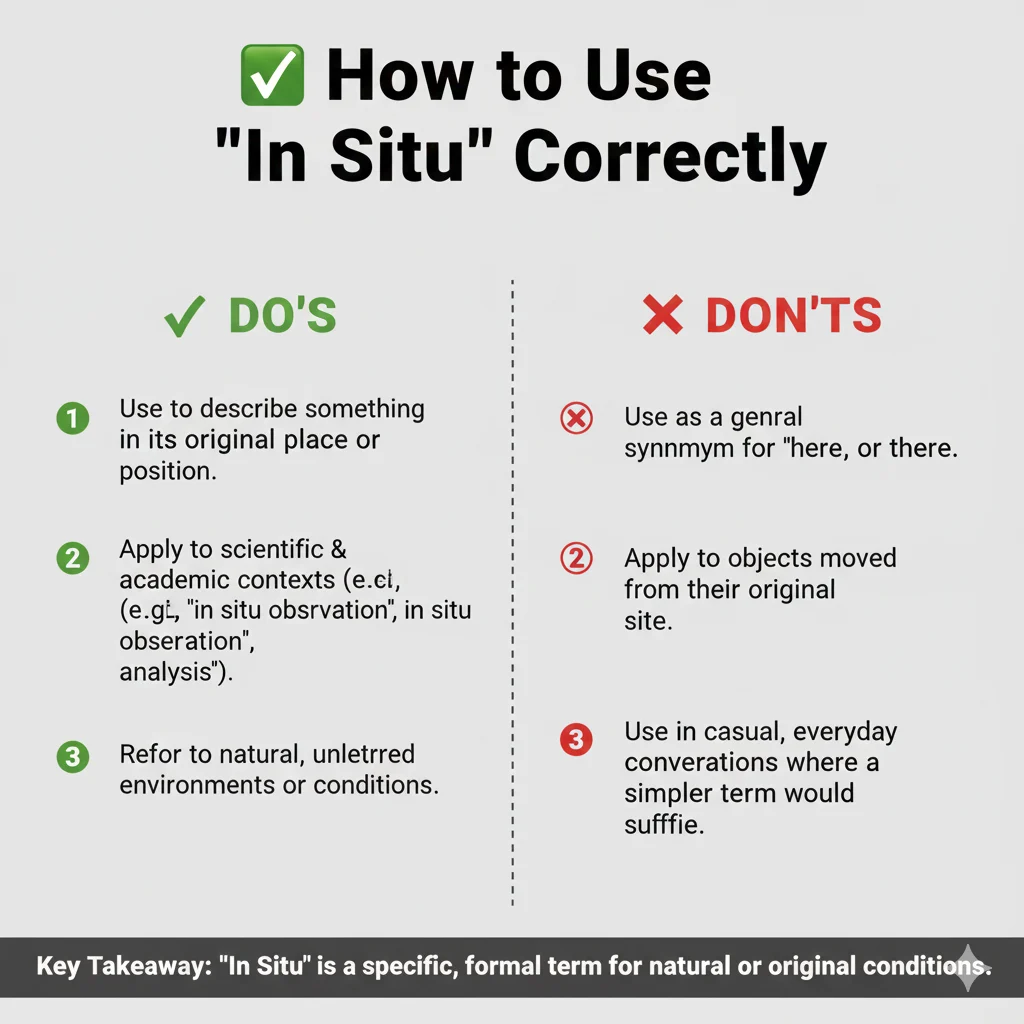
- Use in situ to describe something in its original or natural position.
- Italicize it in formal writing (since it’s Latin): in situ.
- Ideal for academic, professional, or descriptive contexts.
❌ Don’ts:
- Avoid using it casually in texts or informal chats — it sounds overly formal.
- Don’t confuse it with ex situ (which means “out of place”).
Correct: “The statue was restored in situ.”
Incorrect: “Let’s meet in situ for coffee.” (sounds unnatural)
⚠️ Common Mistakes or Misinterpretations
- Confusing in situ with “on-site”
- While similar, “on-site” is a plain English term, whereas in situ carries a more academic or technical tone.
- While similar, “on-site” is a plain English term, whereas in situ carries a more academic or technical tone.
- Mixing up in situ and ex situ
- In situ = in place; Ex situ = out of place or off-site.
- In situ = in place; Ex situ = out of place or off-site.
- Using without italics in formal contexts
- It’s standard to italicize Latin phrases like in situ, in vitro, and ex situ in scholarly writing.
- It’s standard to italicize Latin phrases like in situ, in vitro, and ex situ in scholarly writing.
❓ FAQ Section
1. What does in situ mean in simple terms?
It means “in its original place.” Whether it’s an object, structure, or biological element, in situ means it remains exactly where it belongs.
2. Is in situ slang or formal?
It’s formal — commonly used in academic, medical, and professional fields rather than casual conversation.
3. What’s the difference between in situ and ex situ?
In situ means in place; ex situ means removed or relocated. For example, fossils in situ are untouched, while those taken to a museum are ex situ.
4. How do you pronounce in situ?
It’s pronounced “in SEE-too” or “in SIGH-too”, depending on regional preference.
5. Where is in situ most used?
You’ll find it in scientific research, medical reports, engineering, art restoration, and archaeology.
6. When should you not use in situ?
Avoid it in casual speech or texts — it’s better suited for technical or academic discussions.
🧩 Conclusion
In short, “in situ” means “in its original or natural position.” From archaeology and medicine to construction and art, it’s a phrase that highlights authenticity, precision, and context.
Now that you know what in situ means, you’ll recognize it everywhere — from museum labels to research papers! Keep exploring our site for more fascinating word origins and trending terminology explained clearly.

Evie Wyld is a word-meaning specialist at Meanovia.com. She simplifies complex words, phrases, and language trends, helping readers quickly grasp the exact meaning behind every term in a clear and approachable way.