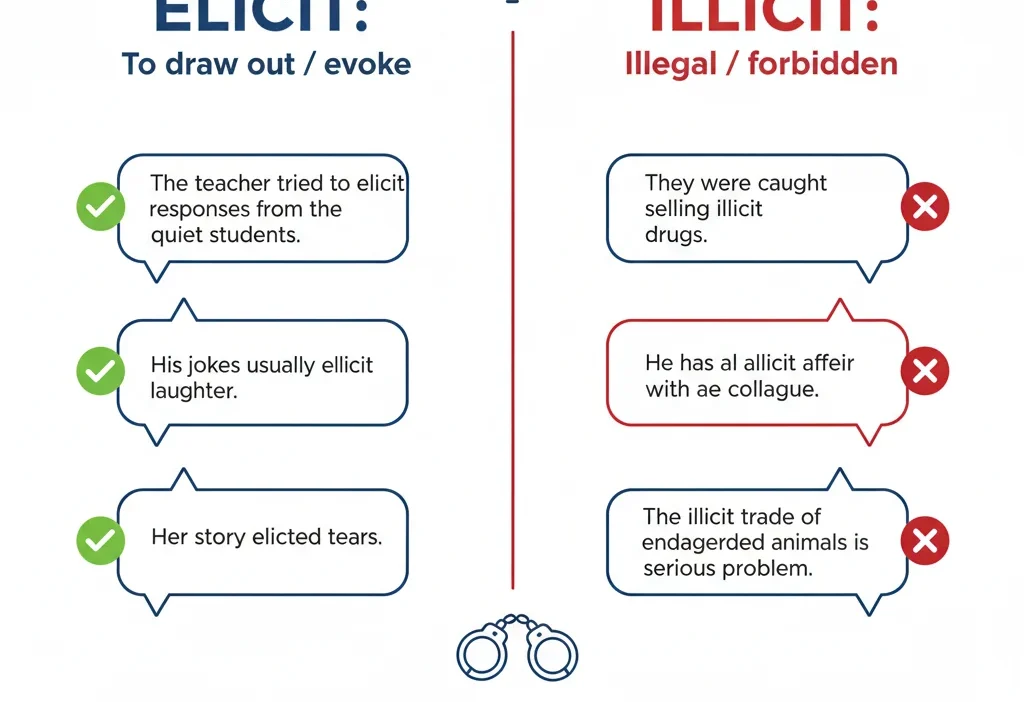
Ever heard someone say a question was meant to “elicit a response” and wondered what that really means? You’re not alone. The word “elicit” often confuses people because it sounds similar to “illicit” — but their meanings are completely different.
In this article, we’ll break down the meaning of “elicit”, its origin, and how it’s used in conversation, education, psychology, and business writing. You’ll also find real-life examples, common mistakes, and a quick FAQ to help you use it naturally and correctly.
What Does “Elicit” Mean?
The word “elicit” means to draw out, evoke, or bring forth a response, reaction, or piece of information.
It’s most commonly used as a verb in formal or academic contexts like teaching, psychology, or discussions.
✅ Example:
“The teacher tried to elicit thoughtful answers from the students.”
Origin and Popularity
The term “elicit” comes from the Latin word “elicere,” meaning “to draw out or entice.” It entered the English language in the mid-17th century, maintaining nearly the same meaning over centuries.
It’s often used in academic writing, communication studies, and psychology to describe the act of triggering a response — emotional, verbal, or behavioral.
A key moment that boosted its everyday use came from educational psychology, where teachers were encouraged to “elicit responses” rather than just “ask questions.”
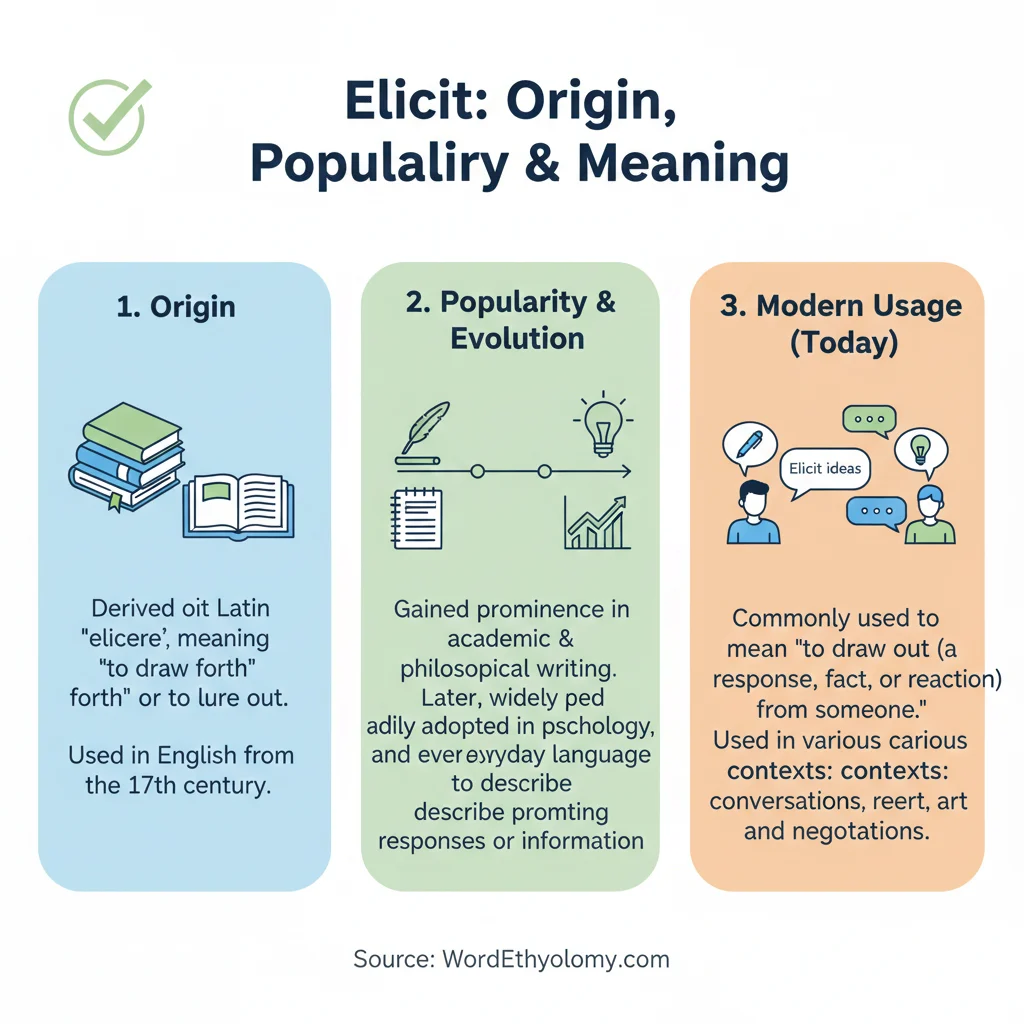
📅 Timeline:
- 1600s: Entered English via Latin.
- 1900s: Common in psychology and education.
- Today: Widely used in business, interviews, and academic discussions.
Elicit Meaning in Different Contexts
1. In Everyday Conversation
Used to mean drawing out a reaction or comment.
- “Her joke elicited laughter from the crowd.”
2. In Education
Teachers use questions to elicit responses that show understanding.
- “The quiz was designed to elicit critical thinking.”
3. In Psychology
Refers to stimulus and response behavior.
- “The experiment elicited a fear response in the subject.”
4. In Business or Communication
Used for feedback or opinions.
- “The manager elicited valuable insights during the meeting.”
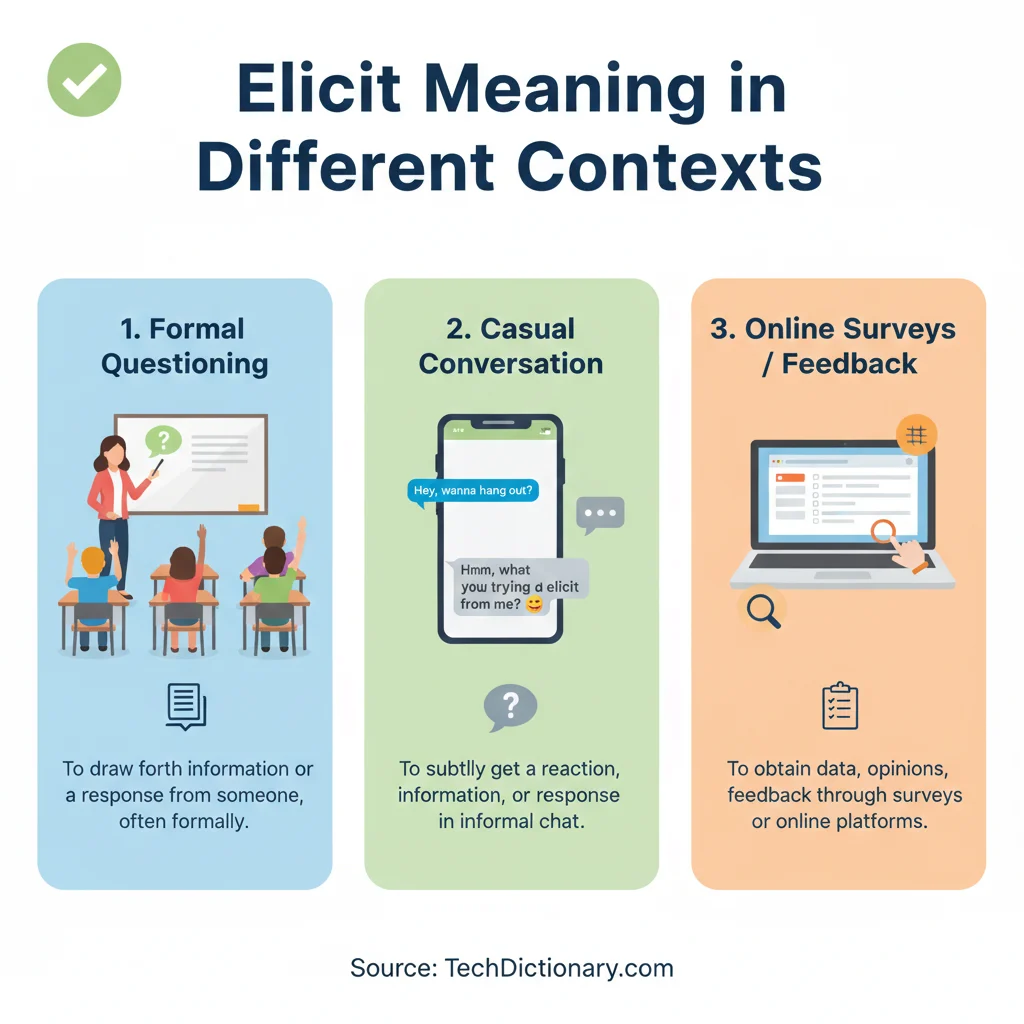
| Context | Meaning of Elicit | Example |
| Text or Conversation | Draw out an emotional or verbal reaction | “His speech elicited cheers.” |
| Education | Encourage participation or ideas | “Teachers elicit answers through questions.” |
| Psychology | Trigger a mental or emotional response | “The image elicited anxiety.” |
| Business | Gain feedback or data | “The survey elicited customer preferences.” |
Examples of “Elicit” in Sentences
Here are some examples showing how to use “elicit” naturally:
💬 Conversation Examples:
- “The comedian’s story elicited laughter from everyone.”
- “Her honesty elicited admiration from her peers.”
- “The teacher’s question elicited silence — nobody knew the answer.”
- “That scene in the movie elicited tears.”
💼 Formal Example:
“The company’s report was designed to elicit constructive feedback from stakeholders.”
Similar or Related Terms
| Term | Meaning | Example |
| Evoke | To bring a feeling or memory to mind | “The song evoked nostalgia.” |
| Extract | To remove or pull something out physically or figuratively | “They extracted key insights from the data.” |
| Prompt | To cause someone to take action or speak | “Her remark prompted an apology.” |
| Illicit (commonly confused) | Illegal or forbidden | “They were involved in illicit activities.” |
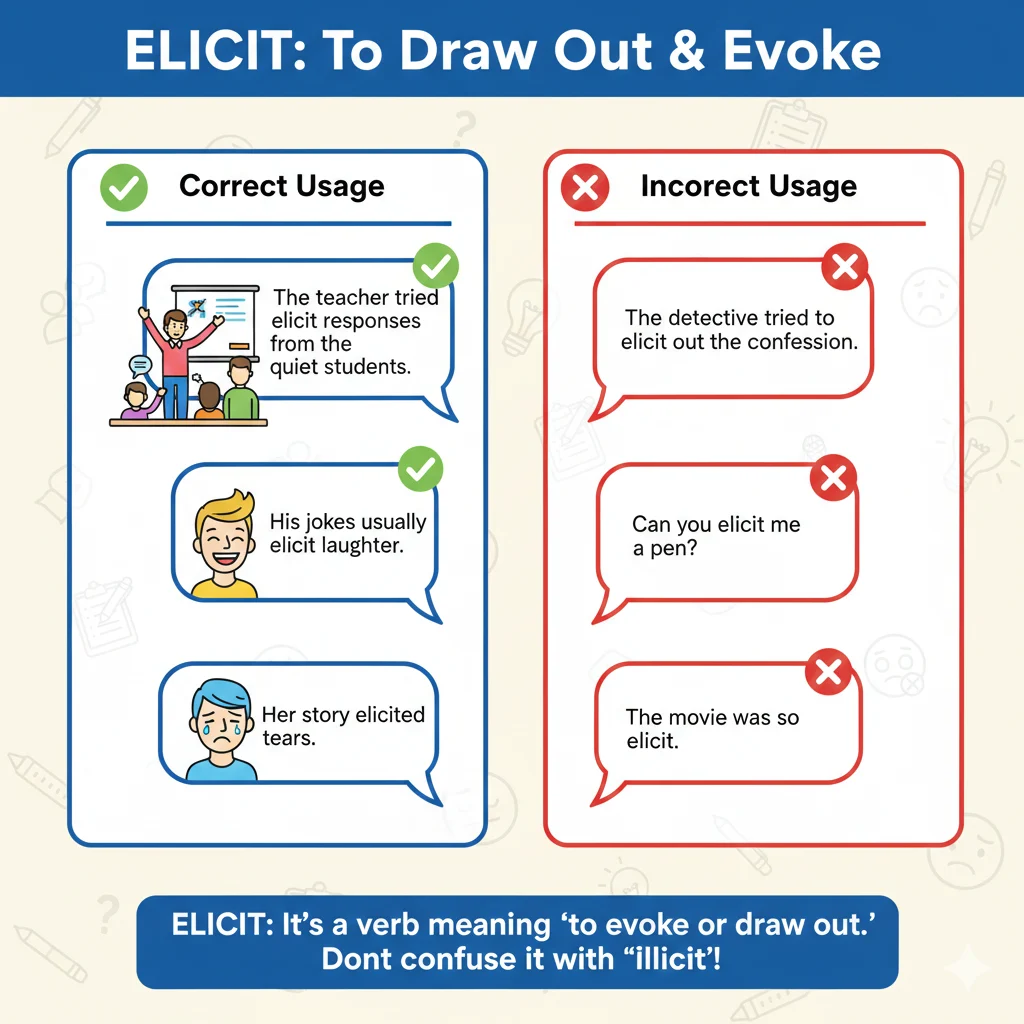
🔹 Note: “Elicit” (draw out) ≠ “Illicit” (illegal).
How to Use “Elicit” Correctly
✅ Do’s
- Use elicit when describing drawing out a response.
- Use it in academic, professional, or formal writing.
- Pair it with emotions, answers, reactions, or feedback.
❌ Don’ts
- Don’t confuse elicit with illicit.
- Don’t use it for physical actions — it’s about responses, not objects.
Examples:
- ✅ “The coach’s speech elicited motivation.”
- ❌ “He elicited the ball from the box.” (Incorrect — use “took” or “removed” instead.)
Common Mistakes or Misinterpretations
Many English learners and even native speakers confuse “elicit” with “illicit” because they sound alike.
Here’s the difference:
- Elicit (verb): To draw out or evoke.
Example: “The video elicited strong emotions.” - Illicit (adjective): Illegal or forbidden.
Example: “Illicit trade is strictly prohibited.”
A good tip:
👉 Elicit = Emotion
👉 Illicit = Illegal
FAQ: Elicit Meaning Explained
1. What does “elicit” mean in English?
“Elicit” means to draw out or evoke a response, emotion, or piece of information from someone. It’s commonly used in formal and academic settings.
2. Is “elicit” slang or formal?
It’s a formal English verb, not slang. You’ll often see it in business reports, psychology papers, and education materials.
3. What is the difference between “elicit” and “illicit”?
“Elicit” means to bring out, while “illicit” means illegal or forbidden. They’re homophones (sound-alike words) with totally different meanings.
4. How do you use “elicit” in a sentence?
Use it when describing the act of drawing out a reaction:
“The teacher’s question elicited thoughtful discussion.”
5. Where is “elicit” most used?
It’s most common in education, psychology, business communication, and research writing.
6. Can “elicit” be used in casual speech?
Yes, but it may sound a bit formal. In casual talk, people often say “get” or “bring out” instead.
Conclusion
The word “elicit” means to draw out or evoke a reaction, emotion, or response.
It has deep roots in Latin and remains a powerful word in education, psychology, and professional communication.
Now that you know what “elicit” means — and how to use it — you’ll never confuse it with “illicit” again! Keep exploring our site to discover more English words, slang, and expressions that can elevate your vocabulary and writing.

Evie Wyld is a word-meaning specialist at Meanovia.com. She simplifies complex words, phrases, and language trends, helping readers quickly grasp the exact meaning behind every term in a clear and approachable way.