
Have you seen the word “discrete” in math class or writing and wondered what it really means?
Quick answer: Discrete means separate, distinct, or individually different from others. It describes things that are clearly divided and not continuous. In simple terms, discrete refers to separate units rather than something flowing without interruption.
In general English, “discrete” describes things that are independent and not connected. In math, however, a discrete variable is one that can only take specific values (like whole numbers). The word comes from the Latin discretus, meaning “separated.”
If you searched for “discrete meaning,” you likely want to know:
- What discrete means in simple English
- What it means in mathematics or statistics
- The difference between discrete and continuous
- And how it differs from “discreet” (which means careful or private)
Below, you’ll find clear explanations, examples, pronunciation help, and comparisons — so you can understand and use “discrete” correctly in any context.
🧐 What Does “Discrete” Mean?
“Discrete” means something that is separate, distinct, or individually different from others.
It’s an adjective used in academic, mathematical, and general English contexts to describe individual, unconnected parts.
Example:
“The project was divided into discrete phases to manage progress more efficiently.”
🏛️ Origin and Popularity of “Discrete”
The word “discrete” originates from the Latin term “discretus,” meaning separated or distinct. It entered Middle English around the 14th century and has since been used in both formal and academic writing.
In modern English, “discrete” gained renewed popularity in technical fields like:
- Mathematics (e.g., discrete variables, discrete data)
- Computer science (e.g., discrete signals, discrete systems)
- Philosophy and linguistics (e.g., discrete units of meaning)
🕰️ Timeline Snapshot:
- 1300s: Entered English from Old French discret.
- 1900s: Adopted widely in mathematics and engineering.
- Today: Common in academic and analytical writing.
🌐 “Discrete” Meaning in Different Contexts
| Context | Meaning of ‘Discrete’ | Example |
|---|---|---|
| Everyday English | Separate or distinct items | “The museum has discrete sections for each art period.” |
| Mathematics | Individual values (not continuous) | “A discrete variable can take only specific values.” |
| Computer Science | Data that exists in separate units | “Digital signals are discrete, unlike analog signals.” |
| Linguistics | Units that stand alone in meaning | “Language is made up of discrete sounds called phonemes.” |
Discrete units are individual elements that exist separately from one another. In linguistics, phonemes are discrete units of sound. In science, particles can be treated as discrete units when analyzed individually.
Computer Science
In computer science, discrete refers to data or signals that exist in separate values rather than continuous streams. Digital systems operate using discrete signals (0s and 1s), unlike analog systems that vary continuously. Discrete structures are fundamental in algorithms, databases, and data processing.
In mathematics, discrete meaning refers to values that are countable and distinct. A discrete variable can take specific numbers (like 1, 2, 3) but not fractions in between. Discrete mathematics studies structures that are fundamentally separate rather than continuous.
In statistics, discrete data refers to countable values that cannot be broken into smaller parts. For example, the number of students in a class is discrete because you cannot have 25.5 students. Discrete probability distributions are based on specific, separate outcomes.
⚛️ Discrete Meaning in Physics
In physics, discrete refers to quantities that exist in distinct units rather than as a smooth, continuous range. For example, energy levels in atoms are discrete — electrons can only occupy specific energy states, not values in between. This concept is important in quantum mechanics and modern physics.
🩺 Discrete Meaning in Medical Terms
In medicine, discrete describes lesions, spots, or physical findings that are clearly separate from surrounding tissue. For example, discrete skin lesions are individual marks that do not merge together. Doctors use this term to indicate that something appears distinct rather than widespread or continuous.
🧪 What Does “Pseudo-Discrete” Mean on the MCAT?
In the MCAT exam, a pseudo-discrete question looks independent but is actually connected to a passage. It appears separate, yet it requires understanding of the broader context. These questions test whether students can apply discrete knowledge while integrating passage-based information.
Discrete Steps Meaning
Discrete steps means a process broken into separate, distinct stages that are clearly defined and not continuous. Each step is completed individually before moving to the next one.
This term is commonly used in math, science, programming, and everyday instructions to describe actions that happen in clear intervals.
Example:
- “Solve the problem in discrete steps.”
→ Do it step by step, one clear action at a time.
Discrete Steps MThe opposite of discrete is continuous. Non discrete meaning refers to something that flows without clear separation, such as temperature changes or time. Continuous values can take any number within a range, unlike discrete values.eaning
210+ Rain Check Meaning 🌧️ | Simple Explanation & Real-Life Uses 2025
💬 Examples of “Discrete” in Sentences
Here are some real-world examples of how “discrete” is used correctly:

1. Everyday Use:
“The company operates in discrete markets across Asia and Europe.”
2. Mathematical Use:
“The study focuses on discrete probability distributions.”
3. Computer Science Use:
“Each sensor provides discrete data points for analysis.”
4. Linguistic Use:
“Words are made up of discrete sounds combined to form meaning.”
5. Academic Use:
“The course is divided into discrete modules that build on each other.”
🔍 Similar or Related Terms
Here are some related words and how they differ from “discrete”:
| Term | Meaning | How It Differs from ‘Discrete’ |
|---|---|---|
| Discreet | Careful or tactful | Often confused due to similar spelling, but unrelated in meaning. |
| Distinct | Clearly different | Synonym, but less formal. |
| Separate | Not joined or connected | More general, less academic. |
| Individual | Single or unique | Overlaps in certain contexts. |
🌟 210+ Unique 🌟 Angel Number Meaning & Symbolism 2025 Collection!
🧠 How to Use “Discrete” Correctly
✅ Do’s:
- Use “discrete” when referring to separate or distinct items.
- Common in mathematical, technical, or analytical writing.
- Remember: “Discrete” is about separation, not secrecy.
❌ Don’ts:
- Don’t confuse it with “discreet” (which means careful or tactful).
- Avoid using it in casual texting or slang contexts.
Memory Tip:
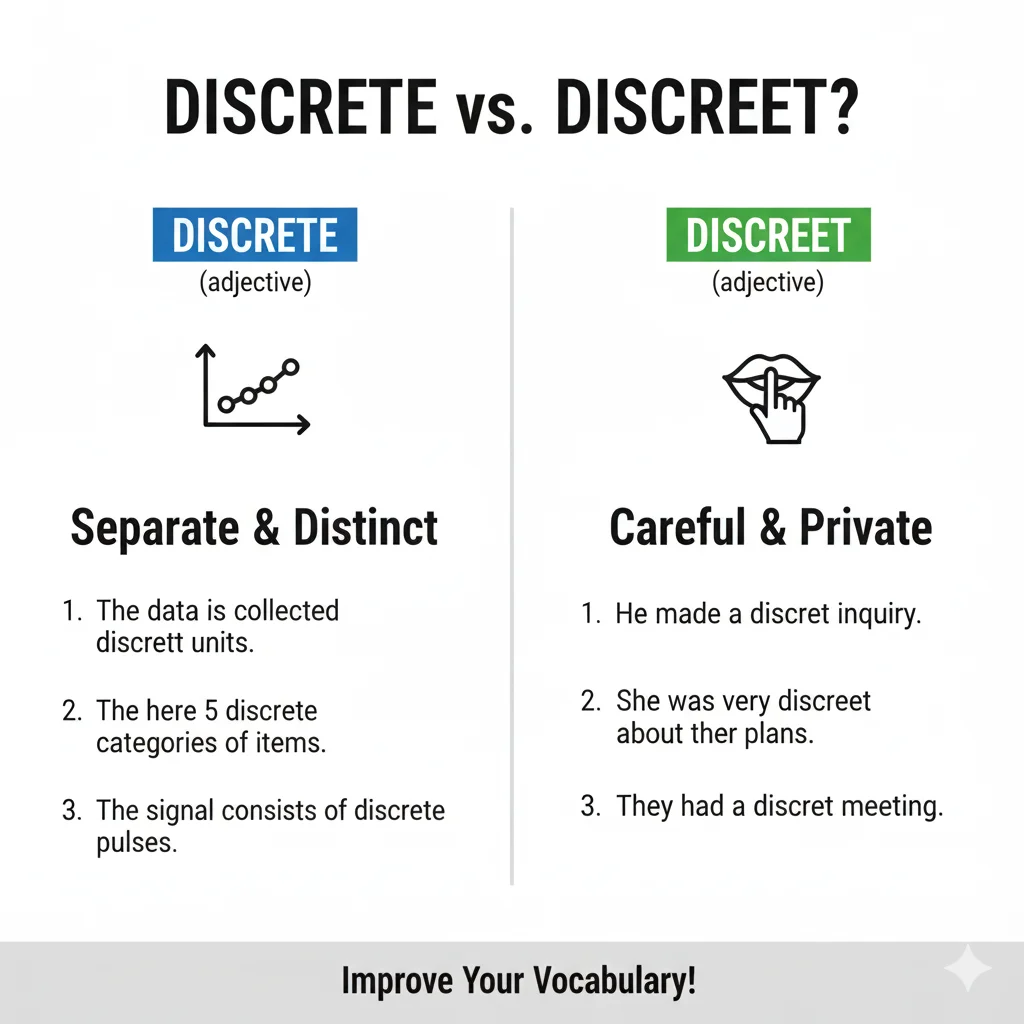
“Discrete = Separate; Discreet = Secret.”
Discrete vs Discreet: What’s the Difference?
Many people confuse “discrete” and “discreet,” but they have completely different meanings.
- Discrete means separate or distinct.
- Discreet means careful, private, or secretive.
If you’re asking, “Does discrete mean secret?” — the answer is no. The word related to secrecy is “discreet,” not “discrete.”
Example:
✔ “The data is divided into discrete categories.”
✔ “She was discreet about the conversation.”
⚠️ Common Mistakes or Misinterpretations
The most common error is mixing up “discrete” and “discreet.”
- “Discrete” → separate, distinct
- “Discreet” → careful, modest, or private
Example of confusion:
❌ “She gave a discrete smile.”
✅ “She gave a discreet smile.”
To avoid mistakes, focus on context — academic = discrete, behavior = discreet.
❓ FAQ Section
1. What does “discrete” mean in simple terms?
“Discrete” means separate or distinct. It refers to things that are individually different or not connected.
2. Is “discrete” a noun or adjective?
“Discrete” is an adjective. It describes something separate or distinct, like “discrete elements” or “discrete events.”
3. What’s the difference between “discrete” and “discreet”?
“Discrete” means separate, while “discreet” means careful or private.
Example: Discrete data points vs. a discreet conversation.
4. Where is the word “discrete” mostly used?
It’s most common in academic, mathematical, and scientific writing — especially in statistics, linguistics, and engineering.
5. How do you pronounce “discrete”?
It is pronounced /dɪˈskriːt/ — rhyming with “street.” The stress is on the second syllable: dis-CREET.
6. Can “discrete” be used in everyday English?
Yes, but it’s more formal. You might say:
“The report covers three discrete topics.”
rather than “separate topics.”
7. What is the discrete meaning in Hindi?
In Hindi, “discrete” can be translated as “अलग” (alag) or “पृथक” (prithak), meaning separate or distinct.
8. What does discrete mean in Arabic?
In Arabic, discrete can be translated as “منفصل” (munfasil), meaning separated or distinct.
🧾 Conclusion
Now you know that “discrete” means separate, distinct, or individual. It’s rooted in Latin and widely used in technical, mathematical, and academic fields.
Just remember — “discrete” = separate, while “discreet” = careful. With that clarity, you’ll never mix them up again!
Keep exploring our site for more word meanings, slang explanations, and language insights to level up your vocabulary.

Deborah Levy is a word-meaning expert at Meanovia.com. She explains complex terms, phrases, and language trends in a clear, relatable way, helping readers quickly understand the exact meaning behind every word.