

Discerning describes someone who notices, understands, and judges things clearly and wisely. It reflects keen insight, good judgment, and the ability to distinguish quality or truth in people, situations, or objects, making it an important trait in decisions and daily life.
Being discerning goes beyond just noticing details—it’s about careful observation, thoughtful evaluation, and wise decision-making. A discerning person can spot subtle differences, recognize quality, and make informed choices, whether in relationships, work, or personal decisions.
The word also signifies insightfulness, understanding, and perceptiveness, making it a valued trait in leadership, learning, and social interactions.
Explore discerning’s meaning, traits, and real-life examples to see how keen insight can improve understanding and decision-making.
🧠 What Does “Discerning” Mean?
“Discerning” means having or showing good judgment and keen insight.
It’s often used as an adjective to describe someone who can distinguish subtle differences, recognize quality, or make wise choices.
You’ll commonly see it in formal speech, literature, reviews, and business writing — anywhere precision or taste is valued.
👉 Example:
- “She’s a discerning reader who appreciates complex stories.”
📜 Origin and Popularity
The term “discerning” comes from the Latin word discernere, meaning “to separate” or “to distinguish.” It entered English in the 15th century, initially used in religious and philosophical contexts to describe wise or perceptive judgment.
Over time, it evolved into a broader term used to compliment someone’s refined taste or perceptive abilities — for example, a discerning customer, a discerning critic, or a discerning investor.
By the 20th century, the word became especially popular in marketing and journalism to appeal to audiences who see themselves as selective or sophisticated.
🌐 “Discerning” Meaning in Different Contexts
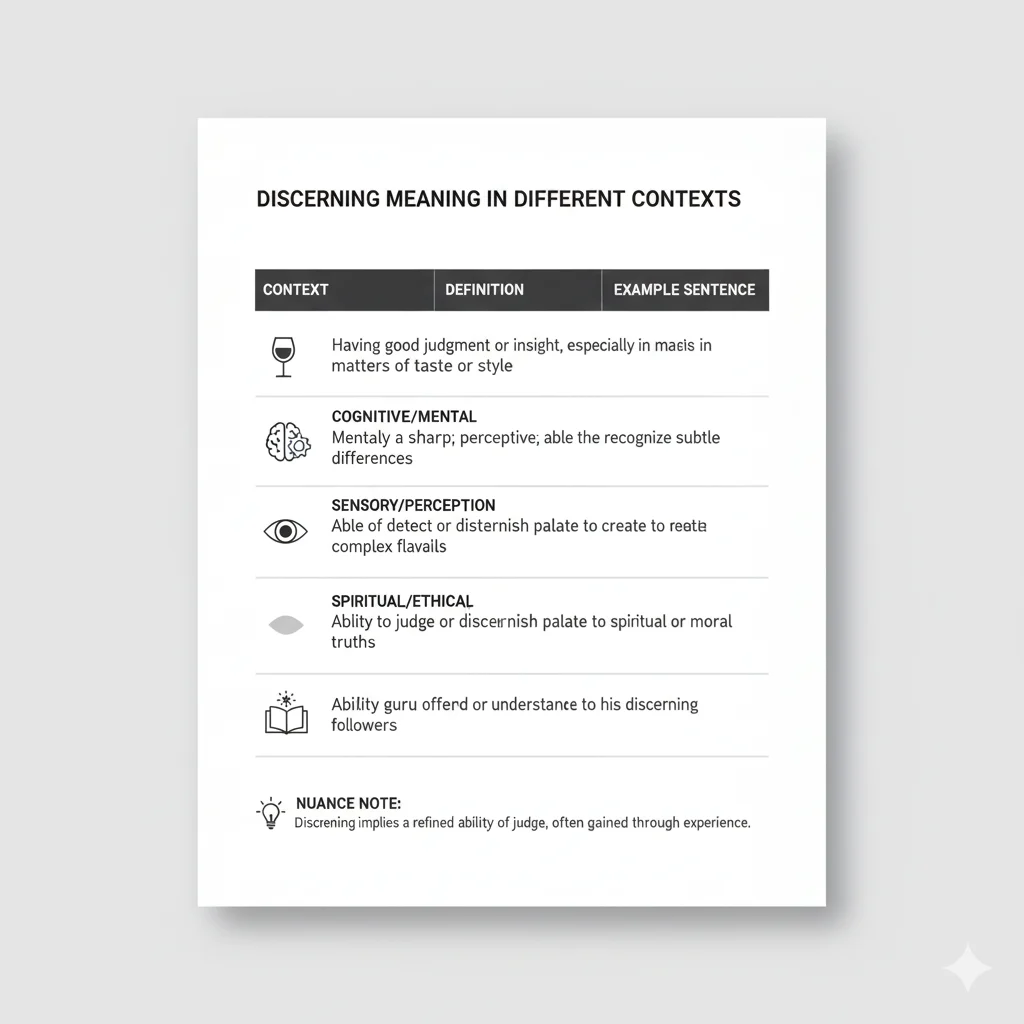
Let’s break down how “discerning” is used across various settings:
| Context | Meaning & Tone | Example |
| Everyday Conversation | Describes someone who makes wise or careful choices. | “He’s discerning when it comes to friends.” |
| Business / Professional | Highlights good judgment in decision-making. | “A discerning investor knows when to take calculated risks.” |
| Fashion / Art / Reviews | Suggests refined taste or appreciation for quality. | “The gallery attracts a discerning audience.” |
| Spiritual or Moral Context | Implies insight into right and wrong. | “Discerning truth from deception is a valuable skill.” |
💬 Examples of “Discerning” in Conversations
Example 1 — Everyday Use:
Person A: That restaurant’s food looks great!
Person B: You’ll love it — it’s perfect for discerning diners.
Example 2 — Professional Use:
Manager: We need someone discerning to review the new designs.
Designer: I’ll make sure only the best options reach the client.
Example 3 — Written Example:
“Only a discerning reader will notice the author’s subtle symbolism.”

🔍 Similar or Related Terms
Here are some related words and how they compare to “discerning.”
| Word | Meaning | Difference |
| Perceptive | Quick to notice or understand things. | Focuses on awareness rather than judgment. |
| Judicious | Having sound judgment, often in legal or moral matters. | More formal; tied to decision-making. |
| Insightful | Showing deep understanding of complex situations. | Emphasizes understanding rather than taste. |
| Astute | Clever and mentally sharp, especially in business or strategy. | Carries a shrewd or practical tone. |
🧭 How to Use “Discerning” Correctly
✅ Do:
- Use it to compliment someone’s refined judgment or taste.
- Apply it in professional, academic, or artistic contexts.
- Use it when describing selectivity or appreciation for quality.
❌ Don’t:
- Use it in casual slang or humorous tone — it’s a formal adjective.
- Confuse it with “decisive” (making decisions quickly) or “observant” (simply noticing details).
Example:
✅ “A discerning traveler seeks authentic experiences.”
❌ “He’s discerning about memes.” (Too casual for the tone)
⚠️ Common Mistakes or Misinterpretations
Many people confuse “discerning” with “picky” or “snobbish.”
However, being discerning isn’t about being difficult to please — it’s about being thoughtful and informed in your choices.
Another misconception is that it’s negative or arrogant, but in reality, it’s a compliment suggesting wisdom and taste.
❓ FAQ: “Discerning” Meaning Explained
1. What does “discerning” mean in simple terms?
It means having good judgment or being able to recognize quality. A discerning person notices details and makes smart choices.
2. Is “discerning” a compliment?
Yes. Calling someone “discerning” praises their intelligence, taste, or insight.
3. Can “discerning” be used in business?
Absolutely. It’s often used to describe smart investors, leaders, or customers who make well-informed decisions.
4. What’s the difference between “discerning” and “perceptive”?
“Perceptive” means noticing details quickly, while “discerning” means judging or evaluating wisely.
5. How do you use “discerning” in a sentence?
Example: “A discerning shopper looks beyond price and values quality.”
6. Is “discerning” formal or casual?
It’s more formal and fits best in professional, academic, or descriptive writing.
🏁 Conclusion
To sum it up, “discerning” means showing sharp judgment, insight, and refined taste. It’s a word that reflects intelligence, awareness, and appreciation for quality — whether in people, art, or decisions.
Now that you know what “discerning” means, you’ll recognize it everywhere — from business reviews to conversations about style and taste. Keep exploring our site for more clear, helpful explanations of modern words and expressions!