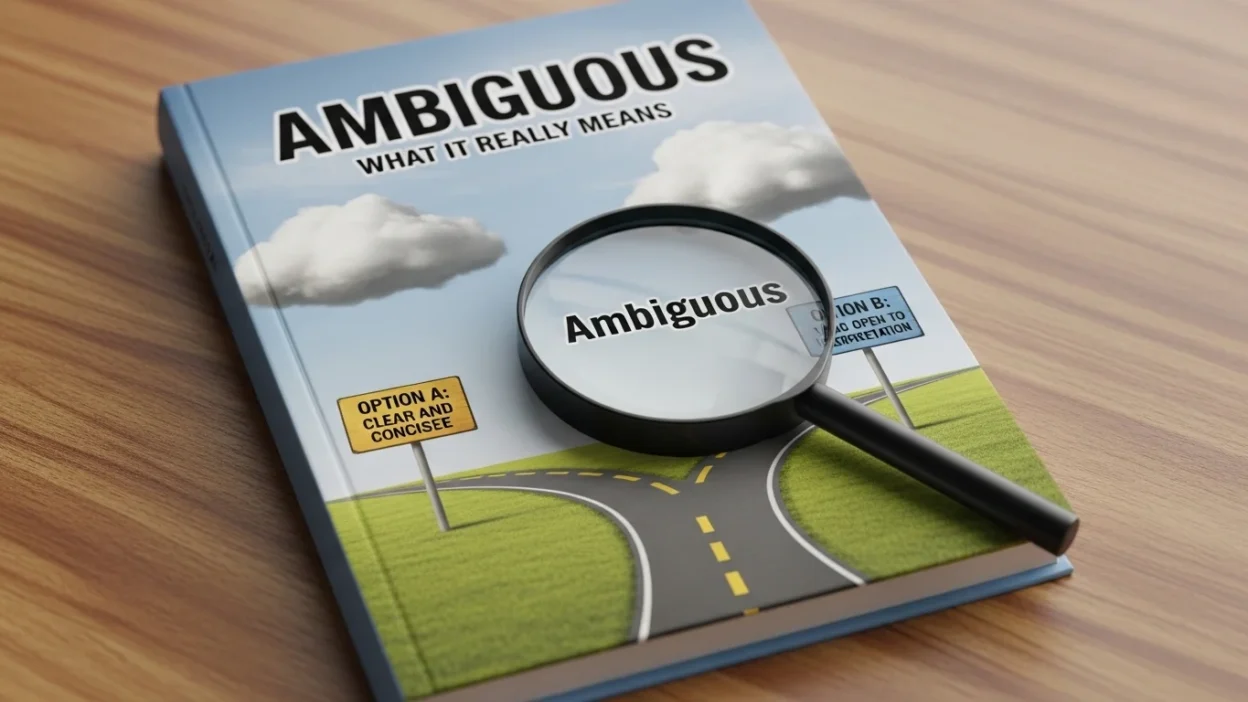
Sometimes a sentence or word can have more than one meaning. When that happens, we call it ambiguous. But what does ambiguous mean?
Quick answer: Ambiguous means something that is not clear because it can have two or more meanings.
From helping students learn English words, I often see people get confused by tricky sentences. Many times, the problem is ambiguity — the message is not clear, so people understand it in different ways.
The word ambiguous is used in school writing, legal papers, books, and daily talk when we want to say something is unclear or confusing.
People search for “ambiguous meaning” when they read a sentence that is hard to understand or has more than one meaning.
🧠 What Does Ambiguous Mean?
“Ambiguous” means something that can be understood in more than one way.
It refers to words, statements, or situations that are unclear or have multiple interpretations.
It’s often used in writing, speech, law, and everyday conversation to describe vague or confusing expressions.
Many people spell ambiguous wrong, like “ambigous” or “ambigious,” but the correct spelling is ambiguous.
Example:
“His reply was ambiguous — I couldn’t tell if he was joking or serious.”
Ambiguous Definition
Ambiguous definition refers to a meaning that is unclear, confusing, or can be understood in more than one way. When something is described as ambiguous, it means the information is not specific or precise enough, leading to multiple possible interpretations.
🔊 How to Pronounce Ambiguous
Ambiguous is pronounced:
am-BIG-yoo-us
Say it slowly: am-BIG-yoo-us
The stress is on BIG.
What Is Ambiguity
Ambiguity is the noun form of ambiguous.
It means having more than one meaning.
Example: The sentence had ambiguity.
📜 Origin and Popularity
The term “ambiguous” comes from the Latin word ambiguus, meaning uncertain or doubtful.
It entered the English language in the early 16th century and has remained a staple in academic, legal, and literary contexts.
Quick Timeline:
- 1500s: Adopted from Latin ambiguus (“wavering, undecided”).
- 1800s: Common in literature to describe vague character motives or endings.
- Today: Used in writing, media, and casual conversation to describe unclear meanings or statements.
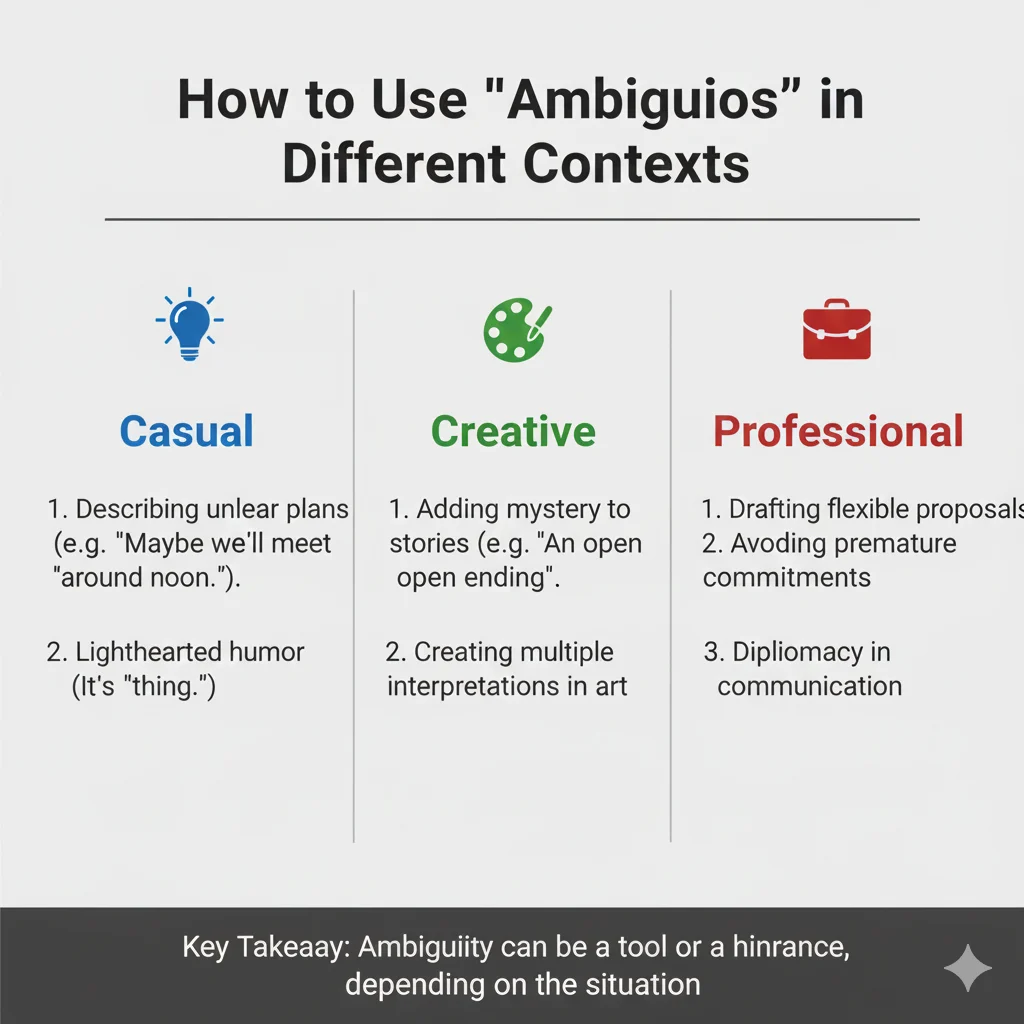
💬 Ambiguous Meaning in Different Contexts
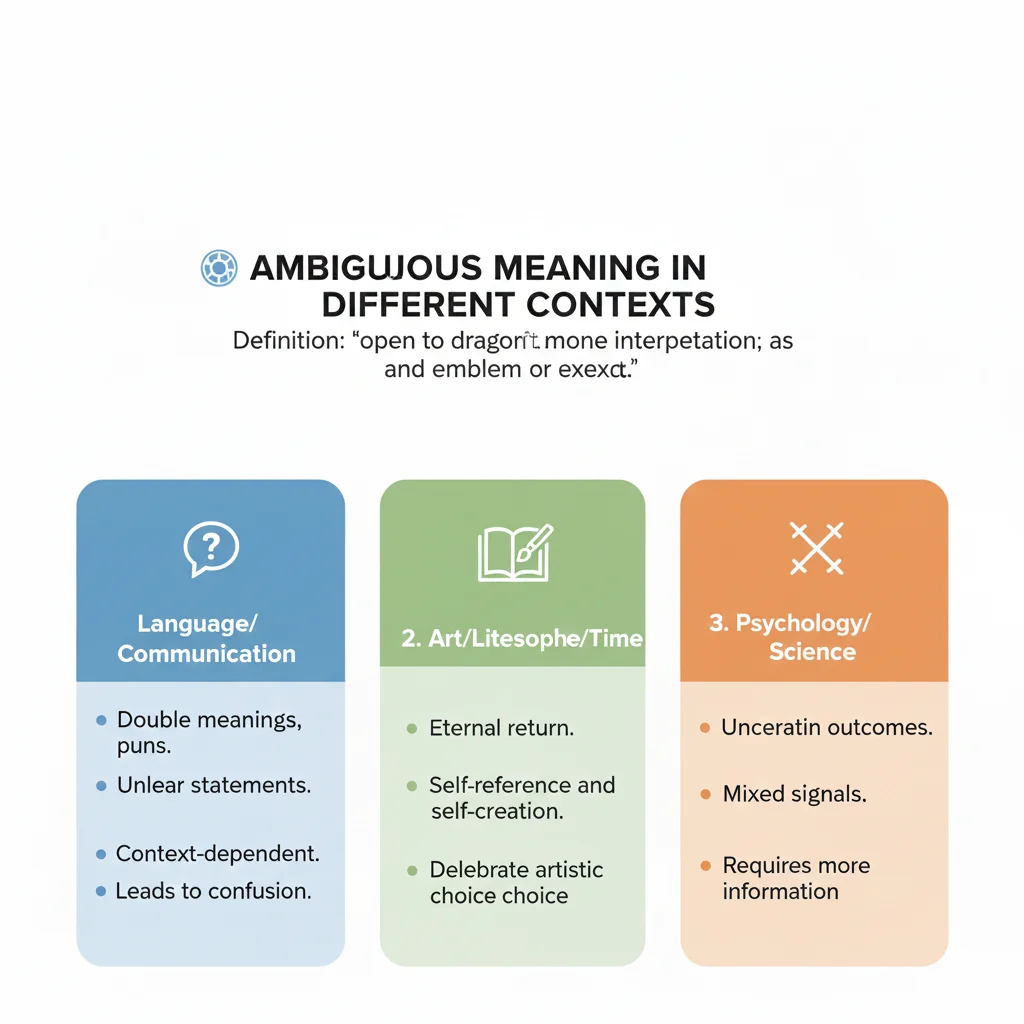
1. In Texting or Everyday Conversation
When someone says something ambiguous, it usually means their message isn’t clear.
Example: “I’ll call you later.” — Does that mean tonight, tomorrow, or never? 🤔
2. In Literature or Movies
Writers use ambiguity to make readers think deeper or interpret differently.
Example: The ending of Inception (2010) is famously ambiguous — was it real or a dream?
3. In Business or Legal Writing
Ambiguity can be problematic, leading to misunderstandings or disputes.
Example: “Deliverables should be submitted soon” — without a clear deadline, this phrase is ambiguous.
Legally Ambiguous Meaning
Legally ambiguous means a law or rule is not clear.
Example: If a contract says “pay soon,” the time is not clear. That is legally ambiguous.
Morally Ambiguous Meaning
Morally ambiguous means it is hard to say if something is right or wrong.
Example: A movie hero steals money to save a child. Is that good or bad? It is morally ambiguous.
Racially Ambiguous Meaning
Racially ambiguous means a person’s race is not clear.
Ethnically ambiguous means you cannot easily tell a person’s ethnic group.
Example: Some actors look racially ambiguous because they have mixed backgrounds.
Sexually Ambiguous Meaning
Sexually ambiguous means someone’s gender or sexual identity is not clear.
Example: A character in a movie may be sexually ambiguous on purpose.
| Context | Example | Meaning |
| Texting | “Maybe we’ll see.” | Unclear response |
| Literature | “The door was left open.” | Symbolic uncertainty |
| Business | “Project completion in due course.” | Vague timeline |
🗣️ Examples of “Ambiguous” in Conversations
Example 1 (Casual Chat):
Friend 1: Are you coming tonight?
Friend 2: Maybe.
👉 Ambiguous — not clear whether yes or no.
Example 2 (Workplace):
Manager: We’ll revisit this soon.
Employee: Does “soon” mean this week or next month?
👉 Ambiguous phrasing can cause confusion.
Example 3 (Literary Use):
“Her smile was ambiguous — comforting, yet unsettling.”
More Ambiguous Meaning Examples
- “I saw her duck.”
- “Kids make tasty snacks.”
- “Flying planes can be dangerous.”
Each sentence has two meanings.
🔄 Similar or Related Terms
| Term | Meaning | Difference |
| Vague | Lacking clarity or detail | Not always multiple meanings, just unclear |
| Ambivalent | Having mixed feelings | Refers to emotions, not language |
| Equivocal | Open to multiple interpretations | Similar to ambiguous, often intentional |
| Obscure | Difficult to understand | Hard to interpret due to complexity |
Ambiguous vs Ambivalent
Ambiguous = two meanings.
Ambivalent = two feelings.
Example:
- “His answer was ambiguous.” → Not clear.
- “She felt ambivalent.” → She had mixed feelings.
So ambiguous is about meaning, and ambivalent is about emotion.
🧩 How to Use “Ambiguous” Correctly
✅ Do:
- Use it to describe unclear or double-meaning phrases.
“The instructions were ambiguous.” - Use in essays or analysis to describe uncertain interpretations.
❌ Don’t:
- Use it to describe people’s emotions — that’s “ambivalent.”
- Use it as a synonym for complicated or difficult.
⚠️ Common Mistakes or Misinterpretations
- Confusing “ambiguous” with “ambivalent.”
- “Ambiguous” = unclear meaning.
- “Ambivalent” = mixed feelings.
- “Ambiguous” = unclear meaning.
- Using it for factual uncertainty.
- “The weather is ambiguous” ❌
- “The politician’s statement was ambiguous” ✅
- “The weather is ambiguous” ❌
- Overusing it in formal writing without examples.
- Always clarify what exactly is ambiguous.
- Always clarify what exactly is ambiguous.
Non-Ambiguous Meaning
Non-ambiguous means very clear. It has only one meaning.
Example: “Class starts at 9:00 AM” is non-ambiguous.
Ambiguous Meaning in Other Languages
In Hindi, ambiguous means “aspasht” (not clear).
In Urdu, it means “ghair wazeh.”
In Arabic or Bengali, it still means unclear or double meaning.
Funny Ambiguous Quiz
Read the sentence:
👉 “Kids make tasty snacks.”
What does it mean?
- Kids cook snacks.
- Kids are snacks.
Both are possible! That sentence is ambiguous.
Try another:
👉 “I saw her duck.”
Did she see a bird, or did she bend down?
Ambiguous sentences can be funny 😄
❓ FAQs
1. What does “ambiguous” mean in simple terms?
It means unclear or having more than one meaning. If something’s ambiguous, people can understand it differently.
2. Is “ambiguous” positive or negative?
It depends on context. In art or literature, ambiguity can be intriguing. In contracts or instructions, it’s often negative because it causes confusion.
3. What’s the difference between “ambiguous” and “vague”?
“Ambiguous” means two or more specific meanings are possible. “Vague” means lacking detail or precision.
4. How do you use “ambiguous” in a sentence?
“The politician gave an ambiguous answer to avoid controversy.”
5. When should you avoid ambiguity?
Avoid it in contracts, emails, and professional writing where clarity is essential.
6. What is the opposite of “ambiguous”?
The opposite is “clear,” “definite,” or “unambiguous.”
🏁 Conclusion
The word “ambiguous” describes something open to more than one interpretation — whether it’s a message, statement, or situation.
It originated from Latin and remains a powerful tool in both creative and analytical writing.
Now that you understand what “ambiguous” means and how to use it, you’ll spot unclear phrases more easily — and express yourself with greater precision.
✨ Keep exploring our language guides to uncover the real meanings behind everyday words and expressions.

Evie Wyld is a word-meaning specialist at Meanovia.com. She simplifies complex words, phrases, and language trends, helping readers quickly grasp the exact meaning behind every term in a clear and approachable way.