
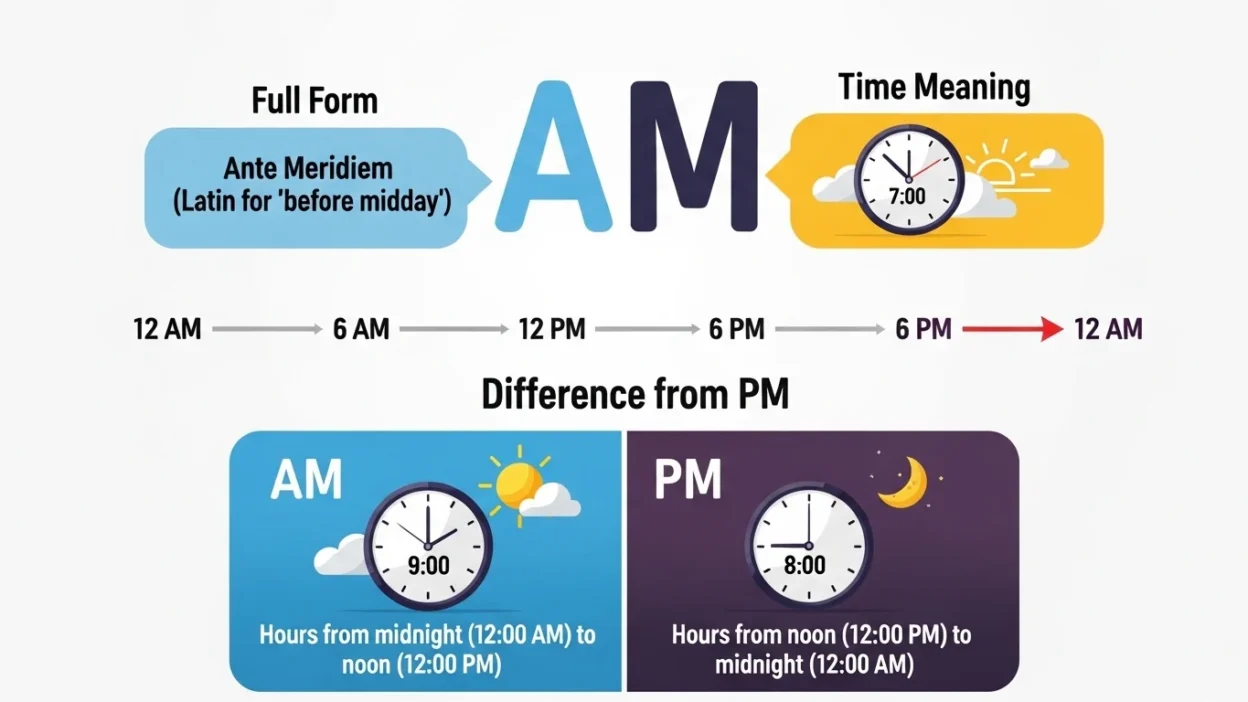
You’ve probably seen “AM” on a clock or in text messages — but what does it actually mean?
Quick answer: AM stands for “ante meridiem,” a Latin phrase meaning “before midday.” It refers to the time period from midnight (12:00 AM) until noon (11:59 AM) in the 12-hour clock system.
In everyday usage, AM appears most commonly in the 12-hour clock system to separate morning hours from afternoon and evening (PM). However, AM can also refer to Amplitude Modulation (AM radio) or serve as an abbreviation for “I am” in informal writing.
If you searched for “AM meaning,” you likely want to know:
- What AM stands for in time
- The difference between AM and PM
- Whether 12 AM is midnight or noon
- And other common meanings of AM
Below, you’ll find a clear explanation of each meaning, pronunciation, examples, and common mistakes — so you can use AM correctly in any context.
🕐 What Does AM Mean?
“AM” stands for “Ante Meridiem,” a Latin phrase meaning “before midday.”
It’s used to indicate time between midnight (12:00 AM) and noon (11:59 AM) in the 12-hour clock format.
In short:
AM = Before Noon (Morning hours)
PM = After Noon (Afternoon to night hours)
It’s a time abbreviation, not a slang or text acronym, and it’s most commonly used in schedules, clocks, and formal time expressions.
🔤 What Is the Full Form of AM?
The full form of AM is “Ante Meridiem.” If you’re asking what AM stands for in time, the word “ante” means “before” and “meridiem” means “midday” in Latin.
🕰️ Origin and Popularity
The abbreviation AM comes from Latin, where “Ante Meridiem” translates to “before midday.”
Its opposite, PM (“Post Meridiem”), means “after midday.”
The 12-hour time system originated in ancient Egypt and Rome, where day and night were divided into two 12-hour periods. The AM/PM convention was later adopted by English-speaking countries and is now standard in the United States, Canada, and parts of Asia.
🗓️ Timeline Snapshot:
- Ancient Rome: AM/PM terms appear in Latin documentation.
- 17th–18th centuries: Widely used in printed clocks and calendars.
- Modern era: Common in digital clocks, scheduling, and everyday timekeeping.
✍️ Is It “AM,” “A.M.” or “a.m.”?
All three forms — AM, A.M., and a.m. — are used in English. Modern style guides prefer “AM” without periods, especially in digital writing. However, “A.M.” is still acceptable in formal print.
🌍 AM Meaning in Different Contexts
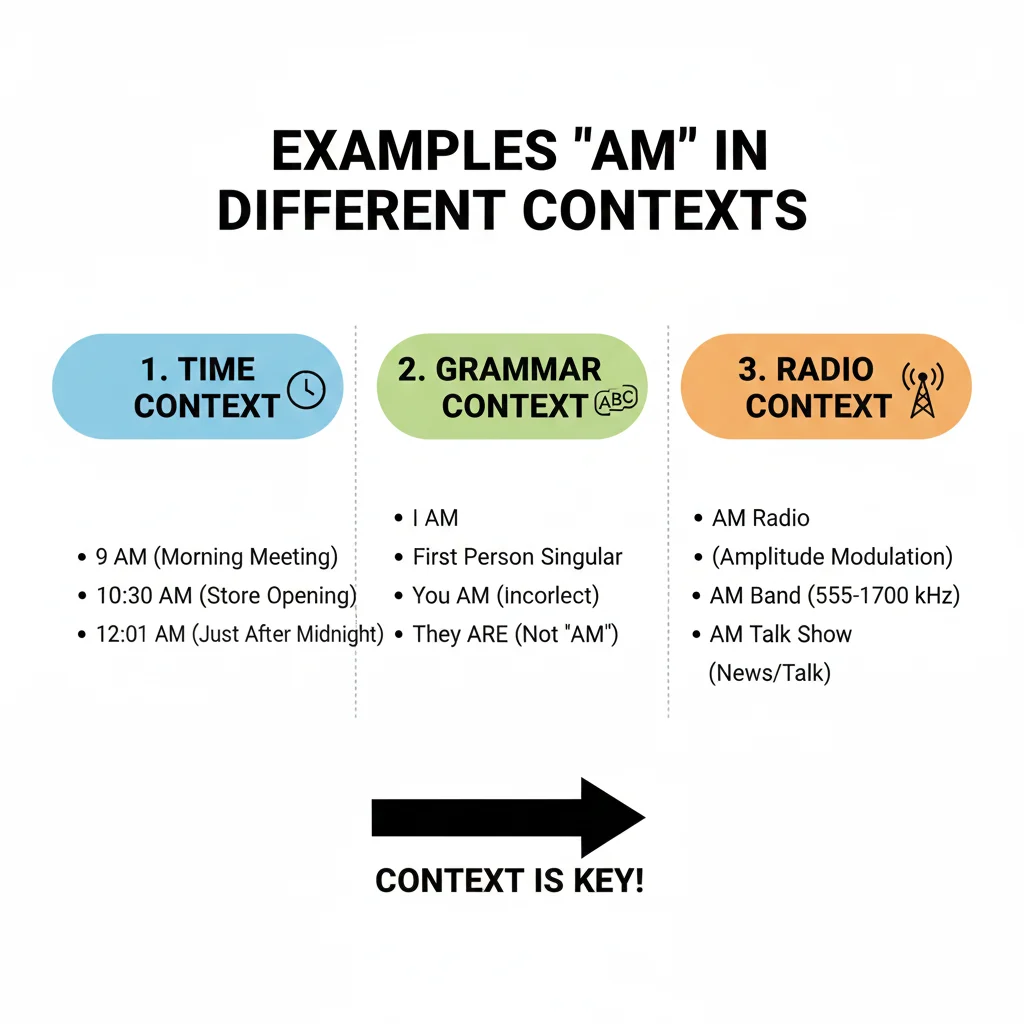
While “AM” primarily refers to time, it can appear in different contexts depending on where it’s used.
🕑 1. In Timekeeping (Most Common)
“AM” indicates morning hours, starting right after midnight.
Example: “The train departs at 6:45 AM.”
Common in digital clocks, schedules, and business timings.
💬 2. In Texting or Messaging
Sometimes, “am” (lowercase) is simply the first-person present tense of “be.”
Example: “I am happy,” “I am on my way!”
In texting, people often shorten it to ’m (“I’m”) or just am casually.
💼 3. In Business and Technology
In some contexts, AM can also stand for other terms, like:
- Account Manager (Job title)
- Amplitude Modulation (Radio broadcasting term)
📻 AM Meaning in Radio
In broadcasting, AM stands for “Amplitude Modulation,” a method of transmitting radio signals. This is different from its time-related meaning.
💼 AM Meaning in Business
In business settings, AM may stand for “Account Manager,” referring to someone responsible for managing client relationships.
📱 AM Meaning in Text or Chat
In texting, “am” is usually just the verb form of “to be,” as in “I am.” It is not typically used as slang. However, context matters — in most conversations, AM refers to time unless clearly written in lowercase within a sentence.
| Context | AM Meaning | Example Use |
| Time | Before Noon | “Meeting starts at 9:00 AM.” |
| Grammar | Verb form of “to be” | “I am ready.” |
| Business | Account Manager | “Talk to the AM for approval.” |
| Technology | Amplitude Modulation | “AM radio still operates in many regions.” |
💬 Examples of AM in Conversations
Example 1 (Time format):
Friend 1: What time’s your flight?
Friend 2: 5:30 AM — way too early!
Example 2 (Grammar use):
“I am going to the gym before work.”
Example 3 (Business context):
“Our AM will reach out with the project details.”
Example 4 (Tech use):
“That old car radio only picks up AM stations.”
🔁 Similar or Related Terms
| Term / Abbreviation | Meaning | Usage Context |
| PM | Post Meridiem (After Noon) | Time |
| GMT | Greenwich Mean Time | Global Time Standard |
| UTC | Coordinated Universal Time | International Timing |
| 24-Hour Clock | Time system without AM/PM | Military / Global use |
These are all time-related terms that help differentiate daytime, nighttime, or international time formats.
🧭 How to Use “AM” Correctly
✅ Do’s:
- Use AM to indicate times before noon.
- Use capital letters in formal writing (e.g., 8:00 AM).
- Use it consistently with PM to avoid confusion.
❌ Don’ts:
- Don’t write “8:00 A.M. in the morning” — it’s redundant.
- Don’t mix 12-hour and 24-hour formats in one schedule.
- Avoid lowercase “am” in formal contexts unless used grammatically (“I am happy”).
⚠️ Common Mistakes or Misinterpretations
- Mixing up AM and PM:
→ “12:00 AM” is midnight, not noon — a very common confusion. - Redundant expressions:
→ Saying “10 AM in the morning” repeats the meaning twice. - Wrong case usage:
→ “am” in lowercase may be mistaken for the verb form “I am.” Always capitalize when referring to time.
❓ FAQ Section
1. What does AM mean in time?
AM stands for Ante Meridiem, Latin for “before midday.” It refers to any time between midnight and noon.
2. Is AM the same as morning?
Yes, AM represents the morning hours, typically from 12:00 AM to 11:59 AM.
3. What does 12:00 AM mean?
12:00 AM marks midnight, the very start of a new day.
4. What’s the difference between AM and PM?
AM means before noon, while PM (Post Meridiem) means after noon.
5. Should I write “am” or “AM”?
Use capitalized “AM” in formal writing. Lowercase “am” is correct only as part of a sentence (“I am tired”).
6. Who uses AM and PM formats?
Primarily English-speaking countries like the U.S., Canada, and the Philippines. Many others use the 24-hour clock instead.
🎙️ Voice Search Answer
If you ask, “Hey Google, what does AM mean?” the answer is simple: AM stands for “ante meridiem” and represents the hours between midnight and noon.
🌅 Conclusion
In summary, AM stands for “Ante Meridiem,” meaning “before noon.”
It’s a time abbreviation used to represent the morning hours in the 12-hour clock format. Understanding AM helps you avoid mix-ups with PM and improves clarity in schedules, messages, and professional communication.
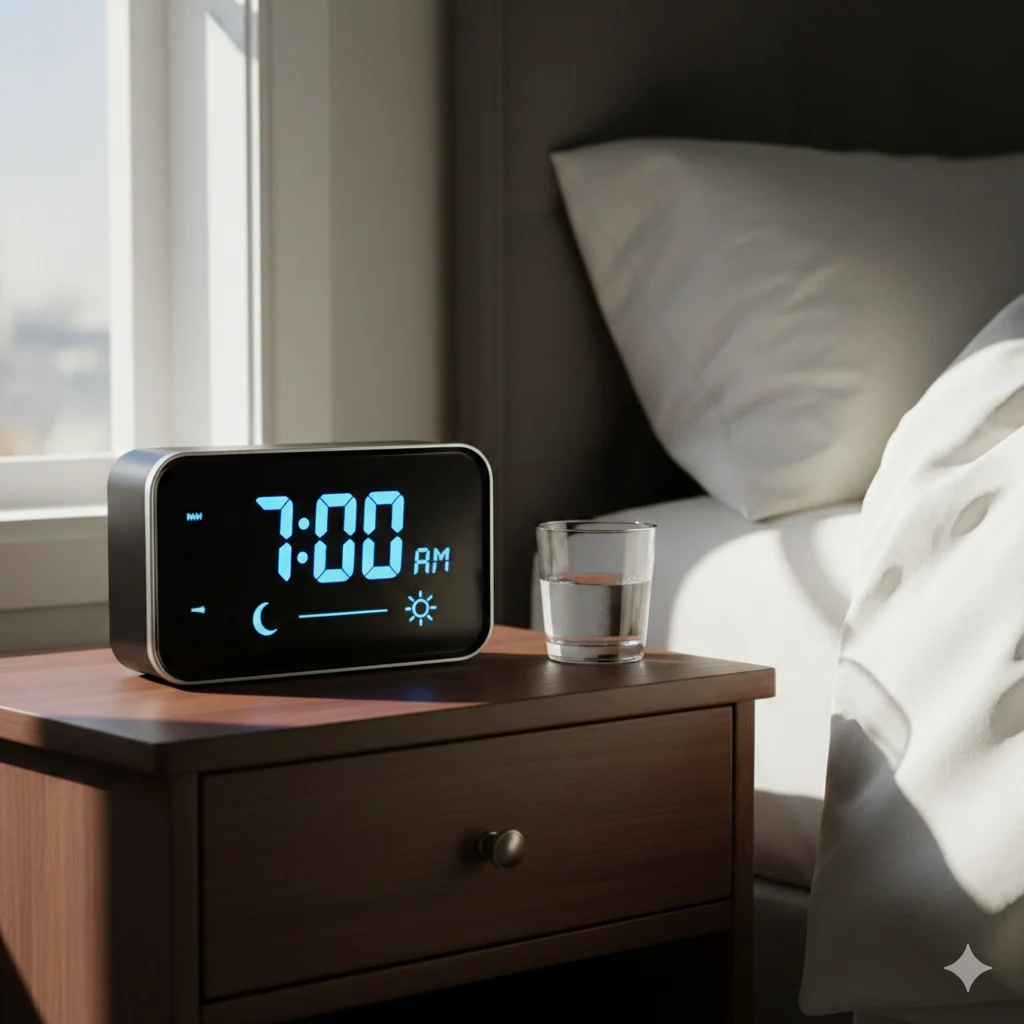
Now that you know the true meaning of AM, you’ll never question what “7:00 AM” means again! Keep exploring our site for more helpful breakdowns of common abbreviations, acronyms, and slang terms used every day.

Jon McGregor is a language and word-meaning expert at Meanovia.com. He specializes in explaining complex words, phrases, and modern language trends in a clear, approachable style. His mission is to help readers quickly grasp the true meaning behind every term, making language learning and understanding effortless and engaging.